
Understanding Serializability in DBMS
Ensuring Consistency and Integrity in Concurrent Transactions

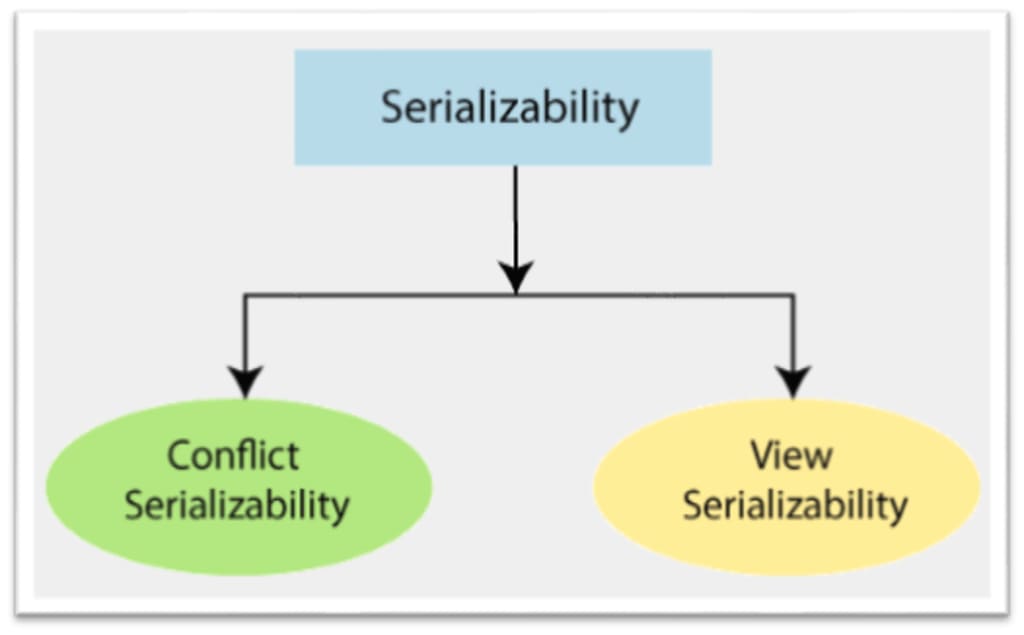
Database Management Systems (DBMS) are crucial for managing and manipulating large volumes of data efficiently. A fundamental aspect of DBMS is ensuring that transactions are executed in a way that maintains the consistency and integrity of the database. One key concept that helps achieve this is serializability. In this blog, we will explore what serializability is, its importance, types, and methods to ensure serializability in a DBMS.
What is Serializability?
Serializability is a concept in DBMS that ensures the correctness of concurrent transactions. It refers to the idea that a schedule (sequence of transaction operations) is serializable if it results in a database state that could be obtained by executing the transactions serially, one after the other, without overlapping. In other words, even though transactions may run concurrently, their outcome must be equivalent to some sequential execution of those transactions.
Importance of Serializability
Consistency: Ensures that the database remains in a consistent state after the execution of concurrent transactions.
Isolation: Provides a way to execute transactions independently, without interference.
Correctness: Guarantees that the results of transactions are accurate and reliable, maintaining data integrity.
Types of Serializability
Conflict Serializability:
A schedule is conflict-serializable if it can be transformed into a serial schedule by swapping non-conflicting operations.
Conflicts occur when two operations from different transactions access the same data item, and at least one of them is a write operation.
Example: If T1 reads X and T2 writes X, or both T1 and T2 write X, these are conflicts.
View Serializability:
- A schedule is view-serializable if it is view-equivalent to a serial schedule.
- View equivalence considers the overall effect of the transactions, not just individual operations.
- A schedule is view-equivalent if:
- Initial reads are the same.
- Final writes are the same.
- Intermediate reads (from other transactions) are the same.
Ensuring Serializability
Several techniques are employed to ensure serializability in a DBMS:
Locking Protocols:
- Use locks to control access to data items.
- Two-Phase Locking (2PL) is a common protocol where transactions acquire all necessary locks before releasing any lock, ensuring conflict serializability.
Timestamp Ordering:
- Assigns a unique timestamp to each transaction based on its start time.
- Ensures that conflicting operations are executed in timestamp order, maintaining serializability.
Serialization Graph Testing:
- Constructs a precedence graph (also known as a serialization graph) where nodes represent transactions, and edges represent conflicts.
- If the graph is acyclic, the schedule is conflict-serializable.
Optimistic Concurrency Control:
- Transactions execute without restrictions initially.
- Validation phase checks for conflicts before committing.
- If conflicts are detected, the transaction is rolled back and restarted.
Examples
Consider two transactions, T1 and T2:
- T1: Read(A), Write(A)
- T2: Read(B), Write(B)
If they execute concurrently:
- Schedule S1: T1: Read(A), T2: Read(B), T1: Write(A), T2: Write(B)
This schedule is serializable because the final state is the same as executing T1 followed by T2 or vice versa.
However, if:
- T1: Read(A), T2: Read(A), T1: Write(A), T2: Write(A)
This schedule is not serializable because T2 reads A before T1 writes A, causing inconsistency.
Conclusion
Serializability in DBMS is a cornerstone of transaction management in DBMS, ensuring that concurrent transactions do not compromise the integrity and consistency of the database. By understanding and implementing conflict and view serializability through various techniques, DBMS can provide a robust environment for concurrent data access, maintaining reliable and accurate outcomes. Whether through locking protocols, timestamp ordering, or serialization graph testing, ensuring serializability is essential for the effective functioning of modern database systems.
About the Creator
Pushpendra Sharma
I am currently working as Digital Marketing Executive in Tutorials and Examples.
Keep reading
More stories from Pushpendra Sharma and writers in Education and other communities.
Regular Expressions in Compiler Design
Regular expressions (regex) are a fundamental concept in compiler design, playing a crucial role in lexical analysis, the first phase of compiling source code into executable programs. They provide a powerful way to specify patterns for text processing and form the basis for token recognition in a compiler.
By Pushpendra Sharmaabout a year ago in Education
Speak and Be Heard: A Beginner’s Guide to Becoming a Podcast Host and Growing Your Audience
Becoming a podcast host is an exciting way to share your ideas, inspire others, and build a strong community. Whether you want to teach, entertain, or have great conversations, podcasting gives you a voice that can reach people around the world. But starting a podcast and growing an audience takes more than just a microphone. It requires planning, patience, and a real connection with your listeners. In this guide, you'll learn how to become a podcast host and grow your audience step by step.
By Spencer Hakimian8 days ago in Education


Comments (1)
Thanks for the analysis