
Topmost deliverables of Procurement function
Supply Chain Procurement

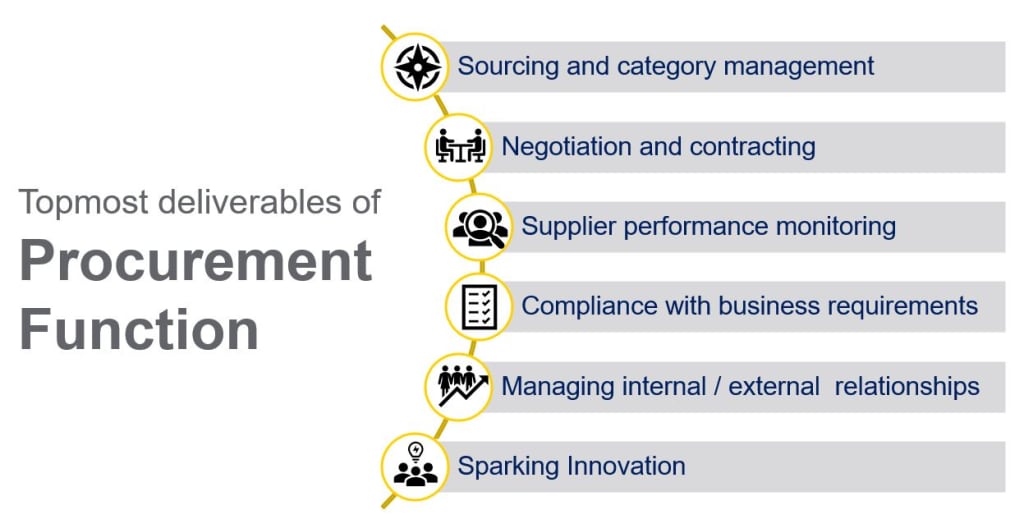
The roles and responsibilities of the entire procurement function in a business can be grouped into these topmost deliverables, starting with category management, which involves developing clear supplier strategies and organizing suppliers based on their classifications. Another important deliverable is managing innovation within the ecosystem. In addition, it is essential to uphold ethical standards and maintain compliance with the company's principles, which are considered to be core values.
Sourcing and category management:
One of the most important activities of the procurement function is to buy products and services from the external sources. It plays a dynamic role in the overall business strategy of any company as it requires strategic planning. To obtain any product/service at the best possible cost, from the right sources at the right time and at the right quality, will enable in fulfilling the business strategy by meeting the expectations of the final customers.
Procurement is often accountable for more than half of a company’s external spending. Through correct and controlled spending, companies can expand market share and increase their sales by producing the right-quality product at right time to the market. Procurement function also improves profitability by efficiently developing those products and services through collaboration with their suppliers.
The process of grouping the same products into a category for easy supply and spend management as any business is to improve customer experience, drives efficiencies to businesses and delivers high-quality products and services that generate profits.
In another way, category management includes product, place and price to facilitate customers in supplying efficiently based on their respective choices of what, where and when they want. For this purpose, category team should have in-depth knowledge of supply market knowledge, cross-functional team approach, accurate supplier data and effective implementation.
Negotiation and contracting:
The only focus of procurement professionals is not only to get the lowest price for a product or service but an attempt to save money without compromising the standard of the product or service, but by using their negotiation skills to get the best possible deal for their company in terms of prices and contractual terms. In addition to price negotiation, favorable contract terms that improve cash flow by prolonging payment, keeping penalties for the performance concerned, defining quality requirements well in advance in the means of contract management.
After evaluating suppliers’ bids on the basis of technical and commercial compliance, quality and value proposition, procurement professionals offer the contract to the best shortlisted suppliers by taking into consideration the unique business requirements of the organization and also in accordance with the company standards, industry regulations and the expectations of the end customer.
From the early beginning, it is preferred to share the request in an RFP template considering the main contractual conditions (ex: warranty period, liquidated damages, governing law, …etc.). This is to avoid the having additional cost added by the supplier to comply with those terms and conditions.
Supplier performance monitoring
What gets measured, gets managed by Peter Drucker. Procurement professionals must monitor supplier performance inline to agreed contract terms and conditions to ensure the performance of the suppliers in terms of quality, delivery and pricing. They should check the timely delivery of materials and the expected quality from the suppliers otherwise, it would affect the complete production chain.
The promised deliveries by the suppliers should be tracked to know whether the invoices are approved and paid in a timely manner. Keeping track of all the products and services that are ordered, received and maintain inventory records accurately along with details of performance, delivery and pricing are very essential as it is the utmost important function across all enterprises.
Supplier performance monitoring is important for both the organization and the supplier as it:
Help identify the highest-quality and best-performing suppliers, assisting decision-making regarding:
a. Which suppliers should get specific orders.
b. When a supplier should be retained or removed from an approved list.
c. Which suppliers show potential for more strategic partnership relationship, and
d. How to distribute the spend for an item among several suppliers to manage risk.
Suggest how relationships with suppliers can (or need to be) enhanced to improve their performance.
Help ensure that suppliers live up to what was promised in their contracts.
Provide suppliers with an incentive to maintain and/or continuously improve performance levels.
Significantly improve supplier performance, by identifying problems which can be tracked and fixed, or areas in which support, and development is needed.
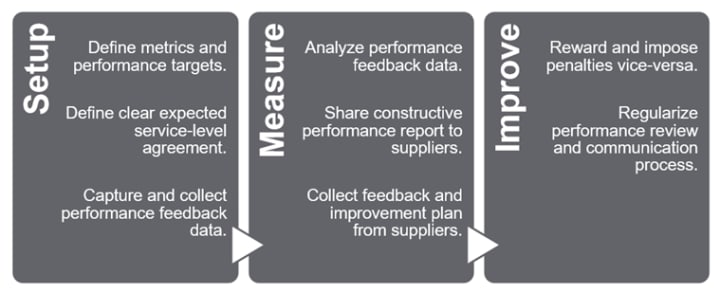
Advanced procurement function follows these steps and activities around supplier performance management which is explained in detail in the following chapters.
Compliance with business requirements
Establishing and doing business with the right suppliers really matter as much as price and delivery concern.
For example, companies may want to ensure that they support small businesses by allocating a certain percentage of their procurement budgets accordingly. They may also want to avoid suppliers having bad reputations or business practices. Procurement function helps to achieve such objectives.
The procurement function must ensure to meet all the objectives of company and compliance requirements.
For example, in an organization, if members or staff request to procure products and services needed for their business, then it has to be looked into the business protocols for procurement and budget approvals and ensured whether the items procured are in compliance and strictly adhered within the organization’s procurement policy.
Managing supplier relationships
Procurement professionals can work with anyone in their supplier and service provider companies that may include C-levels or representatives from marketing, technical, finance and logistics functions too.
Given the broad range of products and services that they buy and the impact of these decisions on the company, shows how procurement connects functions and lines up their efforts in search of the company’s general goals.
Successful supplier relationship management yields to quick market time, overall process efficiency, technical and commercial competitiveness, including larger top- and bottom-line financial gains as they support the companies to stay ahead of the market.
This topic has been given in detail in specific chapter called “Supplier relationship management and how it matters.” (Chapter 3) including illustrating Resilient governance structure that you can apply on your business while establishing SRM.
Sparking innovation
Innovation is the fuel of continuous improvement; hence, at present, procurement professionals look for the opportunity to bring innovation as an attractive feature and strategy. At the same time, most of the companies have started looking for innovation initiative to apply into procurement function to control and manage the ecosystem.
By integrating innovative solutions to the business issues and finding ways to improve financials, procurement professionals are helping their company to grow. In addition, working closely with the suppliers and service providers, enables to share the needs of the company and explore the ways, of how suppliers are bringing ideas to their business. Together, it leads to an better outcome of technologies and products to their end customers and it refine the process of delivering products and services in an efficient way.
In the “Innovation in procurement” chapter you will find comprehensive details about supplier innovation management, innovation from digital transformation and innovation from contract management. Innovation from digital transformation also has barriers to procurement’s contribution towards innovation and expectations from procurement functions toward Innovation.
About the Creator
Sendil Arasu Vijaya Kumar
I attained bachelor degree in mechanical engineering and master degree in marketing management, having 21 Years of professional work experience. International exposure in Supply Chain Procurement domain. Author of "The Procurement Acumen"
Keep reading
More stories from Sendil Arasu Vijaya Kumar and writers in Education and other communities.
The Energy Pivot The State of Russia’s Oil and Gas in 2026
For decades, this was the "world's gas station": Russia's pipeline network to Europe was the veins of the world economy. By 2026, that aura is dull and those veins are rerouted out of Europe. Since the collapse of the Soviet Union, the Russian oil and gas sector is facing the largest structural change.
By Neeraj kumar5 days ago in Education
Do you really need to take 10,000 steps a day?
While most people avoid spending the night in jail, Jean Béliveau jumped at the opportunity. For the past three years, Béliveau had been walking from country to country, with the goal of circumnavigating the globe on foot. This required sleeping in tents, strangers’ homes, and the occasional jail cell along the way. But this morning, as Béliveau was ready to leave, the police chief, who had agreed to his sleeping arrangement, was nowhere to be found, and the guards weren’t buying his story. Few people have the time or desire to walk such extreme lengths.
By Munesh Yadavabout 9 hours ago in Education
A Dart at Dusk
Seconds ago, the sullen sun set on the two of us… my exuberant furry companion and me. A fresh breeze embraces us, delivering welcome relief from the day’s oppressive heat. His typical stumbling and staggering along — apace with a sloth — has turned into trip-trapping, high-stepping, almost skipping along.
By Angie the Archivist 📚🪶6 days ago in Petlife



Comments
There are no comments for this story
Be the first to respond and start the conversation.