
Top 50 Ansible Interview Questions And Answers in 2023
Ansible Interview Questions


1. What is Ansible and what makes it stand out from the rest of the Configuration Management tools?
Ansible is an open-source IT Configuration Management, Deployment & Orchestration tool. It aims to provide large productivity gains to a wide variety of automation challenges.
Here’s a list of features that makes Ansible such an effective Configuration Management and Automation tool:
Simple: Uses a simple syntax written in YAML called playbooks.
Agentless: No agents/software or additional firewall ports that you need to install on the client systems or hosts which you want to automate.
Powerful and Flexible: Ansible’s capabilities allow you to orchestrate the entire application environment regardless of where it is deployed.
Efficient: Ansible introduces modules as basic building blocks for your software. So, you can even customize it as per your needs.
2. How does Ansible work?
Ansible, unlike other configuration management tools, is categorized into two types of servers – Controlling machines and Nodes. The controlling machine is where Ansible is installed and nodes are the ones that are managed by the controlling machines through SSH. There is an inventory file in the controlling machine that holds the location of the node systems. Ansible deploys modules on the node systems by running the playbook on the controlling machine. Ansible is agentless, which means there is no need to have a third-party tool to make a connection between one node and the other.
3. What are the different components of Ansible? Explain Ansible Architecture.
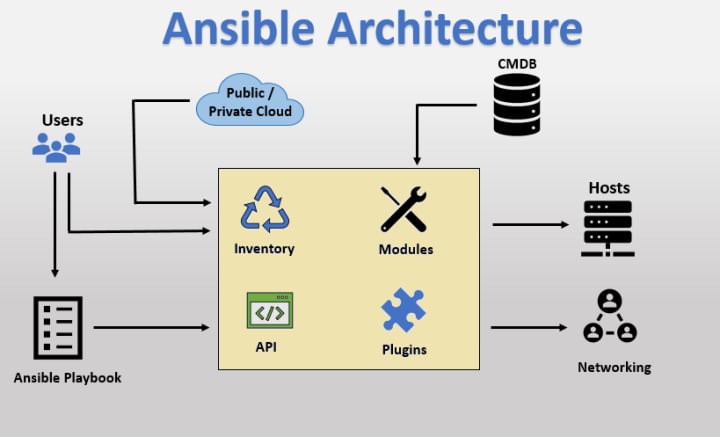
The below diagram depicts the Ansible architecture:
Ansible Architecture
The main component of Ansible is the Ansible automation engine. This engine directly interacts with various cloud services, Configuration Management Database (CMBD), and different users who write various playbooks to execute the Ansible Automation engine.
The Ansible Automation engine consists of the following components:
Inventories: These are a list of nodes containing their respective IP addresses, servers, databases, etc. which need to be managed.
APIs: Just like any other API, the Ansible APIs are used for commuting various Cloud services, public or private services.
Modules: The modules are used to manage system resources, packages, libraries, files, etc. Ansible modules can be used to automate a wide range of tasks. Ansible provides around 450 modules that automate nearly every part of your environment.
Plugins: If you want to execute Ansible tasks as a job, Ansible Plugins can be used. They simplify the execution of a task by building a job-like environment that basically contains pieces of code corresponding to some specific functionality. There are 100s of Plugins provided by Ansible. An example is the Action plugin, which acts as the front end to modules and can execute tasks on the controller before calling the modules themselves.
Networking: Ansible can also be used to automate different networks and services. It can do this by creating a playbook or an Ansible role that easily spans different network hardware.
Hosts: The Ansible Hosts/ Node systems are machines (Linux, Windows, etc) that are getting automated.
Playbooks: Playbooks are simple code files that describe the tasks that need to be executed. The Playbooks are written in YAML format. They can be used to automate tasks, declare configurations, etc.
CMDB: It is a database that acts as a storehouse for various IT installations. It holds data about various IT assets (also known as configuration items (CI)) and describes the relationships between such assets.
Cloud: It is a network of remote servers hosted on the Internet to store, manage, and process data, rather than a local server.
4. How is Ansible different from Puppet?

5. What are Ansible Server requirements?
If you are a windows user then you need to have a virtual machine in which Linux should be installed. It requires Python 2.6 version or higher. you fulfill these requirements and you’re good to go!
6. Explain a few of the basic terminologies or concepts in Ansible.
A few of the basic terms that are commonly used while operating on Ansible are:
Controller Machine: The Controller machine is responsible for provisioning the servers that are being managed. It is the machine where Ansible is installed.
Inventory: An inventory is an initialization file that has details about the different servers you are managing.
Playbook: It is a code file written in the YAML format. A playbook basically contains the tasks that need to be executed or automated.
Task: Each task represents a single procedure that needs to be executed, e.g. Install a library.
Module: A module is a set of tasks that can be executed. Ansible has 100s of built-in modules, but you can also create custom ones.
Role: An Ansible role is a pre-defined way of organizing playbooks and other files in order to facilitate sharing and reusing portions of provisioning.
Play: A task executed from start to finish or the execution of a playbook is called a play.
Facts: Facts are global variables that store details about the system, like network interfaces or operating systems.
Handlers: Are used to trigger the status of a service, such as restarting or stopping a service.
7. Compare Ansible with Chef.

8. What is Ansible Galaxy?
Galaxy is a website that lets Ansible users share their roles and modules. The Ansible Galaxy command line tool comes packed with Ansible, and it can be used to install roles from Galaxy or directly from a Source Control Management system such as Git. It can also be used to build new roles, remove existing ones and perform tasks on the Galaxy website.
You can use the below command to download roles from the Galaxy website:

9. What are the Variables in Ansible?
Variables in Ansible are very similar to variables in any programming language. Just like any other variable, an Ansible variable is assigned a value that is used in computing playbooks. You can also use conditions around the variables. Here’s an example:

Here, we’ve defined a variable called port_Tomcat and assigned port number 8080 to it. Such a variable can be used in the Ansible Playbook.
10. What are the Ansible Modules? Explain the different types.
Ansible modules are a small set of programs that perform a specific task. Modules can be used to automate a wide range of tasks. Modules in Ansible are considered to be idempotent or in other words, making multiple identical requests has the same effect as making a single request.
There are 2 types of modules in Ansible:
Core modules
Extras modules
Core Modules
These are modules that the core Ansible team maintains and will always ship with Ansible itself. They will also receive a slightly higher priority for all requests than those in the “extras” repos. The source of these modules is hosted by Ansible on GitHub in the Ansible-modules-core.
Extras Modules
These modules are currently shipped with Ansible but might be shipped separately in the future. They are also mostly maintained by the Ansible Community. Non-core modules are still fully usable but may receive slightly lower response rates for issues and pull requests.
Popular “extras” modules may be promoted to core modules over time. The source for these modules is hosted by Ansible on GitHub in the Ansible-modules-extras.
11. What is Ansible Task?
Ansible Tasks allow you to break up bits of configuration policy into smaller files. These are blocks of code that can be used to automate any process. For example, if you wish to install a package or update software, you can follow the below code snippet:

12. Can you explain what are playbooks in Ansible? Explain with some examples.
Playbooks in Ansible are written in the YAML format. It is a human-readable data serialization language. It is commonly used for configuration files. It can also be used in many applications where data is being stored.
For Ansible, nearly every YAML file starts with a list. Each item in the list is a list of key/value pairs, commonly called a “hash” or a “dictionary”. So, we need to know how to write lists and dictionaries in YAML.
All members of a list are lines beginning at the same indentation level starting with a “- ” (dash and space). More complicated data structures are possible, such as lists of dictionaries or mixed dictionaries whose values are lists or a mix of both.
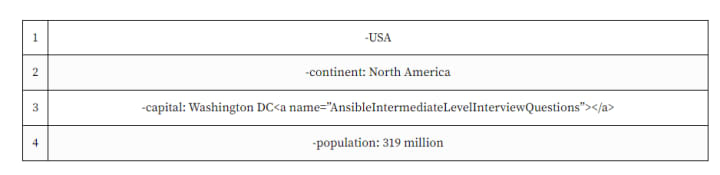
For example, if you want a playbook containing details about the USA:
The Ansible Interview Questions section talks about the commands that are very common amongst docker users.
13. What is Ansible’s role and how are they different from the playbook?
Ansible Roles are basically another level of abstraction used to organize playbooks. They provide a skeleton for an independent and reusable collection of variables, tasks, templates, files, and modules which can be automatically loaded into the playbook. Playbooks are a collection of roles. Every role has specific functionality.
Let’s understand the difference between Ansible roles and playbook with an example.
Suppose you want your playbook to perform 10 different tasks on 5 different systems, would you use a single playbook for this? No, using a single playbook can make it confusing and prone to blunders. Instead, you can create 10 different roles, where each role will perform one task. Then, all you need to do is, mention the name of the role inside the playbook to call them.
14. How to keep secret data in a playbook?
Suppose you have a task that you don’t want to show the output or command given to it when using -v (verbose) mode, the following task can be used to do it:

This can be used to keep verbose output but hide sensitive information from others who would otherwise like to be able to see the output.
The no_log attribute can also apply to an entire play:

15. What are Ansible Vaults and why are they used?
Ansible Vault is a feature that allows you to keep all your secrets safe. It can encrypt entire files, entire YAML playbooks, or even a few variables. It provides a facility where you can not only encrypt sensitive data but also integrate them into your playbooks.
Vault is implemented with file-level granularity where the files are either entirely encrypted or entirely unencrypted. It uses the same password for encrypting as well as for decrypting files which makes using Ansible Vault very user-friendly.
16. How would you install Ansible on a CentOS system?
This can be done in two simple steps:
Step 1: Set up EPEL Repository
EPEL (Extra Packages for Enterprise Linux) is an open-source and free community-based repository project from the Fedora team which provides high-quality add-on software packages for Linux distribution including RHEL (Red Hat Enterprise Linux), CentOS, and Scientific Linux.
The Ansible package is not available in the default yum repositories, so we will enable the EPEL repository by using the below command:

This will download all the necessary packages which will be required to install Ansible.
Step 2: Install Ansible
Now that your EPEL repository has been added, all you have to do now is install Ansible using the command below:

That’s all! It’s a two-step process that barely takes a minute!
If you wish to check the version of Ansible installed on your system, use the command below:

17. How to create encrypted files using Ansible?
To create an encrypted file, use the ‘ansible-vault create’ command and pass the filename.

You’ll be prompted to create a password and then confirm it by re-typing it.

Once your password is confirmed, a new file will be created and will open an editing window. By default, the editor for Ansible Vault is vi. You can add data, save and exit.

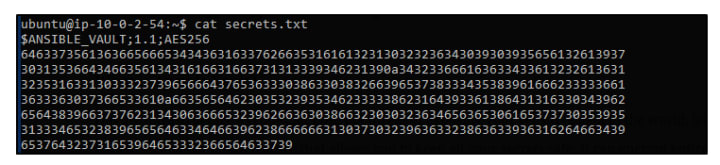
This is your encrypted file:
18. What is Ansible Tower?
Ansible Tower is Ansible at a more enterprise level. It is a web-based solution for managing your organization with a very easy user interface that provides a dashboard with all of the state summaries of all the hosts, allows quick deployments, and monitors all configurations.
The tower allows you to share the SSH credentials without exposing them, logs all the jobs, manage inventories graphically, and syncs them with a wide variety of cloud providers.
19. What features does the Ansible Tower provide?
Ansible Tower Dashboard – The Ansible Tower dashboard displays everything going on in your Ansible environment like the hosts, inventory status, recent job activity, and so on.
Real-Time Job Updates – As Ansible can automate the complete infrastructure, you can see real-time job updates, like plays and tasks broken down by each machine either being successful or a failure. So, with this, you can see the status of your automation, and know what’s next in the queue.
Multi-Playbook Workflows – This feature allows you to chain any number of playbooks, regardless of the usage of different inventories, utilize various credentials, or run different users.
Who Ran What Job When – As the name suggests, you can easily know who ran what job where and when as, all the automation activity is securely logged in Ansible Tower.
Scale Capacity With Clusters – We can connect multiple Ansible Tower nodes into an Ansible Tower cluster as the clusters add redundancy and capacity, which allows you to scale Ansible automation across the enterprise.
Integrated Notifications – This feature lets you notify a person or team when a job succeeds or fails across the entire organization at once, or customize on a per-job basis.
Schedule Ansible Jobs – Different kinds of jobs such as Playbook runs, cloud inventory updates, and source control updates can be scheduled inside Ansible Tower to run according to the need.
Manage & Track Inventory – Ansible Tower helps you manage your entire infrastructure by letting you easily pull inventory from public cloud providers such as Amazon Web Services, Microsoft Azure, and more.
Self-Service – This feature of Ansible Tower lets you launch Playbooks with just a single click. It can also, let you choose from available secure credentials or prompt you for variables and monitor the resulting deployments.
REST API & Tower CLI Tool – Every feature present in Ansible Tower is available via Ansible Tower’s REST API, which provides the ideal API for a systems management infrastructure. The Ansible Tower’s CLI tool is available for launching jobs from CI systems such as Jenkins, or when you need to integrate with other command-line tools.
Remote Command Execution – You can run simple tasks such as adding users, restarting any malfunctioning service, and resetting passwords on any host or group of hosts in the inventory with Ansible Tower’s remote command execution.
Ansible Technical Interview Questions
20. How is Ansible used in a Continuous Delivery pipeline? Explain.
It is well known that DevOps development and operations work is integrated. This integration is very important for modern test-driven applications. Hence, Ansible integrates this by providing a stable environment for both development and operations resulting in a smooth delivery pipeline.
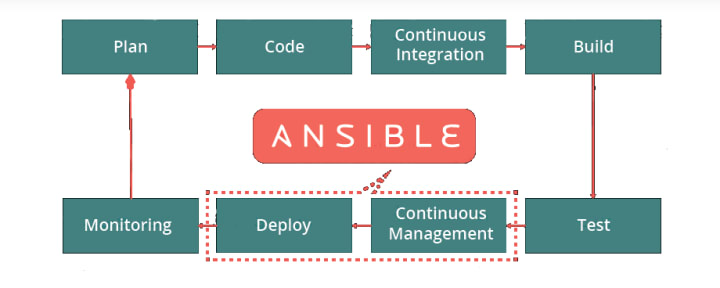
When developers begin to think of infrastructure as part of their application i.e as Infrastructure as code (IaC), stability and performance become normative. Infrastructure as Code is the process of managing and provisioning computing infrastructure and its configuration through machine-processable definition files, rather than physical hardware configuration or the use of interactive configuration tools. This is where Ansible automation plays a major role and stands out among its peers.
In a Continuous Delivery pipeline, Sysadmins work tightly with developers, development velocity is improved, more time is spent doing activities like performance tuning, experimenting, and getting things done, and less time is spent fixing problems.
21. What are callback plugins in Ansible?
Callback plugins basically control most of the output we see while running cmd programs. But it can also be used to add additional output. For example log_plays callback is used to record playbook events to a log file, and mail callback is used to send email on playbook failures. We can also add custom callback plugins by dropping them into a callback_plugins directory adjacent to play, inside a role, or by putting it in one of the callback directory sources configured in ansible.cfg
22. Suppose you’re using Ansible to configure the production environment and your playbook uses an encrypted file. Encrypted files prompt the user to enter passwords. But since Ansible is used for automation, can this process be automated?
Yes, Ansible uses a feature called password file, where all the passwords to your encrypted files can be saved. So each time the user is asked for the password, he can simply make a call to the password file. The password is automatically read and entered by Ansible.
$ ansible-playbook launch.yml --vault-password-file ~/ .vault_pass.txt
Having a separate script that specifies the passwords is also possible. You need to make sure the script file is executable and the password is printed to standard output for it to work without annoying errors.
$ ansible-playbook launch.yml --vault-password-file ~/ .vault_pass.py
23. Have you worked with Ansible before? Please share your experience.
Be very honest here. If you have used ansible before then talk about your experience. Talk about the projects that required ansible. You can tell the interviewer about how Ansible has helped you in provisioning and configuration management. If you haven’t used Ansible before then just talk about any related tools that you’ve used. These related tools could be anything like Git, Jenkins, Puppet, Chef, Satltstack, etc.
Be very honest because they know if you’re lying.
24. Is Ansible an Open Source tool?
Yes, Ansible is open source. That means you take the modules and rewrite them. Ansible is an open-source automated engine that lets you automate apps.
25. How can you connect other devices within Ansible?
Once Ansible is installed on the controlling machines, an inventory file is created. This inventory file specifies the connection between other nodes. A connection can be made using a simple SSH. To check the connection to a different device, you can use the ping module.
ansible -m ping all
The above command checks the connection to all the nodes specified in the inventory file.
26. Is it possible to build our modules in Ansible?
Yes, we can create our own modules within Ansible. It’s an open-source tool that basically works on python. You can start creating your own modules. The only requirement would be to be amazingly good at programming.
27. What does Fact mean in Ansible?
When any new variable about the system has been discovered it’s considered to be a “fact” in the playbook. Facts are mainly used to implement conditional executions. It can also be used to get ad-hoc information about the system.
You can get facts with the following command:
$ ansible all- m setup
So when you want to extract only a part of the information, you use the setup module to filter out only the needed information.
28. What is the ask_pass module in Ansible?
Ask_pass is the control module in an Ansible playbook. This controls the prompting of the password when the playbook is getting executed. By default, it’s always set to True. If you are using SSH keys for authentication purposes then you really don’t have to change this setting at all.
29. Explain the callback plugin in Ansible?
Callback plugins enable adding new behaviors to Ansible when responding to events. By default, callback plugins control most of the output you see when running the command line program. It can also be used to add additional output, integrate with other tools, etc.
30. Does Ansible support AWS?
Ansible has hundreds of modules supporting AWS and some of them include:
Autoscaling groups
CloudFormation
CloudTrail
CloudWatch
DynamoDB
ElastiCache
Elastic Cloud Compute (EC2)
Identity Access Manager (IAM)
Lambda
Relational Database Service (RDS)
Route53
Security Groups
Simple Storage Service (S3)
Virtual Private Cloud (VPC)
31. Does Ansible support hardware provisioning?
Yes, Ansible can provision hardware. A lot of companies are still stuck on massive data centers of hardware. There are a few requirements. You must set up some services before you go ahead. Some of them are – DHCP, PXE, TFTP, Operating System Media, Web Servers, etc.
Visit by :-https://www.datacademy.ai/ansible-interview-questions-answers/
About the Creator
datacademy ai
Datacademy.ai is an e-learning platform that aims to make education accessible to everyone, no matter where they are located. We believe that education is the key to unlocking one's potential and we are dedicated... see more
Keep reading
More stories from datacademy ai and writers in Education and other communities.
Top Data Science Programming Languages
If you are interested in getting into the field of data science, you need to become proficient in several programming languages because a single language can’t solve problems in all areas. Without mastering the specific ones frequently used in data science, your skillset will be incomplete. Demand for these languages, like Python. A lot of these demands are directly associated with a set of thriving technologies that are now gaining mainstream adoption. The momentum from the cloud, artificial reality (AR), virtual reality (VR), artificial intelligence (AI), machine learning (ML), and deep learning is driving the demand for certain languages. Moreover, specific languages complement different job roles in data science, like business analyst, data engineer, data architect, or machine learning (ML) engineer.
By datacademy ai3 years ago in Education
Smart Strategies for Scaling a Coffee Bar Business
A thriving neighborhood coffee bar often begins with a simple mission: serve great coffee and create a welcoming place for people to gather. However, growth quickly introduces new challenges. Higher customer demand, operational complexity, and the need for consistent quality can stretch even the most passionate owners. Therefore, building a clear strategy early helps transform a small shop into a sustainable brand.
By Alexander Schifter3 days ago in Education
Interactive Learning Transforming Modern Education
Education has always evolved with time. From handwritten manuscripts to printed books and now digital platforms, the way people learn has continuously adapted to new technologies and changing societal needs. In the modern world, education is no longer limited to traditional classrooms or long lectures. Instead, learning has become more interactive, engaging, and accessible than ever before.
By Backlinks Cart7 days ago in Education


Comments
There are no comments for this story
Be the first to respond and start the conversation.