
Top Data Science Programming Languages
Data Science Programming Languages

If you are interested in getting into the field of data science, you need to become proficient in several programming languages because a single language can’t solve problems in all areas. Without mastering the specific ones frequently used in data science, your skillset will be incomplete. Demand for these languages, like Python. A lot of these demands are directly associated with a set of thriving technologies that are now gaining mainstream adoption. The momentum from the cloud, artificial reality (AR), virtual reality (VR), artificial intelligence (AI), machine learning (ML), and deep learning is driving the demand for certain languages. Moreover, specific languages complement different job roles in data science, like business analyst, data engineer, data architect, or machine learning (ML) engineer.
Eventually, it is your data science environment, platform framework, interests, organization, and career path that will lead you to specialize in a specific programming language. However, data scientists must be willing to learn more so that they can adapt to the latest developments and trends in this rapidly evolving industry.
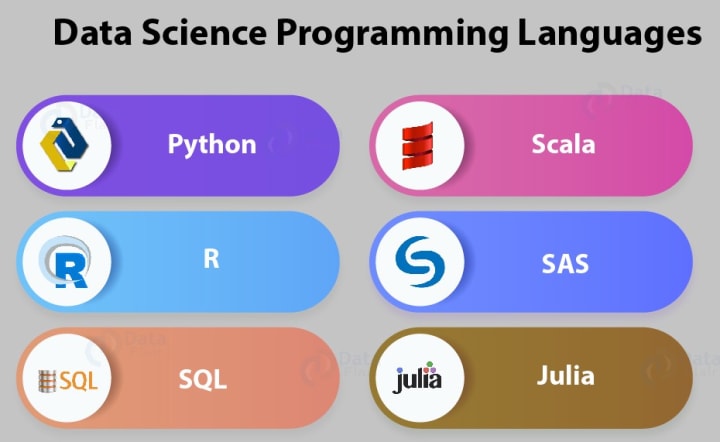
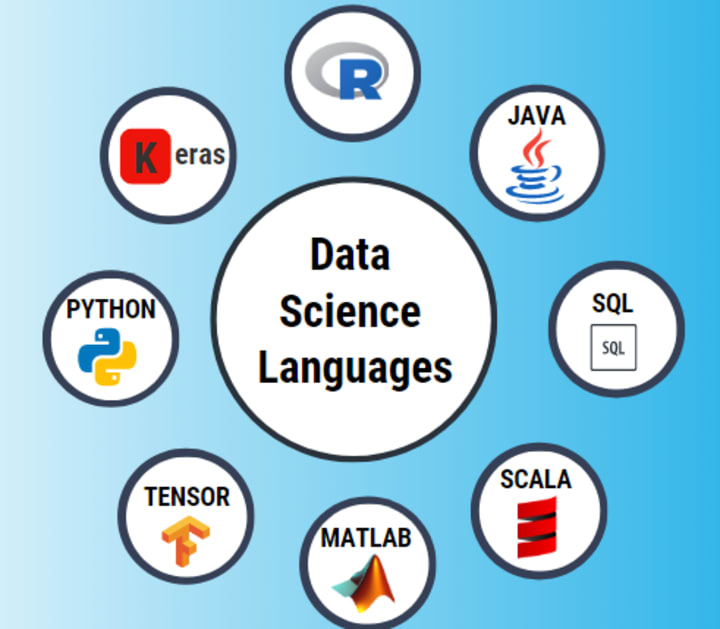
The top programming languages for data science are:
R
SQL
Julia
Scala
Note that the popularity of these languages may vary based on the industry and specific use case, but Python and R are widely considered the most commonly used and versatile for data science.
Here’s an overview of the top programming languages for data science with a few coding examples for each:
Python is a high-level, interpreted language known for its simplicity and ease of use. It has a vast library for data analysis and visualization, including NumPy, Pandas, and Matplotlib. Python is widely used for machine learning, natural language processing, and web development.
Example:
python
import pandas as pd
# Load the iris dataset
data = pd.read_csv("iris.csv")
# Print the first 5 rowsprint(data.head())
# Calculate the mean of the sepal width column
mean_sepal_width = data["sepal_width"].mean()
print("Mean sepal width:", mean_sepal_widt
R is a programming language specifically designed for statistical computing and graphics. It has a vast library of packages for data analysis and visualization, including ggplot2 and dplyr. R is widely used for data analysis, statistical modeling, and scientific research.
Example:
bash
# Load the iris dataset
data <- read.csv("iris.csv")
# Print the first 5 rowshead(data)
# Calculate the mean of the sepal width column
mean_sepal_width <- mean(data$sepal_width)
print(paste("Mean sepal width:", mean_sepal_width)
SQL (Structured Query Language) is used to manage and manipulate relational databases. It’s widely used for data analysis and data warehousing. SQL is good for handling large datasets and performing complex data analysis operations.
Example:
sql
-- Select the first 5 rows from the iris tableSELECT *FROM iris
LIMIT 5;
-- Calculate the mean of the sepal width columnSELECT AVG(sepal_width)
FROM iris;
Julia is a high-level, high-performance language designed for numerical and scientific computing. It has a growing library for data analysis, including DataFrames.jl and Gadfly.jl. Julia is fast and efficient, making it a good choice for large-scale data analysis and scientific computing.
Example:
makefile
using DataFrames, Statistics
# Load the iris dataset
data = DataFrame(CSV.File("iris.csv"))
# Print the first 5 rows
println(first(data, 5))
# Calculate the mean of the sepal width column
mean_sepal_width = mean(data[!, :sepal_width])
println("Mean sepal width: $mean_sepal_width
Scala is a high-level, statically-typed programming language that runs on the Java Virtual Machine. It’s widely used for big data processing, machine learning, and web development. Scala has libraries for data analysis, including Spark and Breeze, making it a good choice for large-scale data analysis.
Example:
kotlin
import org.apache.spark.sql.SparkSession
val spark = SparkSession.builder().appName("IrisExample").getOrCreate()
// Load the iris datasetval data = spark.read.csv("iris.csv")
// Pri
Example (continued):
scss
// Print the first 5 rows
data.show(5)
// Calculate the mean of the sepal width column
val mean_sepal_width = data.agg(avg("_c3")).first().getDouble(0)
println(s"Mean sepal width: $mean_sepal_width")
spark.stop(
These are the top programming languages for data science, each with its own strengths and weaknesses. The choice of which language to use depends on the specific data analysis task, the size of the data, and personal preference. Python and R are the most commonly used and versatile, but other languages like SQL, Julia, and Scala can be more suitable for specific use cases.
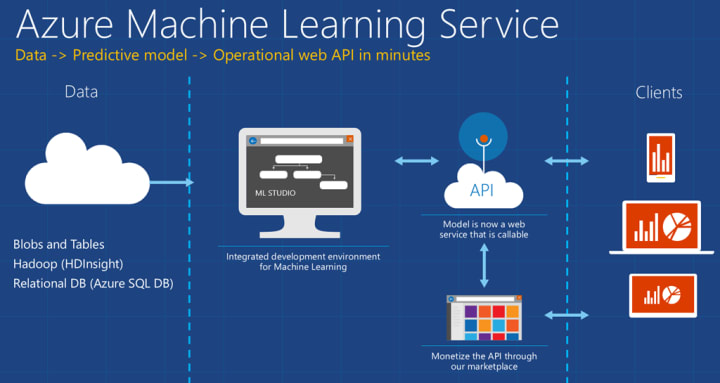
What Are Azure Machine Learning Service and Cognitive Services?
Azure Machine Learning Service is a cloud-based platform for building, deploying, and managing machine learning models. It provides a suite of tools and services to simplify the end-to-end process of creating, training, and deploying ML models.
Cognitive Services is a collection of pre-built APIs for natural language processing, computer vision, speech recognition, and other cognitive tasks. These APIs can be integrated into apps, websites, and other solutions to add intelligent features such as image and speech recognition, language understanding, and decision making.
In-Demand Data Science Programming Languages:
The most in-demand programming languages for data science are:
Python – widely used for machine learning, data analysis, and scientific computing.
R – a language specifically designed for statistical computing and data visualization.
SQL – used for managing and querying large datasets.
Julia – a high-performance language for numerical and scientific computing.
Scala – a functional programming language for big data processing and machine learning.
Note: The popularity of a language may vary depending on the industry, company, or specific project requirements.
Conclusion:
In summary, the field of data science involves using various tools and techniques to extract insights and knowledge from data. The choice of programming language to use is an important consideration and can have a significant impact on the success of a data science project. The top programming languages for data science are Python, R, SQL, Julia, and Scala. Each of these languages has its own strengths and weaknesses and the most appropriate choice depends on the specific data analysis task, the size of the data, and the user’s preference. Python and R are widely considered the most versatile and commonly used languages for data science, while SQL is good for managing and manipulating large datasets, Julia is efficient for large-scale data analysis, and Scala is well suited for big data processing.
About the Creator
datacademy ai
Datacademy.ai is an e-learning platform that aims to make education accessible to everyone, no matter where they are located. We believe that education is the key to unlocking one's potential and we are dedicated... see more
Keep reading
More stories from datacademy ai and writers in Education and other communities.
More Than a Sermon: Everyday Roles That Strengthen a Faith Community
A vibrant faith community is about much more than what happens during a sermon. While weekly messages often take center stage, the true heartbeat of any congregation is found in the everyday people who give their time, energy, and care in quiet, meaningful ways. From greeting newcomers to organizing events, there are countless opportunities to support church life beyond preaching or formal leadership.
By Mike Signorelli6 days ago in Education
Why Cloud Computing Is Accelerating Digital Transformation Across Latin America?
Digital transformation is rapidly reshaping industries throughout Latin America, and cloud computing has become a central technology supporting this shift. Businesses, governments, and organizations are increasingly moving data, applications, and services to cloud-based platforms to enhance flexibility, efficiency, and collaboration.
By deepanshu Thakura day ago in Education
Two Grumpy Old Men Solve the Problem
Marty and Steve were two grumpy old men who lived together. They had known each other for years. Marty had been a bachelor all his life. Steve said it was because no one could stand to ever live with. Marty’s standard reply was “Well, you are, so what sort of a moron does that make you!”
By Calvin London3 days ago in Humor




Comments
There are no comments for this story
Be the first to respond and start the conversation.