

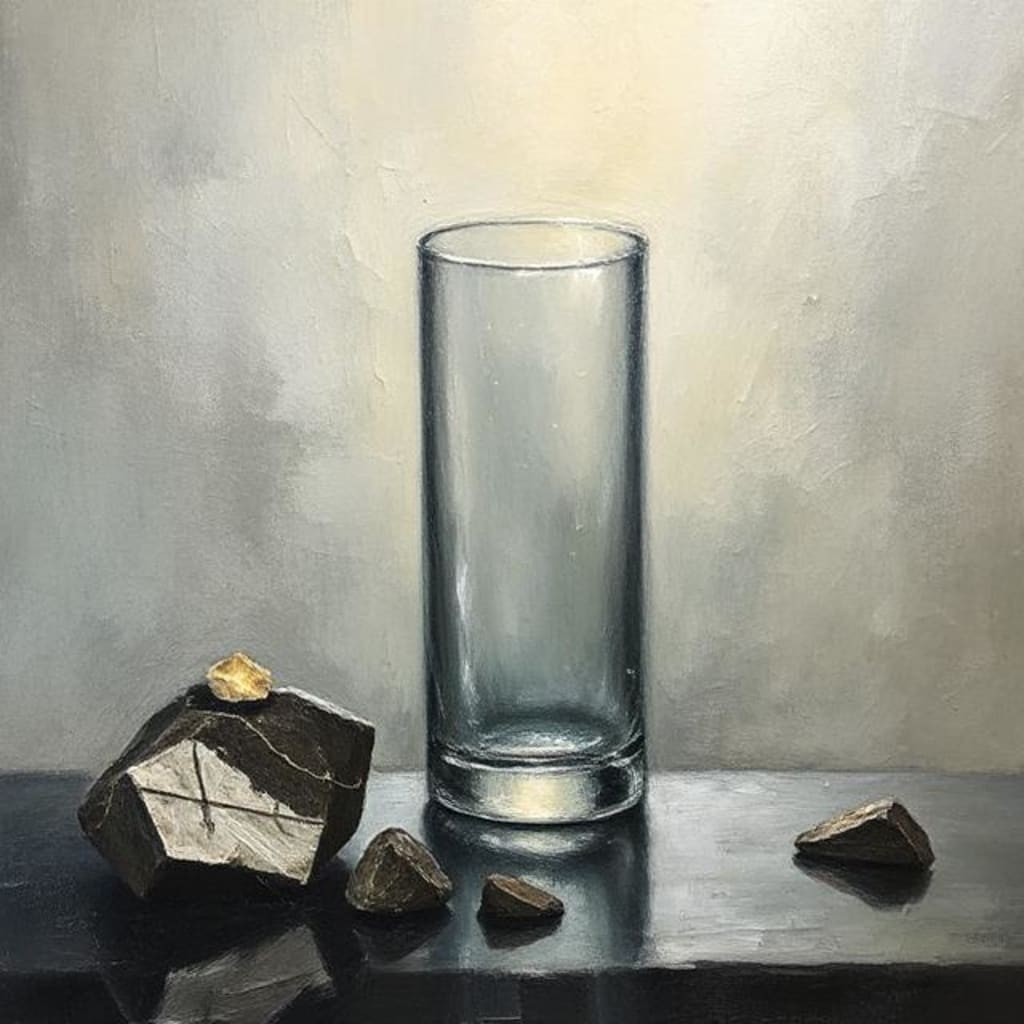
"The Weight of the Glass"
In a quiet village nestled between green hills and flowing rivers, lived a young woman named Mira. She was kind-hearted, intelligent, and always willing to help others. But Mira had one flaw—she worried too much. Whether it was about the future, her family, or things she couldn’t control, Mira constantly carried the weight of anxiety on her shoulders.
One day, Mira went to visit her grandfather, an old retired schoolteacher known in the village for his wisdom. He lived in a small wooden cottage near the edge of the forest. Mira often visited him when life felt too heavy, and this time, she was particularly overwhelmed.
“Grandfather,” she sighed as she sat down, “my thoughts are spinning. I feel anxious all the time. What if I fail? What if something bad happens to the people I love?”
Her grandfather listened patiently, his gentle eyes fixed on her face. After a moment of silence, he stood up and walked into the kitchen. Mira thought he hadn’t heard her, but he soon returned with a glass of water. He held it up and asked, “Mira, how heavy is this glass of water?”
She tilted her head, puzzled. “Not very heavy. Maybe eight ounces?”
He smiled. “Yes, the weight is not much. But what if I held this glass up like this for a minute?”
“That’s fine,” Mira replied.
“What if I held it for an hour?” he asked again.
“Well,” she said, “your arm would get tired.”
“Exactly,” he nodded. “And what if I held it all day?”
“It would hurt! Your arm would probably go numb,” Mira laughed.
Her grandfather placed the glass down gently. “The weight of the glass never changed—but the longer I held it, the heavier it felt. Worry is just like that. If you think about it for a little while, it’s okay. But if you hold onto it for too long, it begins to hurt you.”
Mira looked at him, her eyes widening as the meaning sank in.
“Put the glass down,” he said softly. “Rest. Don’t carry burdens that are too heavy for too long.”
“But Grandfather,” she said, “what if something really does go wrong? How can I not worry?”
He stood up and walked over to his bookshelf. He pulled out an old journal and handed it to her.
“This belonged to your grandmother,” he said. “She was strong, but she worried too—just like you. She used to write down her worries every night, then close the book and say, ‘I’ll let tomorrow handle itself.’ Sometimes, she’d read them again a week later and laugh because most of them never happened.”
Mira opened the journal. Inside were pages filled with neat handwriting. Some worries were small—like burnt soup or a torn dress. Others were bigger—money problems, illnesses, fear of loss. But the final page held a simple message: “You survive more than you fear. Let peace live where panic wants to grow.”
That night, Mira sat by her window and wrote in a journal her grandfather gave her. She listed all her fears—each one poured out like water from a full glass. Then, she closed the journal and whispered, “I’ll let tomorrow handle itself.”
In the days that followed, Mira still had worries, but she didn’t hold onto them the same way. She learned to set the glass down. Some nights, she wrote in her journal. Some days, she went for long walks. Other times, she just sat quietly and breathed, reminding herself that peace could be found in letting go.
Months passed, and Mira became known in the village not just for her kindness, but for her calm strength. When others were anxious, they came to her—and she would listen patiently, then ask, “How heavy is the glass?”
Moral of the Story:
Holding on to worry doesn’t make the problem lighter—it only makes you heavier. Learn to let go when needed, rest your heart, and trust that tomorrow will take care of itself.
About the Creator
Keep reading
More stories from VISHWANATHA and writers in Education and other communities.
The Greedy Mouse and the Wise Tortoise
In a quiet village surrounded by green meadows and crystal-clear streams, lived a clever little mouse named Milo. Milo was known for his sharp mind, but also for his growing greed. He always wanted more—more food, more toys, more of everything.
By VISHWANATHA9 months ago in Education
Guiding While Growing: How Mentorship Shapes Modern Leadership
Leadership today looks very different from what it did a generation ago. Authority alone is no longer enough to inspire trust, loyalty, or growth. The most effective coaches understand that leadership is not about standing above others but about growing alongside them. Mentorship has emerged as one of the most powerful expressions of leadership, especially when coaches are willing to remain learners themselves.
By Thomas Kuriakose, MD3 days ago in Education
The Unique Case of Alma Mater TV
(A Review of Charmaine Voigt's Dissertation on Practical Media Training) Abstract This review examines the Bulgarian case study of Alma Mater TV as discussed in Charmaine Voigt's doctoral dissertation College Television: Practical Media Training in US and German Higher Education. While Voigt's work focuses primarily on Anglo-American and German contexts, the Bulgarian example stands out as an exceptional and largely unmatched model of student television in Europe. Alma Mater TV, based at the Faculty of Journalism and Mass Communication at Sofia University 'St. Kliment Ohridski', functioned not merely as a training platform but as a fully operational public-facing television project. Students produced and aired original programmes on Bulgaria's largest national broadcasters without censorship or editorial interference, while simultaneously participating in the creation of a European student television network. This review argues that Alma Mater TV represented a globally unique pedagogical and institutional experiment whose decline resulted not from structural failure but from a lack of strategic vision at the university leadership level. Particular attention is paid to the decisive roles of Professor Svetla Bozhilova and Professor Peter Ayolov in establishing and sustaining this model.
By Peter Ayolov6 days ago in Education



Comments
There are no comments for this story
Be the first to respond and start the conversation.