

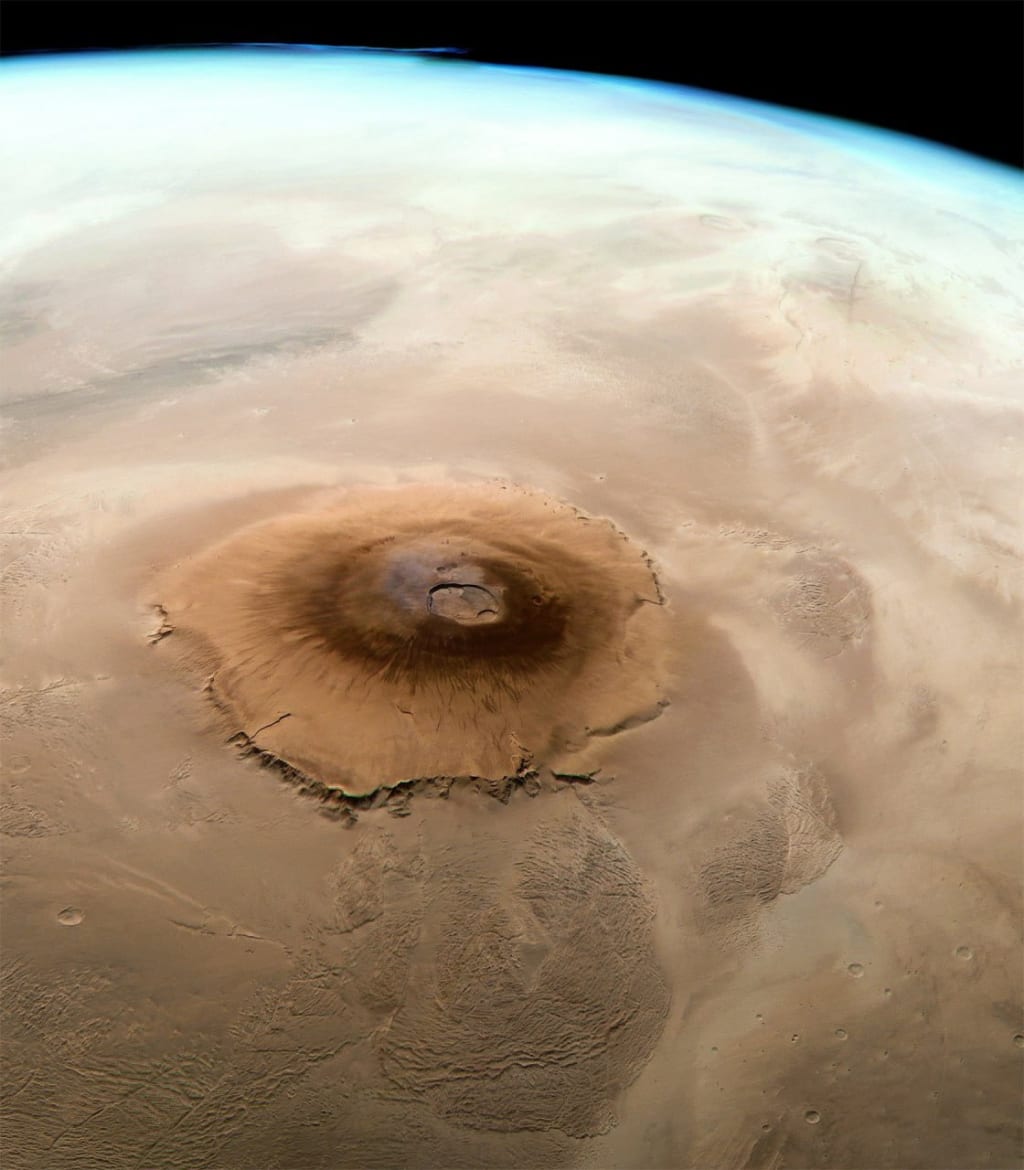
When people think of the tallest mountains, Mount Everest usually comes to mind — that icy peak rising 8.8 kilometers above sea level. It’s the ultimate symbol of human endurance and the limits of Earth’s geography. But in the grand scale of the solar system, Everest looks more like a hill. Because just one planet away, on the dusty red world of Mars, there’s a mountain so colossal that Everest would barely reach a third of its height. Its name is Olympus Mons, and it stands 21 kilometers (13 miles) tall — the highest mountain known in our entire solar system.
A Sleeping Giant on the Red Planet
Olympus Mons isn’t just tall — it’s vast. Its base spreads across 600 kilometers (about 370 miles), roughly the distance between Moscow and St. Petersburg or from Los Angeles to San Francisco. From space, it looks less like a mountain and more like an enormous pancake — a huge, gently sloping shield volcano that dominates the Martian landscape.
Scientists believe Olympus Mons formed through hundreds of millions of years of volcanic activity. But unlike volcanoes on Earth, which erupt from moving tectonic plates, Mars doesn’t have plate tectonics. This means that instead of drifting away from its heat source, the crust above a Martian hotspot stays put. Lava erupts again and again through the same vent, spreading layer upon layer over time. The result? A volcano so massive it could swallow all of France — and still have room for dessert.
Why Mars Could Grow a Mountain This Big
Mars’s weaker gravity — only about 38% of Earth’s — allowed Olympus Mons to grow taller than any mountain on our planet could. On Earth, the weight of such a huge mountain would cause its base to sink deeper into the crust, limiting how high it can rise. But on Mars, the planet’s lighter gravity and thicker crust provided the perfect conditions for Olympus Mons to stretch skyward.
Also, the lack of plate tectonics meant no interruptions. On Earth, the Hawaiian Islands are formed by a similar process: a fixed hotspot under a moving crust. That’s why there’s a chain of volcanoes across the Pacific, each one extinct as the crust shifts. If Earth’s crust didn’t move, Mauna Loa — already one of our largest volcanoes — could have kept growing just like Olympus Mons did.
A View from the Top
Imagine standing on the summit of Olympus Mons — though in reality, it would be a dangerous, freezing, and oxygen-free experience. The thin Martian atmosphere would barely scatter sunlight, leaving the sky a pale salmon color instead of blue. From the top, you’d see a horizon more than 500 kilometers (310 miles) away, curving gently under you like the edge of a giant sphere. The caldera — the volcano’s summit crater — is 80 kilometers wide and dotted with smaller pits where eruptions once burst through.
In other words, standing there would feel less like climbing a mountain and more like being on another planet — which, of course, you would be.
The Science — and the Mystery
Olympus Mons is believed to be relatively young in geological terms, possibly as little as 25 million years old. That’s practically yesterday in planetary history. Some scientists have even speculated that it might not be completely dead. While there’s no direct evidence of current eruptions, the volcano’s youthful features suggest that the Red Planet’s interior might still be geologically active — a thrilling possibility for future explorers.
A Martian Everest — and More
Comparing Olympus Mons to Mount Everest helps put its sheer scale in perspective. If you placed Olympus Mons on Earth, it would reach far into the stratosphere, high enough to poke through jet streams where airplanes fly. A person standing at its base might walk weeks before reaching the slopes steep enough to even notice they were climbing a mountain.
Its edges are ringed with towering cliffs — some as high as six kilometers — formed when parts of the volcano collapsed under their own weight. Around its flanks lie ancient lava flows, frozen in time, telling a story of eruptions that shaped the Martian surface long before life ever appeared on Earth.
A Monument to Cosmic Scale
Olympus Mons isn’t just a record-breaking mountain. It’s a symbol of how alien geology can be when freed from Earth’s constraints. Where Earth’s volcanoes rise and fall, Olympus Mons endures — silent, immense, timeless. It reminds us that Mars was once a world of fire, not just the cold desert we see today.
As humanity plans missions to Mars — and dreams of standing on its surface — Olympus Mons stands as a challenge and an invitation. It says, in the silent language of rock and dust: Come see what your little blue world could never build.
About the Creator
Keep reading
More stories from Holianyk Ihor and writers in Education and other communities.
When Time Stops: The Strange Reality of a Black Hole
Where Physics Bends Reality Imagine drifting through the endless dark of space, stars fading behind you, and ahead—an invisible monster: a black hole. It doesn’t shine, it doesn’t reflect light, but you feel its presence. Its gravity stretches space itself, bending everything toward its center. And here’s where the weirdest thing happens: for someone watching from afar, time itself appears to stop.
By Holianyk Ihor3 months ago in Education
Why Great Customer Service Is Non-Negotiable for Modern Businesses
Excellent customer service is no longer something businesses can choose to offer later. It is a basic requirement in today’s fast-moving market. Customers expect respect, clear communication, and fast solutions. When they do not get these things, they leave. This is why excellent customer service is non-negotiable for businesses that want to survive and grow.
By Apex Service Partners5 days ago in Education


Comments
There are no comments for this story
Be the first to respond and start the conversation.