
The Soul of the Machine
How My Grandfather's Curiosity and a Junkyard PC Taught Me Everything About Computers.

The Soul of the Machine
Subtitle: How My Grandfather's Curiosity and a Junkyard PC Taught Me Everything About Computers.
When I was twelve, I thought computers were magic.
They lit up when you touched a button, obeyed every command like a loyal servant, and opened portals to worlds far beyond our small town library. I didn’t know what RAM was, or how data lived inside something cold and plastic. But I was obsessed. And then, one summer, everything changed.
It was the summer my grandfather moved in with us.
A retired railway engineer with more tools than teeth, he had a quiet presence and a slow, curious way of moving through the world. He could fix almost anything, and when he saw me staring longingly at a broken computer someone had left at a garage sale, he asked only one thing:
“Want to learn what makes it breathe?”
That was the beginning of the summer I met the soul of the machine.
Part 1: The Body
We brought the computer home, dust-covered and silent. It didn’t turn on, the screen was cracked, and a piece of wire dangled from the back like a forgotten vein.
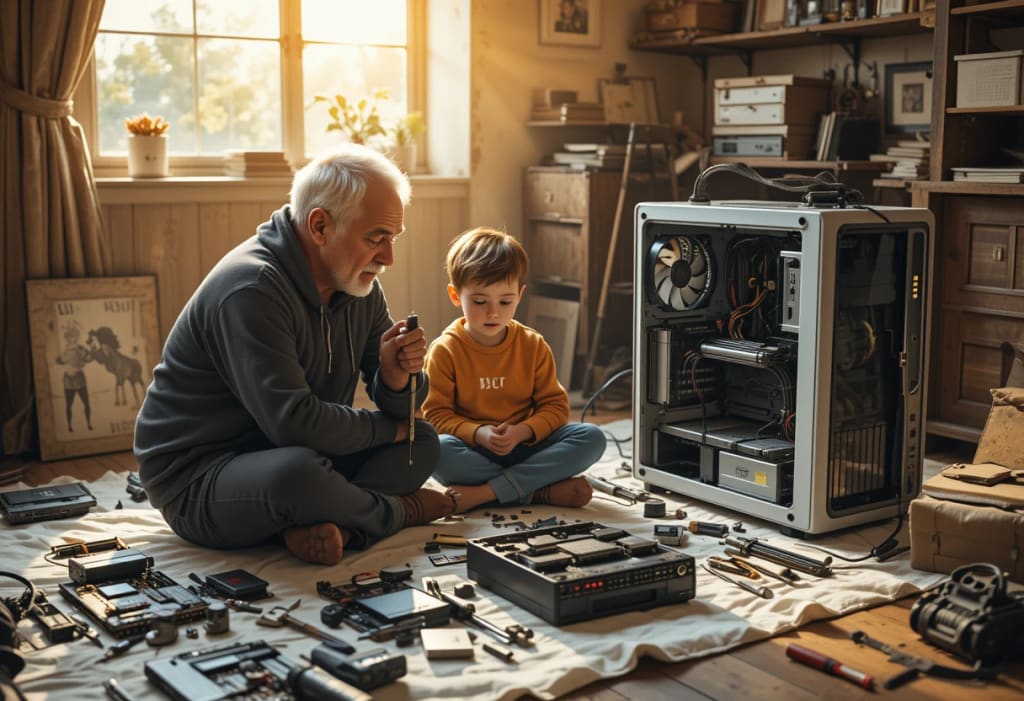
Grandfather spread an old white sheet on the floor and laid the computer gently on its back.
“A computer,” he said, “is like a human body. Everything inside has a role.”
He removed the outer casing, revealing a green board with strange, shining lines. “This is the motherboard. The spine and brain pathways of the system. Everything connects here.”
Then he pointed to a chip: “This is the CPU, the Central Processing Unit. It’s the brain — it does all the thinking, processing commands, calculations, everything.”
A silver box with a fan whirred gently when touched. “That’s the power supply. Think of it like the heart — delivering electricity to all parts of the body.”
I leaned closer, watching how his fingers never hesitated.
He pulled out a long stick and said, “This is the RAM — Random Access Memory. Short-term memory. The more you have, the faster you can think.”
Then he opened a metal case, revealing a spinning disk.
“This is your hard drive — long-term memory. It stores everything: pictures, games, music, documents. You turn the computer off, and it still remembers.”
Bit by bit, he showed me more: the graphics card, the ports, the cooling fans, the network cable. I started to see the machine not as a mystery, but as a living puzzle.
Part 2: The Language
Once we got a replacement monitor and power supply, the computer finally turned on. But now came the part Grandfather called “teaching the machine to speak.”
He introduced me to software.
“Hardware,” he said, “is the body. But software? That’s the soul.”
He installed Windows 7 and explained how the operating system was like a translator between human commands and machine logic. “When you click an icon, the OS tells the hardware what to do.”
He showed me how files are stored in binary — just ones and zeroes — and how every image, word, or song is ultimately reduced to combinations of this simple language.
“You don’t need to memorize binary,” he said, “but respect its power. It’s the alphabet of the future.”
He showed me how to write basic code in Python, explained what drivers were, how BIOS helped start the computer, and why firewalls protect it like digital immune systems.
My world opened up.
Part3: The Purpose
That summer, we rebuilt three more broken computers. Grandfather donated them to families who couldn’t afford one. He said computers weren’t for games or fame — they were for connection, creation, and curiosity.
“People think computers make us cold,” he told me once. “But they can also bring people together. It’s all in how we use them.”
We video-called my cousin in Canada. We sent emails to scientists just to ask questions. One of them even wrote back.
I began designing simple websites, writing stories, learning how the internet itself worked — the vast web of servers, routers, IP addresses, and protocols that quietly carried the modern world.
Part 4: The Goodbye and the Gift
By the end of the year, Grandfather’s health had declined. His hands shook, and he didn’t talk as much. But he still smiled when I showed him a program I’d written that calculated train speeds — just like he used to do for work.
When he passed away the following spring, I inherited his toolset and the first computer we fixed together.
Inside the case, I found a note taped next to the motherboard:
“Machines have no soul until we give them purpose. Keep building. Keep learning. I’m proud of you.”
Today
Now, as a computer science student and freelance developer, I often explain computers to clients and kids alike. But I always start the same way:
“A computer is like a body — and a soul. Hardware is what you touch. Software is what you feel.”
People nod, some smile, and some truly understand. Just like I once did — on a dusty white sheet, beside a man who believed broken things could always be repaired.
About the Creator
Keep reading
More stories from waseem khan and writers in Education and other communities.
Time Management Hacks Every Entrepreneur Should Know
Running a startup demands more than hustle—it requires precision in how you use your time. As a founder, your daily choices directly impact your company’s growth, culture, and long-term sustainability. Without the right strategies, it's easy to get overwhelmed by tasks and lose sight of what truly matters. Mastering a few smart productivity habits can dramatically improve how you work.
By Per Jacob Solli4 days ago in Education
The "Free" Lead Trap: Why New Real Estate Agents Are Paying a Hidden Price
In the early stages of a real estate career, an agent’s most precious asset isn't their luxury car, their high-end camera gear, or a downtown office lease. It is their time. Yet, for many new professionals, time is the one resource they are most willing to squander in exchange for the "dopamine hit" of a smartphone notification.
By SiftlyLeads3 days ago in Education


Comments
There are no comments for this story
Be the first to respond and start the conversation.