
The "Free" Lead Trap: Why New Real Estate Agents Are Paying a Hidden Price
Your time is your most valuable asset; stop spending it on low-intent prospects and start building a sustainable business.

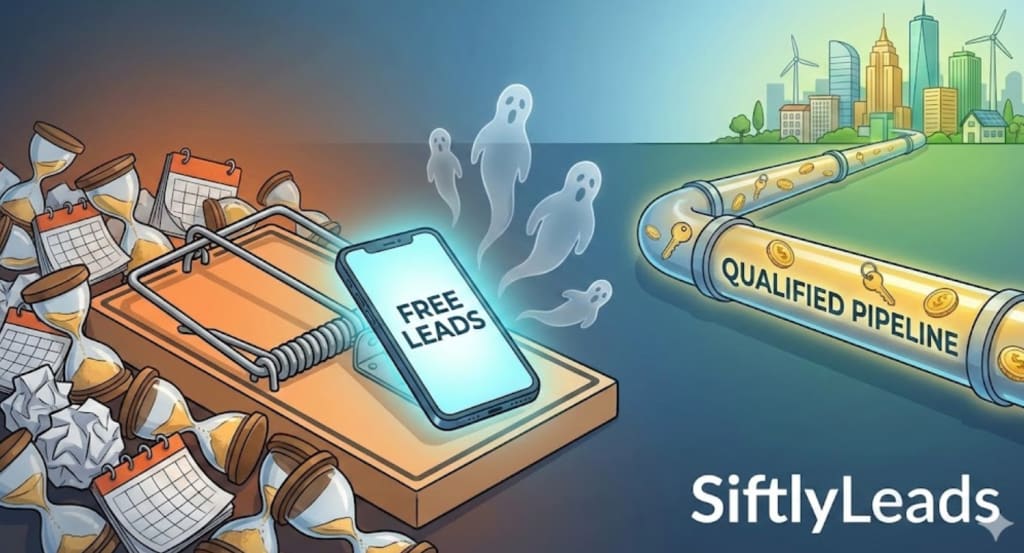
In the early stages of a real estate career, an agent’s most precious asset isn't their luxury car, their high-end camera gear, or a downtown office lease. It is their time. Yet, for many new professionals, time is the one resource they are most willing to squander in exchange for the "dopamine hit" of a smartphone notification.
The notification usually signals a "free" lead from a major property portal. For a beginner, this feels like validation—a potential closing and a significant commission delivered right to their pocket. However, beneath this opportunity lies a complex web of economic traps. To build a sustainable career, an agent must transition from a "reactive" mindset to an "investor" mindset. This starts with understanding a fundamental business principle: Opportunity Cost.
Lesson 1: Bridging the Intent Gap
To understand why these leads are often a net loss, we must examine the business model of data aggregators. These portals are not real estate firms; they are traffic engines designed to capture "top-of-funnel" data.
In an educational context, we call this the Intent Gap. On one side, you have high-intent leads—individuals who are pre-qualified and ready to tour homes. On the other side, you have low-intent leads—the "window shoppers" who accidentally triggered a lead form while trying to zoom in on a photo. When an agent spends their day chasing the latter, they aren't practicing real estate; they are participating in a low-probability lottery that consumes their most valuable resource.
Lesson 2: Analyzing the Statistical Reality
A deep dive into sales data reveals a sobering reality. According to the National Association of Realtors (NAR), nearly half of all buyers start their search online, but the conversion rate for "cold" internet leads remains remarkably low.
- Metric Industry Standard
- Conversion Rate 1% – 3%
- Response Time Goal Under 5 Minutes
- Follow-up Frequency 6 – 10 contacts
- Nurture Cycle 6 – 12 Months
When we analyze these numbers through a pedagogical lens, the inefficiency is clear. If an agent processes 100 "free" leads, roughly 97 will result in silence or rejection. If each lead requires 30 minutes of research and outreach, that agent has spent 50 hours of human capital to secure a single client. In any other industry, this would be flagged as a critical operational failure.
Lesson 3: Identifying High-Yield vs. Low-Yield Activities
The concept of Opportunity Cost dictates that every hour spent "ghost hunting" is an hour stolen from activities that actually build a business. In a professional curriculum, we categorize activities into two distinct buckets:
• Low-Yield Activities: Calling disconnected numbers, cold-emailing "browsers" who aren't ready to engage, and managing databases of prospects who never respond.
• High-Yield Activities: Nurturing your Sphere of Influence (SOI). Statistically, over 80% of transactions come from repeat clients or referrals. Educating your existing network is significantly more profitable than chasing strangers.
• Market Mastery: Spending time studying local zoning laws or absorption rates. This allows an agent to speak with the authority of an expert rather than the desperation of a salesperson.
Lesson 4: The Psychological Cost of Scarcity
Beyond the financial metrics, there is a mental toll to consider. The real estate industry has a notoriously high turnover rate, often because agents burn out within their first two years.
A primary driver of this is the Rejection Ratio. When a daily workflow consists of 98% rejection, professional morale erodes. By shifting focus toward quality over quantity, agents can experience more meaningful, service-oriented interactions. Educationally, we teach agents to protect their mental energy; one conversation with a motivated buyer is worth more to an agent’s longevity than fifty "dead" phone numbers.
The Final Lesson: Becoming the CEO of Your Time
Every real estate agent is effectively the CEO of their own micro-corporation. A CEO’s primary responsibility is to manage resources to ensure a high Return on Investment (ROI).
When you stop chasing "ghosts," you gain the freedom to build deeper relationships, master your local market, and create a predictable business model based on data rather than luck. The path to a thriving, decades-long career is built on focus.
Your Assignment: For the next thirty days, track your "Lead-to-Appointment" ratio. Document exactly where each lead originated and the total time spent on it. Once you see the data on paper, the true cost of "free" becomes impossible to ignore.
Further Reading
- How New Real Estate Agents Can Win More Deals in 2025
- Top 9 Mistakes That Push Real Estate Leads Away
- Top 5 Mistakes Realtors Make When Buying Real Estate Lead
- Navigating the Disclosure Process
- Why Verified Information is Gaining Traction Among Real Estate Pros
- How to Find Verified Buyer Leads That Actually Convert
About the Creator
SiftlyLeads
SiftlyLeads is the premier platform for high-quality, verified leads and precise data. Let us empower your sales team with our expert insights to transform outreach and accelerate growth.
Keep reading
More stories from SiftlyLeads and writers in Education and other communities.
Top 5 Mistakes Realtors Make When Buying Real Estate Leads
Buying fresh customer leads often feels like buying a lottery ticket: exciting potential for huge payoffs, but more often than not, it leads to nothing but an expense report and a sense of professional fatigue.
By SiftlyLeadsabout a month ago in Education
Connected Wealth: Why Strong Networks Are Essential to Smarter Financial Planning
Financial planning is often associated with spreadsheets, forecasts, and long-term projections. While these technical elements are essential, they represent only one side of the process. Relationships, shared knowledge, and access to broader communities strengthen a truly effective financial plan. Networks—both personal and professional—play a critical role in shaping smarter, more resilient financial strategies.
By Lee Generous6 days ago in Education
Rethinking Math Education in the 21st Century: Lessons from the Casie Hynes Perspective
Mathematics has long been considered a fundamental pillar of education. It develops critical thinking, nurtures problem-solving abilities, and plays an essential role in science, technology, engineering, and finance. Yet despite its importance, math remains one of the most challenging and misunderstood subjects for students worldwide. As we step deeper into a data-driven era, reforming how we approach math education is more urgent than ever.
By Casie Hynesabout 22 hours ago in Education
So You Decided To Become a Nurse Practitioner:
So you decided to become an "Advanced Practice" nurse. Congratulations!... is what I would say if this was a good idea. Grad school? In this economy? What were you thinking? Likely it was something along the lines of either 1) “I've seen these other chucklefucks do it— Why can't I?” or even 2) “I've got a nice career, I should shake it up. I miss feeling like I have no clue what I'm doing.”
By Sandor Szabo3 days ago in Fiction




Comments
There are no comments for this story
Be the first to respond and start the conversation.