
The Experiment That Changed Everything
In a quiet school lab, one unlikely experiment became a life lesson in failure, discovery, and human

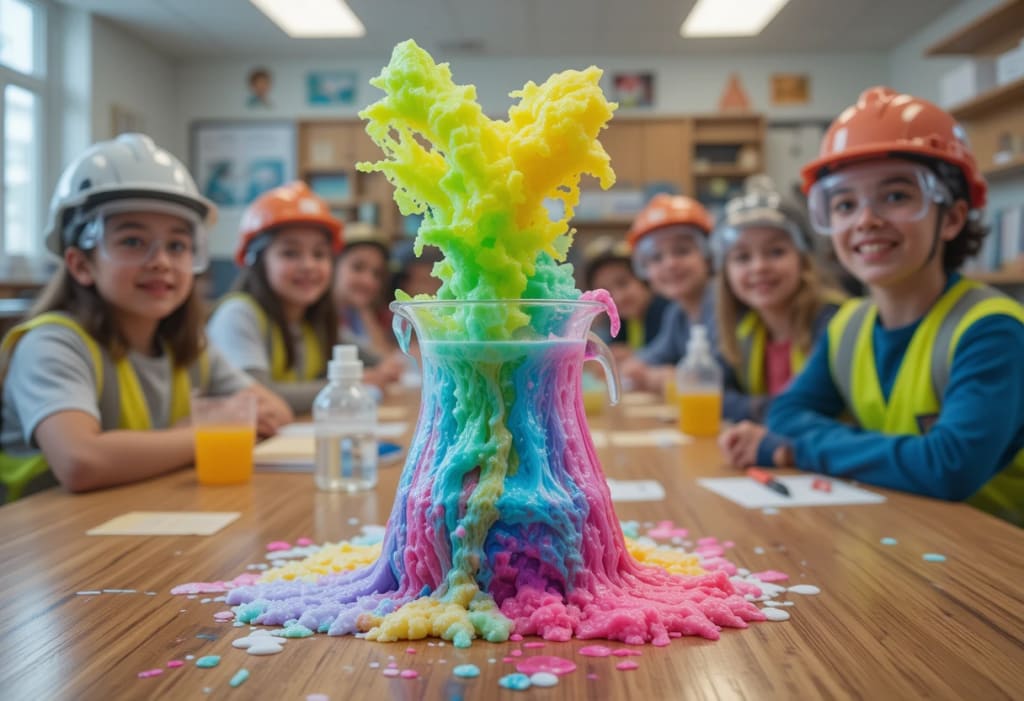
"The Experiment That Changed Everything"
When I think about science, I don’t think about atoms, equations, or the speed of light.
I think about the day I nearly blew up the chemistry lab.
It was the final term of Year 10, and I had exactly zero interest in science. My attendance in chemistry was perfect only because I sat next to my best friend, Amal, who was smart enough to do both our assignments and funny enough to make me forget we were in a class I hated.
Science, to me, was a bunch of boring facts taught by people who didn’t care if we understood—just that we memorized. Mole-to-mass conversions? Why? Chemical reactions? Who cared?
Our teacher, Mr. Caldwell, had other ideas.
“Final project,” he said, handing out a sheet of instructions. “You’ll be designing your own experiment, with a written report and demonstration. Groups of two. Presentation due in three weeks.”
Amal looked excited. I looked like I’d swallowed a nail.
We tossed around ideas in the lunchroom that week—paper rockets, water filtration, photosynthesis—but nothing stuck. It all felt too… safe.
Then Amal came up with it: “Let’s make elephant toothpaste.”
I blinked. “Is that even a thing?”
“Oh yes,” she grinned. “Hydrogen peroxide, dish soap, yeast or potassium iodide. It’s a rapid decomposition reaction. The foam erupts like crazy.”
“So, a science volcano on steroids?”
“Basically.”
I was in.
We did our research. Watched videos. Read articles. Amal handled the ratios and safety gear. I… volunteered to handle the colors and dramatic timing. It was science theater, and I was ready to perform.
The day of the experiment arrived. Our table was lined with plastic sheeting. Mr. Caldwell looked on with his arms crossed. We had our materials lined up: a tall cylinder, gloves, goggles, and a camera phone ready to record it all.
We poured the hydrogen peroxide into the cylinder. Added food coloring—blue and green. Then the dish soap.
Amal gave me the nod. I held the beaker of potassium iodide like it was a sacred vial.
“Ready?” I whispered.
“Do it.”
I poured.
What happened next was not what we rehearsed.
Instead of a steady, toothpaste-like foam rising from the cylinder, it exploded upward like a geyser. A roar of gas and heat surged through the table. The foam hit the ceiling. Everyone screamed.
Including me.
We had used a concentration level too high for the container we chose. The reaction created not only foam but enough steam and oxygen to launch part of the cylinder into the air. Nothing caught fire—but a ceiling tile dislodged and came crashing down in the corner.
Silence followed.
Foam dripped from the lights.
Mr. Caldwell walked over, slow and steady.
“Well,” he said. “That’s certainly... one way to prove a reaction occurred.”
We didn’t get suspended. But we did get a long talk from Mr. Caldwell and a mandatory safety review. Amal was mortified. I couldn’t stop laughing—mostly out of nervous relief.
But here’s the strange thing: I also felt something new.
Excitement.
For the first time in any science class, something had clicked. Not just because it was loud and messy. But because I had seen cause and effect in action. I had helped create something unpredictable, alive, volatile. It wasn’t just theory on a page—it was real.
It made me want to know more.
That weekend, I spent hours looking up other chemical reactions. Amal and I revised our report, turning our mistake into a discussion on variables, reaction rates, and safety protocols. Mr. Caldwell was impressed.
“You did more research after the explosion than you did before,” he said with a smirk. “That’s science. Curiosity fueled by chaos.”
We got an A-.
A year later, I chose chemistry as an elective. To everyone’s shock—including my own. Amal was proud. Mr. Caldwell nodded quietly when I showed up in his advanced class.
I never became a scientist. I didn’t go to university for chemistry or biology or physics. But I learned something more valuable:
Science isn’t about getting it right the first time.
It’s about asking better questions the second time.
It’s about learning through mistakes. Through messes. Through giant blue-green explosions that remind you you're part of something bigger, more reactive, more unknown.
Now, when my little cousin asks me about science, I don’t hand him a textbook.
I show him videos of the experiment gone wrong. I tell him about the ceiling tile. About the laughter. About the foam in my shoes. And how, for the first time, I understood why we ask “why” in the first place.
Because sometimes, one mistake can lead to a hundred discoveries.
And that’s the real experiment, isn’t it?
About the Creator
Keep reading
More stories from waseem khan and writers in Education and other communities.
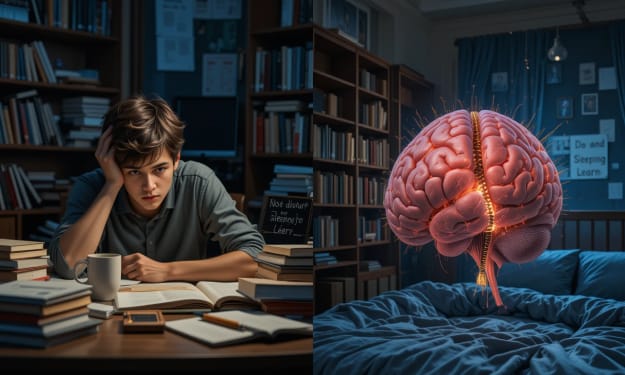
The Silent Cost of Midnight Oil: What Happens When We Study Late at Night
The Silent Cost of Midnight Oil: What Happens When We Study Late at Night For many students, the quiet of the night becomes a refuge for cramming information, finishing assignments, and catching up on readings that were pushed aside during the day. The silence after sunset, the absence of distractions, and the pressure of looming deadlines create the perfect storm for late-night study sessions. But beneath this habit lies a deeper impact that slowly shapes not only academic performance but mental, emotional, and physical well-being.
By waseem khan8 months ago in Education
K-12 Education Technology Spend Market to Reach USD 253.9 Billion by 2033
K-12 Education Technology Spend Market Summary The K-12 Education Technology (EdTech) Spend market covers the budgets allocated by schools and districts for digital learning software, connected classroom tools, student devices, broadband, cybersecurity, and IT support services. This spend is increasingly treated as core education infrastructure, not an optional add-on, because teaching, assessment, and school operations are now tied to digital systems. The global market size is expected to reach USD 253.9 billion by 2033, up from USD 78.2 billion in 2023, reflecting a forecast CAGR of 12.5% from 2024 to 2033.
By Roberto Crum4 days ago in Education
Why Generic Medicines Are Expanding Access to Healthcare Across Latin America?
Healthcare accessibility remains a central priority across Latin America, and generic medicines are playing a critical role in improving treatment availability. Generic drugs provide cost-effective alternatives to branded pharmaceuticals while maintaining the same active ingredients, dosage, and therapeutic effects.
By deepanshu Thakur4 days ago in Education
Review of 'Man on the Run'
My wife and I saw Man on the Run, a nearly 2-hour documentary on Amazon Prime, about Wings, Paul McCartney's group that flew around the world from shortly after The Beatles broke up in early 1970 to shortly after John Lennon was murdered at the end of 1980, making a Beatles reunion forever impossible.
By Paul Levinson6 days ago in Beat


Comments
There are no comments for this story
Be the first to respond and start the conversation.