
The Rise of AI in Everyday Life
How artificial intelligence is quietly reshaping how we live, learn, and interact — one algorithm at a time.

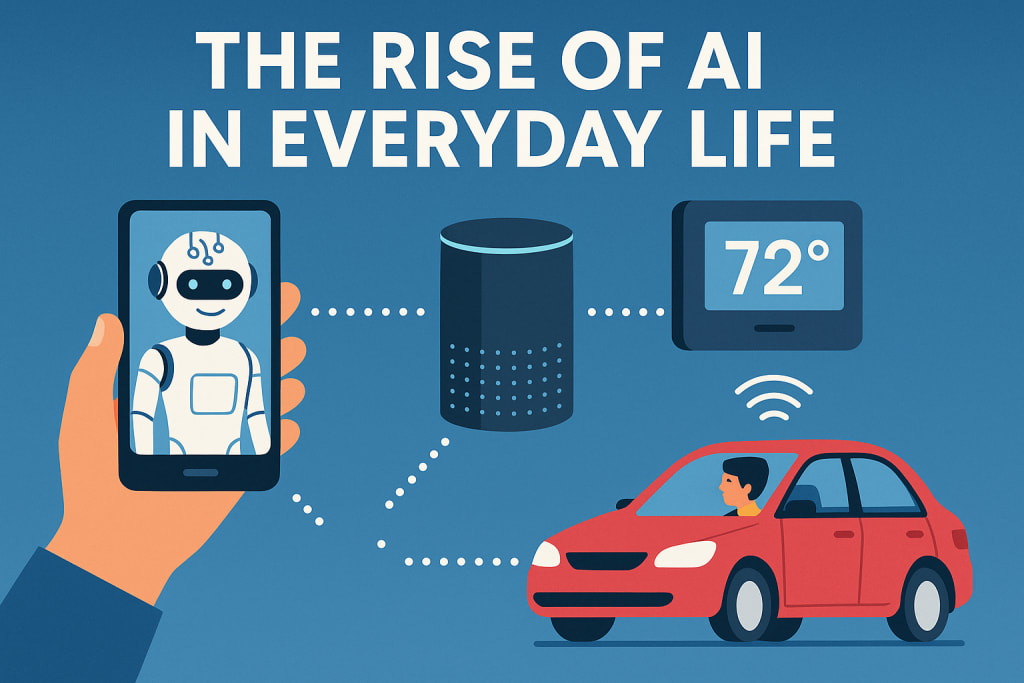
They said artificial intelligence was the future.
Now, it’s the present. And most of us didn’t even notice the shift.
AI has gone from being a distant sci-fi fantasy to something we interact with before we’ve even had our morning coffee. It’s in our phones, our homes, our cars, our classrooms — and sometimes even in our relationships. We don’t think twice about asking Alexa to play a song, letting Google finish our sentences, or letting Instagram’s algorithm decide what we see.
But the deeper truth is this: AI isn’t just changing the way we do things. It’s slowly transforming the way we live.
☕ Your Morning, Powered by AI
Let’s start with a typical day. Your alarm goes off — not at 7:00 AM, but at the optimal time based on your sleep patterns, thanks to a smart app tracking your rest cycles. You scroll your phone while still in bed, greeted by personalized news recommendations curated by AI, showing you stories it thinks you’ll want to read.
Then, your smart coffee machine, synced with your calendar, knows it’s a heavy meeting day — so it brews a double shot instead of your usual single.
This isn’t magic. It’s machine learning — a subset of AI that allows devices to “learn” your habits, adjust behavior, and optimize for convenience. What once felt futuristic now feels normal.
🧠 AI in Education: Personalized, But at What Cost?
AI is also reshaping how we learn. Virtual tutors powered by natural language processing can walk students through complex math problems step-by-step. Apps like Khan Academy and Duolingo use AI to adapt lessons based on a student’s strengths and weaknesses.
In some schools, AI tracks student engagement and even detects early signs of mental health issues based on behavior patterns. In theory, this creates a more supportive environment. But in practice, it raises critical ethical questions:
Are students being judged by algorithms?
Are we replacing human connection with digital prediction?
The promise is personalization. The risk is depersonalization.
🛍️ Shopping, Streaming, and the Algorithm You Didn’t Ask For
We’ve all experienced it: You search for new headphones once, and for the next two weeks, every ad on every platform is trying to sell you a pair.
AI powers recommendation engines — the systems behind Netflix suggestions, Amazon product ads, and even Spotify playlists. These engines use your behavior (what you watch, buy, click, or skip) to predict what you'll like next. Sometimes, they know us better than we know ourselves.
This kind of convenience is addictive. But it also limits our exposure to new ideas. Algorithms often show us more of what we already like, keeping us in a digital echo chamber — where diversity of thought can quietly fade.
🧍♂️ AI and Relationships: More Than Just a Chatbot
In 2025, people are forming relationships with AI.
No, not just Siri jokes or chatbot flings. Actual companionship. Apps like Replika let users “build” a digital friend — someone (or something) who listens, remembers, and responds with empathy. Some people turn to AI for comfort during grief, loneliness, or depression. In fact, for some, it’s the only “person” they feel safe opening up to.
But what does that say about us?
Are we using AI as a tool to bridge emotional gaps — or as a replacement for real connection?
🏠 Smart Homes, Smarter Surveillance
Your smart home may be watching more than you think. From smart doorbells with facial recognition to thermostats that learn your schedule, AI is embedded in the very walls of modern living. It helps us feel safer, keeps our energy bills low, and makes life more efficient.
But convenience often comes at the cost of privacy.
Where does that data go? Who owns it? What happens when machines know more about your behavior than you do?
In China, AI surveillance is already part of public life. Facial recognition tracks citizens in real time. Social credit scores are influenced by digital behavior. This may feel distant now — but it’s a possible glimpse into the direction we’re heading.
⚖️ The Double-Edged Sword of Innovation
Artificial intelligence is a tool. But like all powerful tools, it depends on how we use it.
It can detect cancer in early stages, predict earthquakes, write poetry, help children learn, and connect isolated people. But it can also manipulate elections, reinforce biases, invade privacy, and reduce human jobs.
The rise of AI is not inherently good or bad — it’s just fast. Faster than regulation. Faster than education. Faster than many of us can understand.
🧭 So, Where Do We Go From Here?
The question isn’t whether AI will shape our lives.
It’s how much control we’re willing to give it.
We must demand transparency from the companies behind the algorithms. We need better education on how AI works. And we must remind ourselves that convenience should never come at the expense of humanity.
Because while AI may be smart — it’s still our responsibility to decide what a meaningful life looks like.
And that’s something no machine can choose for us.
About the Creator
Muhammad Hamza Safi
Hi, I'm Muhammad Hamza Safi — a writer exploring education, youth culture, and the impact of tech and social media on our lives. I share real stories, digital trends, and thought-provoking takes on the world we’re shaping.
Keep reading
More stories from Muhammad Hamza Safi and writers in Education and other communities.
The Woman They Called Eccentric
Said she was just “different.” A free spirit. A quirky woman with too many ideas and too few filters. They spoke about her with a kind of amused detachment, like she was a character from a novel — too strange to understand, but too entertaining to ignore.
By Muhammad Hamza Safi8 months ago in Education
What to Eat (And Avoid) During Colon Cancer Treatment: A Nutritionist-Approved Guide
When undergoing colon cancer treatment, your diet is more important than ever. The right nutrition can support your immune system, reduce side effects, and even enhance the effectiveness of treatments like chemotherapy and radiation. But knowing what to eat and what to avoid can be overwhelming.
By Erika Phillips 6 days ago in Education
Surviving Cancer: Entering the Golden Alchemical Door to Teaching
It starts with love . . . Entering the Golden Door: Who Am I? Going through cancer treatments with chemo, a strange thing happened, for I started to forget things, even who I am because my wife ghosted me and my friends would have nothing to do with me. Without human contact, you forget what it means to be human. I am a professor at a university, but I forgot what I taught. . . .
By WILD WAYNE : The Dragon Kinga day ago in Education



Comments
There are no comments for this story
Be the first to respond and start the conversation.