
The Mystery of the 1965 Silver Quarter: Identifying Transitional Error That Shouldn't Exist
by Laura Bennett

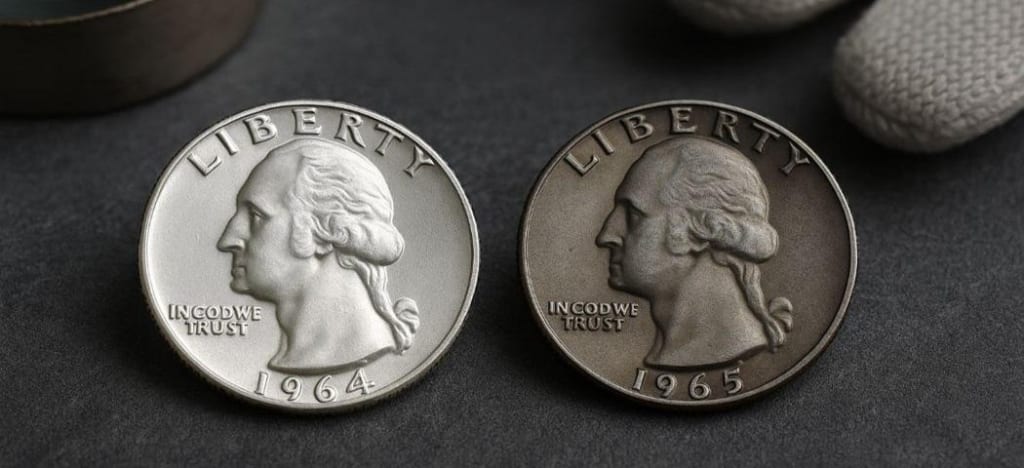
For over eight years as a Senior Numismatic Analyst, few topics generate more excitement and confusion than the legend of the 1965 silver quarter. Collectors often come to me with a glint in their eye, holding a worn 1965 quarter, convinced they've struck it rich. The story is compelling: the U.S. Mint officially stopped making 90% silver quarters after 1964, switching to a copper-nickel clad composition. So, a genuine silver quarter dated 1965 shouldn't exist. Yet, a handful do. This article will cut through the myths, explain the true nature of this "transitional error," and give you the definitive, step-by-step process to separate hopeful fantasy from numismatic reality.
The Historical Context: The End of Silver in Circulation
To understand why a 1965 silver quarter is an error, you must understand the great shift of 1965. Facing a critical silver shortage and the threat of hoarding, the U.S. government ended the production of 90% silver dimes and quarters for general circulation. Starting in 1965, these coins were minted from a copper-nickel clad composition: a core of pure copper sandwiched between two outer layers of a copper-nickel alloy.
This means every quarter dated 1965 should be copper-nickel clad. A quarter from that year made from the old 90% silver planchet is a profound mistake—a transitional error created when a silver blank, leftover from 1964 or incorrectly stockpiled, fed into a press striking 1965-dated dies.
Expert Insight from Laura: The most important principle to remember is this: Authentic 1965 silver quarters are among the rarest of all modern U.S. mint errors. Believed to number fewer than a dozen genuine examples, they are all accounted for and reside in major collections or have been certified by the leading grading services. The coin in your pocket change is astronomically unlikely to be one. Treat any potential find with extreme skepticism and rigorous testing.
The Step-by-Step Guide to Investigation
If you encounter a suspicious 1965 quarter, follow this methodical process. Do not skip steps.
Step 1: The Edge Examination
This is your fastest and most reliable initial test. Pick up the quarter and look at its edge.
- A Clad Quarter (99.99% of 1965 quarters): You will see a distinct brown copper band sandwiched between two outer silver-colored layers. This is the copper core visible at the rim.
- A Silver Quarter (The Legendary Error): The edge will appear solid silver with no copper band whatsoever. It will look identical to the edge of a pre-1965 silver quarter or a modern silver Eagle.
Step 2: The Magnet Test
- A Clad Quarter: Will exhibit a very slight, weak magnetic attraction due to its nickel content. It may stick very faintly or slide slowly down an inclined magnet.
- A Silver Quarter (90% silver): Will be completely non-magnetic. A magnet will not attract it at all. This alone doesn't confirm silver, but it's a necessary pass/fail checkpoint.
Step 3: The Weight and Ping Test
This requires more sensitive tools but is highly indicative.
- Weight: Use a precision scale that measures in grams.
- A clad 1965 quarter should weigh 5.67 grams.
- A 90% silver quarter weighs 6.25 grams. This half-gram difference is noticeable on a good scale.
- Ping Test: Gently tap the coin on its edge with another coin. A silver coin produces a clear, high-frequency ring that lasts for 2-3 seconds. A clad coin produces a duller, shorter "clunk." This takes practice but is a classic test for metal composition.
The Definitive Comparison: Clad vs. Silver
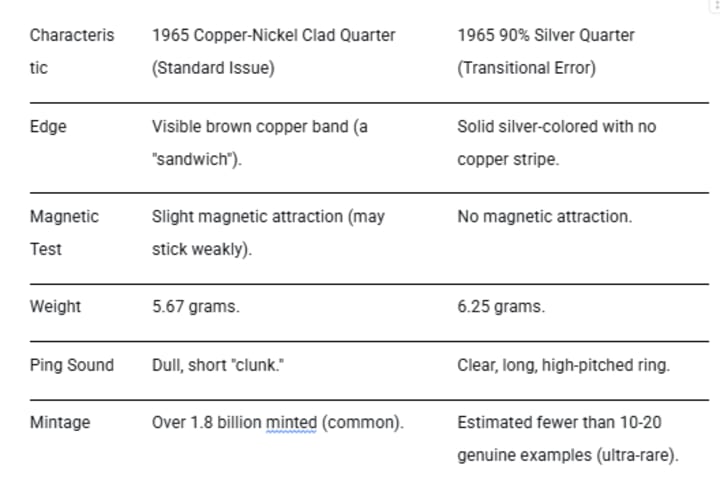
Use this table as your quick-reference diagnostic chart during examination.
The Crucial Final Step: Professional Authentication
If—and only if—your coin has passed every physical test above (solid silver edge, non-magnetic, correct heavier weight), you must seek professional authentication. There is no alternative.
Why It's Essential: Sophisticated counterfeits exist. These include plated coins, altered coins (where a 1964 silver quarter has been re-dated to 1965), or hybrids made from two different coins. Only experts with advanced tools can detect these.
Who to Trust: Submit the coin to either the Professional Coin Grading Service (PCGS) or the Numismatic Guaranty Company (NGC). They will use specific gravity tests, X-ray fluorescence (XRF) analyzers, and microscopic examination to verify the metal content and authenticity of the planchet and strike.
The Reality Check: Be prepared for the overwhelming likelihood that your coin will be returned as "Not Genuine" or as an altered 1964 coin. A genuine 1965 silver quarter grading in even average condition is a six-figure coin. Its discovery would be a major numismatic event.
Conclusion: Embracing the Mystery with a Discerning Eye
The mystery of the 1965 silver quarter is a wonderful part of coin collecting lore. It speaks to a moment of national transition and the fascinating errors that can occur in a massive industrial process. By approaching this mystery not with dreamy hope but with a methodical, evidence-based process, you honor the true rarity of these coins. Use the tests outlined here to satisfy your curiosity. Let them sharpen your skills for identifying other, more accessible errors and varieties. Remember, the true treasure is not necessarily finding a legendary coin, but cultivating the knowledge and discipline of a true numismatist.
FAQ: Unraveling the 1965 Quarter Mystery
I have a 1965 quarter with no mint mark. Is it special?
No. The Philadelphia Mint did not use mint marks on quarters from 1965 through 1967. The absence of a mint mark ("P") is completely normal for this period and does not indicate an error.
Where can I learn more about other modern mint errors?
Reputable online resources include the error coin archives on the PCGS and NGC websites, as well as major numismatic forums where collectors share images and information. For identifying a wide range of coins and their potential errors, a dedicated Coin ID Scanner can be an excellent educational starting point.
What about a 1965 silver dime? Do those exist?
The same transitional error theory applies to dimes. Genuine 1965 silver Roosevelt dimes are believed to be even rarer than the quarters, with perhaps only two or three known examples. Apply the same rigorous testing: check for a solid silver edge (no copper line) and a weight of 2.50 grams instead of the clad weight of 2.27 grams.
My 1965 quarter looks different and is darker. Is it silver?
Color is a very unreliable indicator. Copper-nickel coins can tone to dark browns, blues, and purples. A copper core can become visible on a heavily worn edge. Always rely on the objective tests of edge composition, weight, and magnetism first.
About the Creator
Laura Bennett
Numismatist and data science expert passionate about uncovering the stories behind historical coins through analytics. Bachelor’s degree in Archaeology and a Master’s in Data Science from Harvard University. https://coin-identifier.com/
Keep reading
More stories from Laura Bennett and writers in Education and other communities.
From Bullion to Numismatic: How to Identify and Grade Modern U.S. Commemorative Coins
For over eight years as a Senior Numismatic Analyst, I've witnessed countless collectors reach a fascinating crossroads. They start with bullion coins—valuable for their weight in gold or silver—but eventually feel drawn to coins with a story. This is where the world of modern U.S. commemorative coins opens up, blending precious metal with historical narrative, artistic beauty, and the intricate craft of numismatic grading. Shifting your focus from pure metal content to a coin's condition, rarity, and design is the journey from an investor to a true collector. This guide will equip you with the knowledge to confidently identify, evaluate, and grade these modern treasures.
By Laura Bennett3 days ago in Education
The Most Iconic Moments from Evan Roderick’s Film and Television Journey
Evan Roderick has made an impressive mark in both film and television, delivering performances that reflect authenticity, range, and heart. From emotionally layered dramas to lighthearted romances, he continues to show his versatility and natural ability to connect with audiences. His talent for bringing characters to life has earned him a loyal following and solidified his place as a rising actor to watch. With each new project, Roderick delivers standout moments that linger long after the credits roll.
By Evan Roderick3 days ago in Education
Implications for Custody Arrangements in Early Childhood
Timotheus Homas Abstract Custody arrangements during early childhood can profoundly influence attachment formation and long-term developmental outcomes. This article examines how disruptions in attachment relationships—whether due to custody changes, visitation conflicts, or parental separation—affect emotional, social, and cognitive development. Drawing on empirical research and legal scholarship, the paper argues that family courts often underestimate the developmental risks associated with unstable caregiving environments. By integrating attachment theory with custody jurisprudence, the article advocates for a developmentally informed application of the “best interests of the child” standard that prioritizes relational stability alongside parental rights.
By Emma Wegenasta day ago in Education
Feelings Never Die
It is Valentine's Day again, and it bought back memories that were over fifty years old. It bought me back to 1971, and I woke up and I knew my baby was due today. I was big and pregnant, and I felt like I was about to burst wide open. Imagine my surprise when the doctor told my I had a due date of February 14. I couldn't believe it, and since my baby was due today, I felt I could indulge myself a bit. I had gained a lot of weight, and chocolate was on the no-no list, but I had came to the end of this pregnancy, and I hoped it would be okay, after all I would deliver this baby today. So I walked across the street to the grocery story, and bought myself, a peppermint patty, covered in chocolate, my favorite. Me and my Valentine's baby would enjoy it together.
By Susan Payton2 days ago in Fiction


Comments
There are no comments for this story
Be the first to respond and start the conversation.