
The Man Who Changed the World with His Mind
From a curious child with a compass to the genius who unlocked the secrets of the universe—discover the extraordinary life of Albert Einstein.
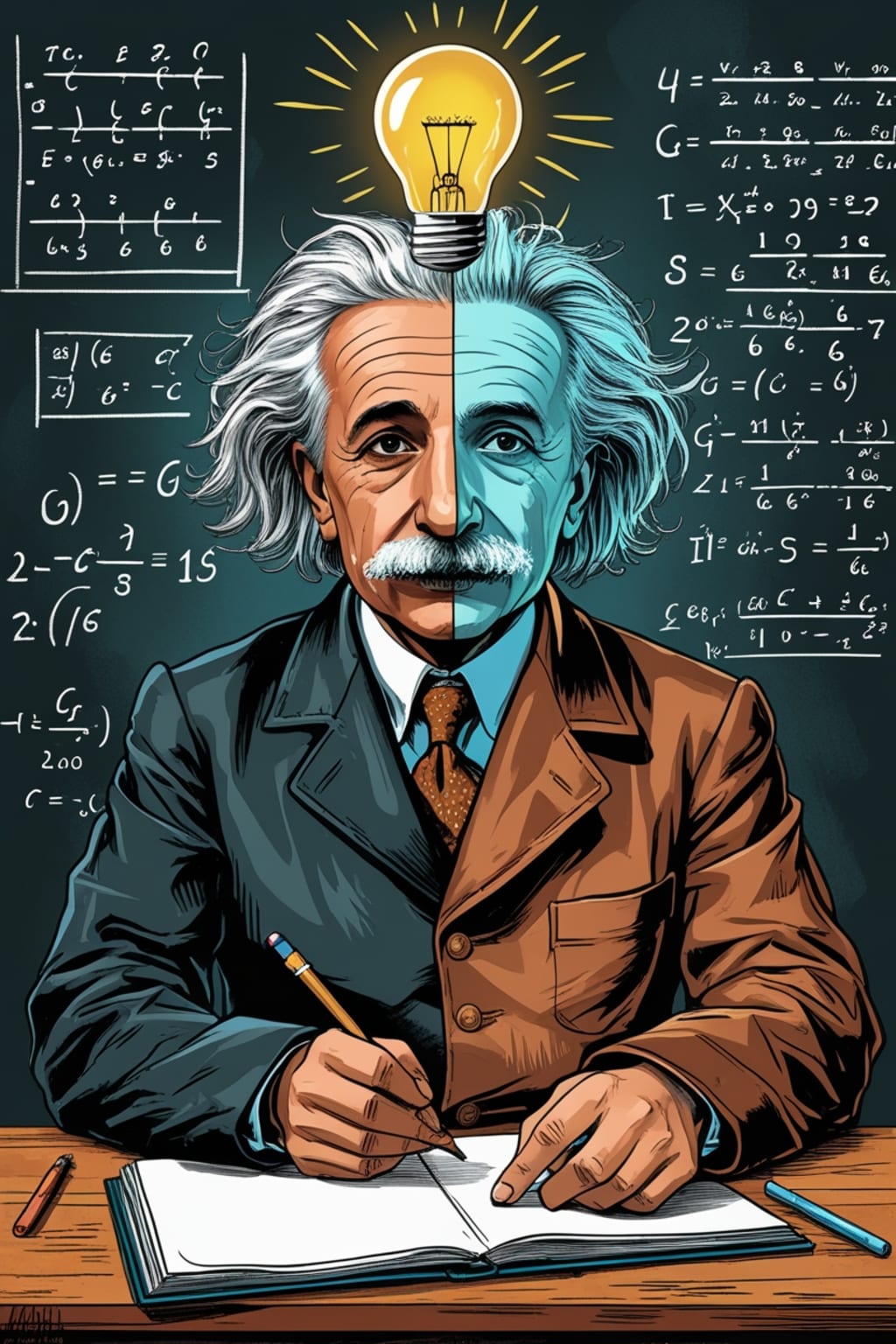
In the small town of Ulm, Germany, in 1879, a baby boy was born who would one day redefine the way we understand the universe. His name was Albert Einstein—a name that would come to symbolize genius itself.
But Einstein’s childhood was far from extraordinary. In fact, he was a slow talker, so much so that his parents worried something might be wrong with him. He didn't speak fluently until he was around nine years old. And in school, he was quiet, independent, and often bored by traditional education. Teachers even called him lazy or distracted.
Yet inside Albert’s mind, something amazing was happening.
From an early age, he had a deep curiosity about the world. When he was five, his father gave him a compass. As he watched the needle always point north, young Albert was fascinated. “What force is moving the needle?” he wondered. That simple gift sparked a lifetime of questioning and exploration.
As a teenager, he taught himself advanced mathematics and read philosophy and science books for fun. But despite his intelligence, Einstein struggled to fit in. He dropped out of school at 15 and later failed the entrance exam to a prestigious engineering school. Still, he didn’t give up.
Eventually, he was accepted into the Swiss Federal Polytechnic in Zurich, where he studied physics and mathematics. After graduating, though, he couldn’t find a teaching job. So, he took a job at the Swiss Patent Office, reviewing applications for new inventions.
That’s where history began to change.
Working a simple 9-to-5 job, Einstein used his free time to dive into the mysteries of the universe. In 1905, at age 26, he published four groundbreaking papers—a year later known as his "Miracle Year". One of those papers introduced the world to the equation that would become the most famous in history:
E = mc²
This small equation revealed something profound: mass and energy are interchangeable. In other words, even a tiny amount of mass can be converted into a huge amount of energy. This idea would later lead to the development of nuclear power—and unfortunately, the atomic bomb.
But Einstein didn’t stop there.
Over the next decades, he developed his Theory of General Relativity, a new way of understanding gravity—not as a force, but as a curve in space and time caused by mass. This theory predicted things like black holes, gravitational waves, and the bending of light from distant stars. At the time, it sounded impossible.
Then, in 1919, a solar eclipse provided the perfect opportunity to test his theory. Astronomers observed light from stars bending around the sun, just as Einstein predicted. Overnight, he became a global celebrity.
But fame didn’t change him.
Einstein used his voice to speak out against war, racism, and inequality. As a Jew, he fled Germany when the Nazis rose to power and moved to the United States. He worked at Princeton University and continued to explore the mysteries of the universe. He also warned world leaders of the dangers of nuclear weapons and advocated for peace.
Even in his final years, Einstein remained deeply curious. He never stopped asking questions. He once said:
“I have no special talents. I am only passionately curious.”
Albert Einstein passed away in 1955, but his legacy lives on. Today, his theories form the foundation of modern physics. Satellites, GPS, lasers, and much of the technology we use daily rely on his ideas.
He showed the world that curiosity, imagination, and a little rebellion against the norm could change the course of history.
Einstein wasn’t just a man of science—he was a philosopher of the universe, a symbol of wonder, and a reminder that even in a quiet mind, there may be a universe waiting to be discovered.
About the Creator
Keep reading
More stories from zakaria khan and writers in Education and other communities.
A Lion's Love Story🦁
The sun bathed the savanna in molten gold as the day began to fade. Tall grasses swayed in the wind, rustling like whispers of forgotten stories. Birds flitted above, calling out their evening songs, and the animals of the plains began their slow return to the coolness of shade. Amid this tranquil beauty stood Kael—the king of the Sunrock Pride.
By zakaria khan10 months ago in Education
Winning Tactics for Building Wealth in Real Estate Investment
Before making any real estate purchase, the most critical step is thorough research. Understanding the local market is more than just browsing listings—it's about identifying economic drivers, population growth, rental demand, and future development plans. By analyzing these trends, investors can identify the areas with the greatest potential for long-term growth and profitability. It’s essential to know which property types are in demand and which tenants or buyers are actively looking for in that specific region.
By Michael O'Sullivan Hamptonabout 18 hours ago in Education


Comments (2)
Great. Keep it up.
good