
The M4A1 Carbine: A Versatile Weapon for the Modern Infantry Soldier
An Overview of the Design, Features, and Capabilities of the M4A1 Carbine
Introduction
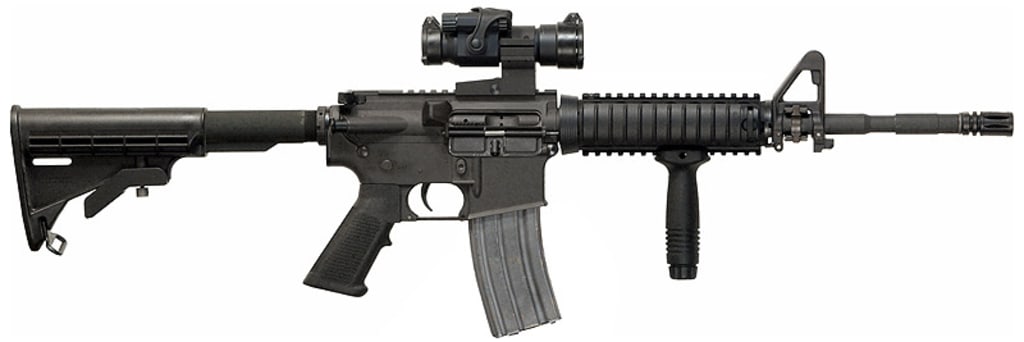
The M4A1 Carbine is a lightweight, compact, and highly portable automatic rifle that has become a standard weapon for infantry soldiers in the U.S. military and many other countries.
Brief history: The M4A1 Carbine is a derivative of the M16 rifle, which was first developed during the Vietnam War. The M4A1 Carbine was introduced in the 1990s as a shorter and more maneuverable alternative to the M16, and has since become the primary weapon of U.S. infantry soldiers. The M4A1 Carbine has undergone numerous updates and improvements over the years, including enhanced accuracy, reliability, and versatility.
Design and Features
Lightweight and portable construction: The M4A1 Carbine is designed to be lightweight and highly portable, making it easier for soldiers to carry and maneuver in the field. The carbine's compact size allows for greater mobility and versatility in close-quarters combat and other tactical situations.
High accuracy and reliability: The M4A1 Carbine is designed to be highly accurate and reliable, with features such as a 14.5-inch barrel, a detachable carry handle, and a collapsible stock. The carbine's gas-operated system, combined with its lightweight construction, results in minimal recoil and improved accuracy.
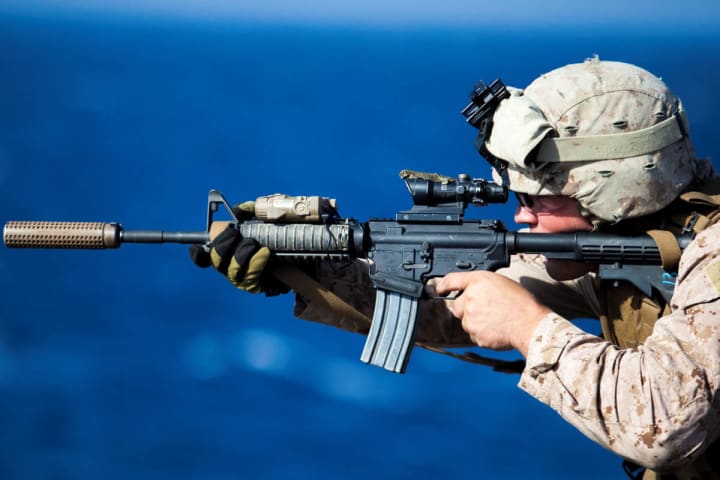
Customizability with accessories and attachments: The M4A1 Carbine is highly customizable, with a wide range of accessories and attachments available to enhance its capabilities. These can include scopes, flashlights, lasers, bipods, and vertical grips, among others. The ability to customize the carbine to meet the specific needs of individual soldiers and missions greatly increases its effectiveness in the field.
Capabilities
Close-quarters combat: The M4A1 Carbine's lightweight and portable design, combined with its high accuracy and reliability, make it an ideal weapon for close-quarters combat situations, such as urban warfare and building clearances. Its compact size allows soldiers to navigate tight spaces and engage targets at close range with minimal exposure.
Medium-range engagements: The M4A1 Carbine is capable of engaging targets at medium ranges, out to around 600 yards, due to its effective sight system and 14.5-inch barrel. Its accuracy and reliability make it a valuable tool for soldiers in a variety of tactical situations, including urban, rural, and jungle environments.
Suppressing fire and support: The M4A1 Carbine's automatic firing capability allows soldiers to provide suppressing fire and support to their comrades in combat situations. The carbine's high rate of fire and low recoil allow soldiers to effectively engage and neutralize enemy targets, providing cover and support to their comrades as they move to their objective.
Advantages over other infantry weapons
Increased mobility and versatility: Compared to other infantry weapons, the M4A1 Carbine offers soldiers increased mobility and versatility on the battlefield. Its lightweight and compact design allows soldiers to move quickly and easily in tight spaces, while its customizability with attachments and accessories allows them to adapt to a variety of combat scenarios.
Improved accuracy and firepower: The M4A1 Carbine's design incorporates a number of features that improve accuracy and firepower over other infantry weapons. This includes its 14.5-inch barrel, effective sight system, and improved reliability, which result in improved accuracy and firepower over a wider range of combat scenarios.
Increased effectiveness in a wider range of combat scenarios: The M4A1 Carbine's combination of mobility, versatility, accuracy, and firepower make it an effective weapon in a wider range of combat scenarios, including close-quarters combat, medium-range engagements, and suppressing fire and support. This versatility and effectiveness make the M4A1 Carbine a valuable asset to infantry soldiers on the battlefield.
Training and Use
Training requirements for soldiers: The use of the M4A1 Carbine requires a significant amount of training for soldiers to effectively operate and utilize its capabilities. This includes training in proper handling and maintenance, marksmanship, and tactical employment of the weapon in various combat scenarios.
Integration with other weapons systems: The M4A1 Carbine is designed to be used in conjunction with other weapons systems, such as night-vision devices, laser aiming systems, and grenade launchers, to enhance its capabilities and effectiveness on the battlefield.
Use in real-world combat operations: The M4A1 Carbine has been widely used by the U.S. military and other armed forces in a variety of real-world combat operations, including Operation Enduring Freedom, Operation Iraqi Freedom, and Operation Inherent Resolve. Its versatility, accuracy, and firepower have made it a valuable asset to soldiers in these operations, and it has proven to be an effective weapon in a wide range of combat scenarios.
Conclusion
Summary of key points: The M4A1 Carbine is a lightweight, portable, and highly accurate rifle used by infantry soldiers. It is designed for close-quarters combat, medium-range engagements, and suppressing fire and support. It offers increased mobility, versatility, accuracy, and firepower compared to other infantry weapons. The M4A1 Carbine requires extensive training for soldiers and is used in real-world combat operations.
Importance of the M4A1 Carbine in modern warfare: The M4A1 Carbine has proven to be a valuable asset to infantry soldiers in modern warfare, providing increased mobility, versatility, and firepower. Its versatility and effectiveness have made it a popular choice for many armed forces around the world.
Future developments and improvements in the M4A1 Carbine and other infantry weapons: The M4A1 Carbine and other infantry weapons will continue to evolve and improve, incorporating new technologies, materials, and design elements to enhance their capabilities and performance. Advances in materials science, electronics, and weapons engineering will likely lead to lighter, more accurate, and more effective infantry weapons in the future.
About the Creator
THE SPHERICAL SPACETIME - ALEXIS KARPOUZOS
I. The Question of a Spacetime without Centre From Aristotle to Kant, Western philosophy approached space and time primarily as conditions of the possibility of experience or as properties of reality. In the Aristotelian tradition, space is defined topologically — as the place of bodies — and time arithmetically — as 'the number of motions with respect to before and after'. In Kantian critical philosophy, space and time become a priori forms of intuition, transcendental conditions of all phenomenal experience. Yet in both traditions a common assumption is preserved: space and time are structures that organise phenomena from a — however implicit — centre of reference. Alexis Karpouzos radically challenges this assumption. The Spherical Spacetime he introduces is neither place nor intuition; it is a dynamic ontological structure that refuses every privileged point of reference, every external centre, every principle that precedes the very movement of the world. The question posed from the outset is this: what does it mean to think a spacetime that does not 'contain' beings but is the very manner in which beings are? And what ontological consequences does this displacement carry for the understanding of existence, consciousness, and truth?
By alexis karpouzosa day ago in Education
Peter Ayolov’s Publications
Peter Ayolov is a media theorist and lecturer at Sofia University 'St. Kliment Ohridski', Faculty of Journalism and Mass Communication. His research focuses on the political economy of communication, propaganda models, digital media, narrative structures, and the transformation of language in contemporary technological environments. His work examines how digital communication systems organise dissent, amplify outrage, and reshape the relationship between media, public opinion, and political power.
By Peter Ayolov4 days ago in Education




Comments
There are no comments for this story
Be the first to respond and start the conversation.