
The Life Story of Albert Einstein
Einstein's early childhood, speech delay, and curious nature.
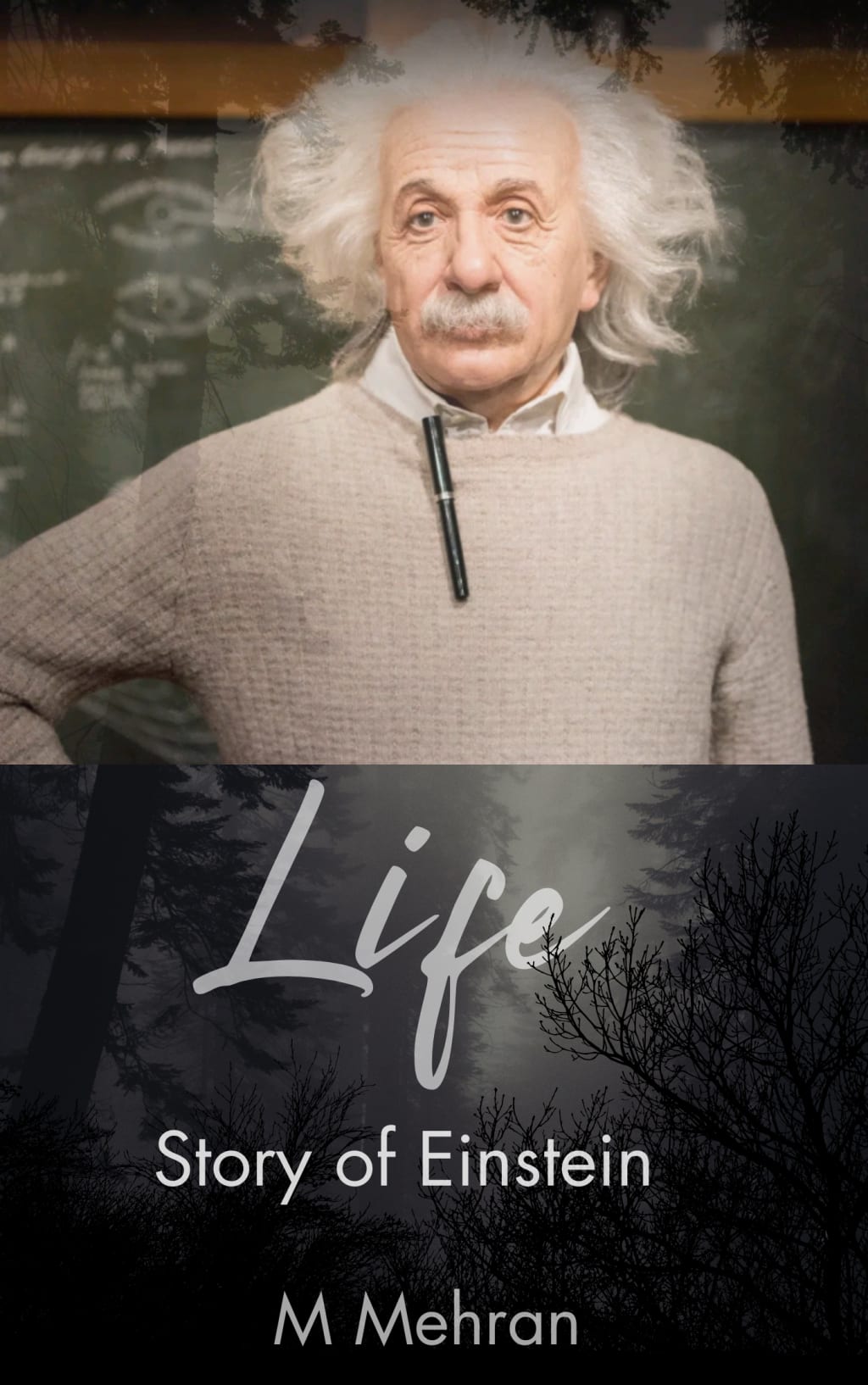
M Mehran
A Journey Through the Mind of a Genius
Albert Einstein, born on March 14, 1879, in Ulm, Germany, is widely regarded as one of the most brilliant minds in history. But his journey was far from smooth or conventional. Raised in a secular Jewish family, his early life offered little hint that he would one day revolutionize modern physics.
From a young age, Einstein showed a quiet but intense curiosity about the world. He spoke late—so late that his parents were concerned. Even as a schoolboy in Munich, Einstein resisted rigid authority and traditional teaching methods. He often clashed with teachers who demanded obedience rather than questioning. But he found joy in solving complex math problems and exploring scientific concepts. A key moment came when he was introduced to a book on geometry; it sparked a lifelong fascination with mathematics and the structure of the universe.
In his teens, Einstein’s family moved to Italy for work. Soon after, he renounced his German citizenship and enrolled at the Swiss Federal Polytechnic in Zurich. There, he met Mileva Marić, a fellow student and future wife. Einstein graduated in 1900, but due to his rebellious attitude and lack of recommendations, he struggled to find an academic position. Eventually, he took a job as a technical assistant at the Swiss Patent Office in Bern.
Though it seemed far from the scientific world, the patent office offered Einstein time to think, reflect, and write. In 1905, he published four groundbreaking papers that would change science forever. This period is known as his “Annus Mirabilis” or “Miracle Year.” One paper introduced the special theory of relativity, proposing that time and space are not absolute. Another explained the photoelectric effect, which provided crucial evidence for quantum theory. A third offered a new way to understand Brownian motion, helping confirm the existence of atoms. The fourth, perhaps the most famous, introduced the equation E = mc², revealing that energy and mass are interchangeable.
As these ideas spread, Einstein became a rising star in the scientific community. In 1909, he left the patent office and began teaching at various universities, eventually returning to Germany to become a professor in Berlin. By 1915, he had developed the general theory of relativity, which redefined gravity as the warping of space and time by mass and energy. In 1919, this theory was confirmed during a solar eclipse when light from stars was observed to bend around the sun—a stunning verification of his predictions. The world hailed Einstein as a genius.
Yet Einstein remained humble and reflective. Fame never swayed him from his personal values. He became increasingly active in political and humanitarian causes. He opposed militarism, supported civil rights, and spoke against racism and nationalism. He once said, “Nationalism is an infantile disease. It is the measles of mankind.”
In his personal life, however, Einstein faced challenges. His marriage to Mileva Marić deteriorated, and they divorced in 1919. He later married his cousin, Elsa Löwenthal. He had two sons, Hans Albert and Eduard. Eduard suffered from mental illness and spent much of his life in psychiatric care, a tragedy that deeply affected Einstein.
As a Jew in Germany during the rise of Adolf Hitler, Einstein became a target of Nazi hatred. In 1933, while visiting the United States, he decided not to return to Germany. He took a position at the Institute for Advanced Study in Princeton, New Jersey, where he remained until his death.
During World War II, Einstein—though a lifelong pacifist—was alarmed by reports that Nazi Germany was developing atomic weapons. He signed a letter to President Franklin D. Roosevelt urging the U.S. to explore nuclear research, which played a role in launching the Manhattan Project. Einstein did not work on the bomb itself and later expressed deep regret over his involvement.
In his later years, Einstein focused on unifying the forces of nature into one “unified field theory,” but the work remained unfinished. He declined offers to become president of Israel in 1952, saying he lacked the political skills required.
Albert Einstein died on April 18, 1955, from an abdominal aneurysm. Even in his final hours, he was working on scientific notes. His brain was removed for scientific study—sparking debate for decades—but what truly mattered was not the physical organ, but the legacy of thought and discovery he left behind.
Einstein’s contributions laid the foundation for much of modern physics. Yet beyond the equations, he left a powerful legacy as a thinker who dared to challenge the norms, a humanitarian who spoke for justice, and a philosopher who pondered the mysteries of existence.
He once remarked, “Try not to become a man of success, but rather try to become a man of value.”
Albert Einstein was, undoubtedly, both.
About the Creator
What to Eat (And Avoid) During Colon Cancer Treatment: A Nutritionist-Approved Guide
When undergoing colon cancer treatment, your diet is more important than ever. The right nutrition can support your immune system, reduce side effects, and even enhance the effectiveness of treatments like chemotherapy and radiation. But knowing what to eat and what to avoid can be overwhelming.
By Erika Phillips 4 days ago in Education
Hands of Hope: The Impact of Volunteer Service in Faith-Based Communities
Faith is often expressed through prayer and reflection, but its true strength is revealed through action. Volunteers play a vital role in translating belief into meaningful service, helping churches grow and positively influence the communities around them. Through dedication, compassion, and teamwork, volunteers become the driving force behind outreach, support, and connection. Their efforts demonstrate how service rooted in faith can create lasting change.
By Mike Signorelli5 days ago in Education




Comments
There are no comments for this story
Be the first to respond and start the conversation.