
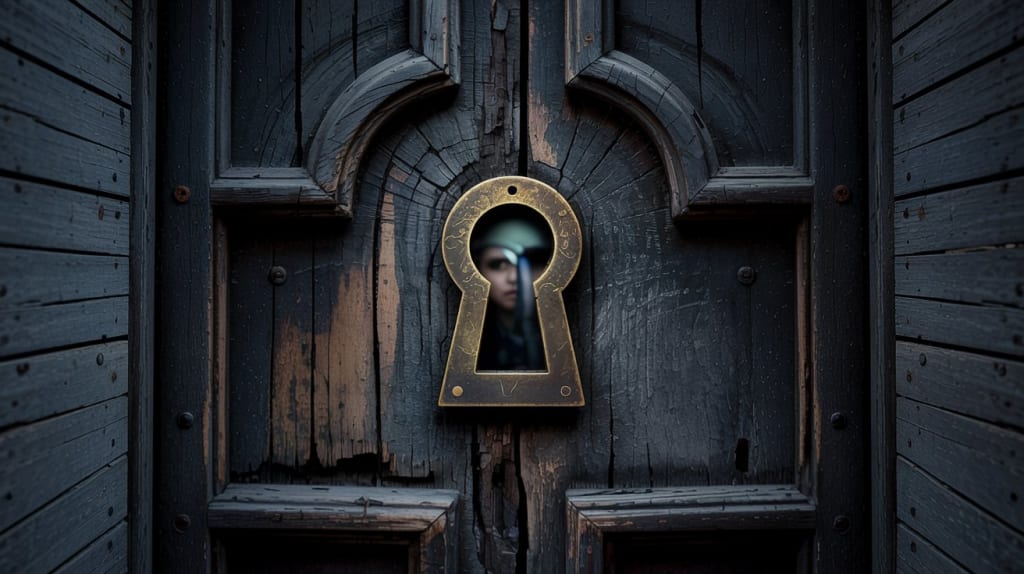
They told Elara the manor was condemned. Locals called it "Welling House," but only in whispers, like the very name could summon something dark. Still, when the letter arrived—parchment sealed with wax and bearing her grandmother’s looping, unmistakable handwriting—Elara boarded the first train north.
The letter was brief.
"Elara, if this finds you, come to Welling House. You must find the last keyhole. Before they do."
— Grandmother
Her grandmother had been dead for three years.
The house stood alone at the edge of a cliff, leaning into the wind like a memory trying to hold itself together. Ivy strangled its stone walls. Its windows were blacked-out mirrors. Elara stood before it, suitcase in hand, coat flapping in the wind, and wondered if she’d made a mistake.
Inside, dust moved like fog. The silence pressed in with the weight of old memories. She ran her fingers over the wood-paneled walls, feeling the grooves of carved patterns—circles, spirals, vines curling into symbols. A grandfather clock, long stopped, stood at the end of the hall. Time had abandoned this place.
But something remained.
Elara hadn’t been here since she was eight, when her grandmother still walked these halls in silk slippers, humming songs no one else knew. That summer had ended with her parents dying in a fire, and Elara being sent to an orphanage. No one spoke of the house again.
Now, it was whispering to her.
In the library, dust-covered books lined every wall. A portrait of her grandmother, younger and sterner than she remembered, stared down from above the fireplace. On the table sat a rusted iron key, long and ornate. Not new—but freshly placed.
She picked it up. Heavy. Cold.
It had the number 13 engraved at the base.
The next few hours were a maze of exploration. Every room had a door. Every door had a keyhole. But none fit.
She found herself drawn to the east wing, where the wallpaper peeled like skin and the floors moaned under her feet. At the end of a narrow corridor, half-obscured by a velvet curtain, she found it.
A door unlike the rest.
Smaller. Older. Built of ironwood with unfamiliar symbols carved into its surface. It had no handle, only a single keyhole. And it fit the key perfectly.
Her heart pounded as she turned it.
The lock clicked—soft but final, like a secret giving up. The door creaked open.
Inside was a study, perfectly preserved. No dust. No decay. The air was warm. A fire burned in the hearth. And seated at the desk, quill in hand, was her grandmother.
“Elara,” the old woman said without looking up. “You came.”
Elara couldn’t breathe. “You’re dead.”
Her grandmother finally looked up. Her eyes shimmered, like candlelight seen through water. “Not here,” she said. “This room is protected. Time does not pass as it does outside.”
“I—I don’t understand.”
“You will,” her grandmother said. “Sit. We don’t have long.”
Elara stepped into the room. The door shut behind her with a whisper. Her grandmother passed her a sheet of parchment.
"The house is alive, Elara. It remembers. It listens. And it keeps secrets."
"They are trying to breach it from the outside. To take what is hidden."
"Only a blood heir can unlock the last keyhole."
"And once opened, it must be sealed again—from within."
Elara looked up. “What’s hidden?”
“The truth. And the danger that comes with it.” Her grandmother stood slowly. “There’s a reason the world forgets Welling House. It’s not just stone. It’s a gate.”
“To where?”
“Not where,” her grandmother said softly. “When.”
Suddenly, Elara felt it—a hum beneath the floorboards, a thrum like a pulse in the walls. The patterns on the paneling began to move, swirling. The house was waking up.
“They’ve found us,” her grandmother whispered. “You must go to the heart.”
“How?”
“Follow the sound. The ticking. There is still one clock that runs.”
Elara ran through the house, the firelight of the sealed room already a memory. The halls stretched. Doors shifted. But she heard it—tick, tick, tick—faint and rhythmic, guiding her downward, ever deeper.
The basement was colder. Stone walls slick with moisture. Pipes ran like veins overhead. The ticking grew louder.
She came to a vault-like door.
One more keyhole. But this time, the key was her.
A drop of her blood on the metal made the mechanism shift. The vault opened with a hiss of breath.
Inside, a spherical chamber. In its center: a grand clock, taller than any human, its hands spinning both ways, forward and back. Beneath it, a pit of swirling light and shadow—like a whirlpool made of memories.
This was the heart.
A voice behind her: “You opened it. Good.”
Elara turned. A man stood there, pale, ageless, his eyes too dark.
“You’re not from here,” she whispered.
“No,” he said. “And thanks to you, I no longer need an invitation.”
He stepped toward the clock.
Elara ran.
She didn’t think—she leapt into the light.
When she awoke, she was back in the study. Alone. Dust-covered once more. The fire long cold. In her hand, the key was now broken.
Outside the study door, everything was silent.
Elara stood. She walked to the hall, and noticed something had changed.
The house was different. Warmer. Quieter. The ticking had stopped.
She’d sealed the gate.
And now… she was its keeper.
About the Creator
Rabbi Ilan Glazer on the Ethics of Belonging, Conflict, and Community in Jewish Life
Rabbi Ilan Glazer is a Jewish clergy leader whose work centers on community, ethics, and ritual life. He has served in congregational settings, including a synagogue in Memphis, Tennessee, and has also worked in non-congregational rabbinic roles. Drawing on experience in Israel and the United States, he reflects on how communities balance welcome and boundaries, manage conflict, and build accountability. Glazer speaks candidly about power dynamics, professional burnout, and the pressures of constant digital access. He emphasizes Shabbat as an anchor of Jewish time and highlights b'tzelem Elohim as a guiding ethic of human dignity in contemporary synagogue life today.
By Scott Douglas Jacobsenabout 6 hours ago in Education
Ludacris and Nelly draw backlash over bookings at MAGA-coded music festival
Ludacris and Nelly headlining a mostly right-wing event is good for them. It’s also great for the genre of hip hop. The two rap veterans have showcased their talents on other stages. Why can’t they perform for mostly MAGA folks and grab that bag?
By Skyler Saunders5 days ago in Beat


Comments
There are no comments for this story
Be the first to respond and start the conversation.