
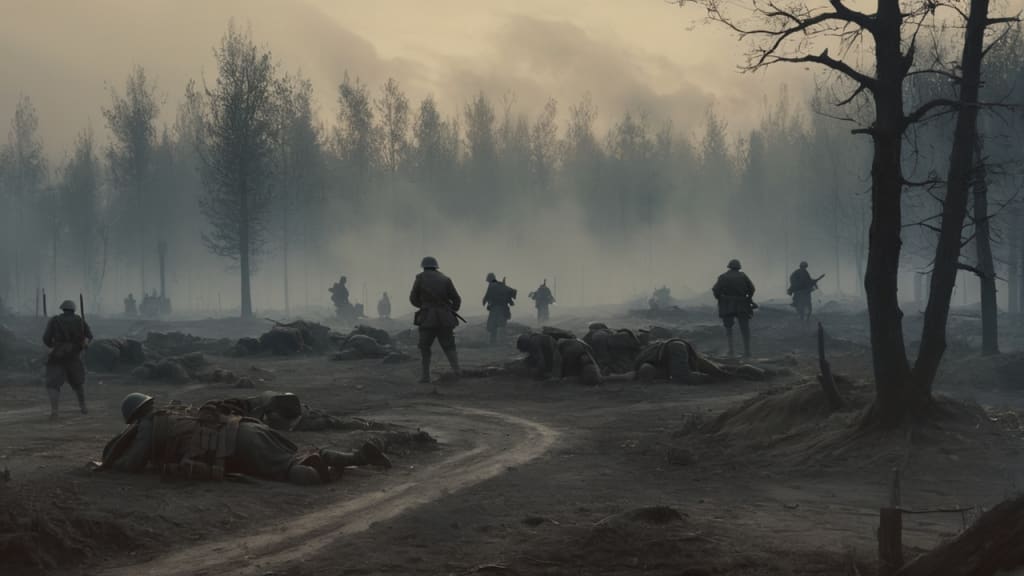
Verdun, France – November 12th, 1916
The mud was worse today. Clinging to boots, to legs, to rifles. Like the earth itself was trying to pull them under. Private Henri Marchand paused in the narrow trench, clutching a small tin box to his chest with gloved hands. His breath ghosted into the cold air, and in the still moment between artillery booms, he imagined he could hear the leaves falling in his mother’s garden back in Lyon.
Inside the tin box were his letters. Not from home—those stopped coming in July—but to her. Every Sunday, even when shells screamed overhead, he wrote. Letters to Élise, the girl who never wrote back.
Lyon – February 1915
They had met in the early days of the war, when uniforms were crisp and farewells were still full of hope. Henri had delivered a telegram to her family shop. Her hands had smelled of lavender and paper ink. He remembered the ink smudge on her cheek, the way she tilted her head when she spoke.
He never told her how deeply he fell.
He enlisted a week later. She gave him a scarf and a smile. He promised to write.
And write he did—every trench, every transfer, every time he nearly died.
Verdun – November 14th, 1916
The letters had never been sent. The field post was unreliable, and besides—Henri feared they were too much. Too honest. So he kept them. Folded them into the tin. A record of what the war was doing to him. A memory of who he had once been.
That morning, a new recruit took a bullet to the throat ten feet from him. Henri didn't flinch. Just pulled out his notebook and wrote again.
“Élise,
They say there is no silence here, but I find it in small things. The pause after a shell. The way frost settles on the helmets of the fallen. I wonder if you still bake on Sundays. If your window still glows yellow at dusk. The memory of your hands keeps me human.”
When the shell hit, Henri was thrown like a rag doll. His head struck something hard, and everything turned white.
Lyon – July 1921
Élise Rousseau stood in the garden behind her family’s shop, clutching a battered envelope in both hands. Her father had found it among old military belongings sent to the shop to be discarded or repurposed. The tin box had been inside a torn haversack labeled: Pvt. Henri Marchand.
She hadn’t heard that name in five years.
Inside were seventeen letters.
All written to her.
All never sent.
Her knees gave out on the bench. Her breath caught on a sob she hadn’t known was still inside her. The war had taken so much. Her brother. Her cousins. Half the boys from their school. But Henri… Henri had been the one she never allowed herself to grieve. He’d left before she realized what she felt. Before she could say:
“Stay.”
Verdun – November 1916
Henri awoke in a makeshift hospital. Half his face bandaged. Ears ringing. The war had taken part of his hearing and most of his memory. Names came slow. Places slower. His notebook was gone. The tin box too.
He was told he’d been found under a collapsed trench, barely alive, no identification on him. No letters. No hope of returning to his unit.
So they called him “Jacques”, gave him new papers, and moved him through recovery like so many others.
The war ended.
Henri Marchand disappeared.
Lyon – August 1921
Élise couldn’t stop reading the letters.
Some were short and factual. Others poetic and raw.
One in particular made her hands tremble:
“Élise,
If I don’t come back, know this: I loved you in silence, in smoke, in fear. I loved you when rats chewed through my boots and bombs fell like rain. I loved you when I forgot my own name in the screams. I loved you so fiercely, it gave me something the war couldn’t steal.
If these letters ever find you, it means I didn’t. Forgive me.”
She pressed the letter to her chest.
She had to know. Even if it had been years.
Verdun – September 1921
The veteran home on the edge of town was quiet, filled with forgotten men. One in particular sat by the window, always sketching. He didn’t speak much, but sometimes he hummed. The nurse told Élise he’d come from the trenches at Verdun, wounded and amnesiac. Called himself Jacques.
She walked into the room slowly.
He didn’t look up at first. Just kept sketching a field of poppies. She stepped closer. Her heart racing.
“Henri?” she whispered.
He looked at her then.
His eyes were the same. Haunted, yes. Older. But hers.
“Do I… know you?” he asked, his voice rough.
Tears filled her eyes. She held out the tin box. “You did once.”
Lyon – Winter 1921
It didn’t all return at once.
Pieces came in fragments. A smell. A song. A touch.
They read the letters together, night after night. Élise filled in the blanks. Henri filled her bakery with laughter again. Slowly, gently, they rebuilt what had been lost.
Not everything was remembered. But what mattered was never forgotten.
Final Letter – Undated, Found in the Tin
To whoever finds this,
War tries to erase us. Names, faces, hopes. But love—real love—is stubborn. It lingers in ink, in bread dough, in scarred hands and sleepless nights. These letters are not just from a soldier. They are from a man who refused to forget what he was fighting for.
And if you’re reading this, maybe that means we’ve won something after all.
—Henri Marchand
The End
About the Creator
What Real Residents Reveal About Co-Living in New York City
Finding housing in New York City can be overwhelming, especially for students, interns, and professionals moving from different parts of the world. While listings and pricing matter, real-life experiences often give the clearest picture of what living in a shared space is actually like. Looking at resident reviews can help uncover what truly makes a co-living experience successful—or challenging.
By Ausfab Groupabout 21 hours ago in Education
Top 10 Essential Skills for Success in 2026
By 2026, the job market is no longer driven only by degrees or titles. Technology, especially Artificial Intelligence (AI), automation, and remote work, has changed how companies operate and how people work. Many routine tasks are now handled by machines, while humans are expected to do work that requires thinking, judgment, creativity, and emotional understanding. This shift means that skills — not just education — determine success. The following 10 skills are considered essential for 2026 because they combine technology awareness with human intelligence. Let’s understand them one by one, step by step.
By Talha khan7 days ago in Education
The Devil's Cut
“Comrade, finally you’re awake.” The voice was smooth, sensual. A flickering incandescent bar was all that lit the white, sterile room. All Vladimir remembered was everything going black. He tried to move his arms and found them strapped to the gurney.
By Matthew J. Fromm6 days ago in Fiction



Comments
There are no comments for this story
Be the first to respond and start the conversation.