
The Immortal Jellyfish: Nature’s Time Traveler
Turritopsis dohrnii’s Enigmatic Cycle of Rejuvenation Challenges the Boundaries of Biological Aging


The Immortal Jellyfish: Nature’s Time Traveler
Deep in the ocean, where countless creatures are born, live, and die, one tiny jellyfish has found a way to bend the rules of life itself. Turritopsis dohrnii, better known as the immortal jellyfish, has captured the imagination of scientists and nature lovers because of its ability to seemingly escape aging.

This jellyfish is small just about 4.5 millimeters across yet striking, with a clear, bell-shaped body, delicate white tentacles, and a bright red digestive system at its center. Originally from the Mediterranean Sea, it has now spread to many parts of the world by hitching rides in ships’ ballast water, quietly appearing in coastal waters from North America to Japan.
A Familiar Start in Life
Like other jellyfish, T. dohrnii goes through a typical cnidarian life cycle. It starts as a tiny free-swimming larva that settles on the ocean floor, forming a polyp. This polyp looks like a small tube and can bud off identical jellyfish, called medusae. Within a few weeks, these medusae grow into adults capable of reproduction, releasing eggs and sperm into the water.
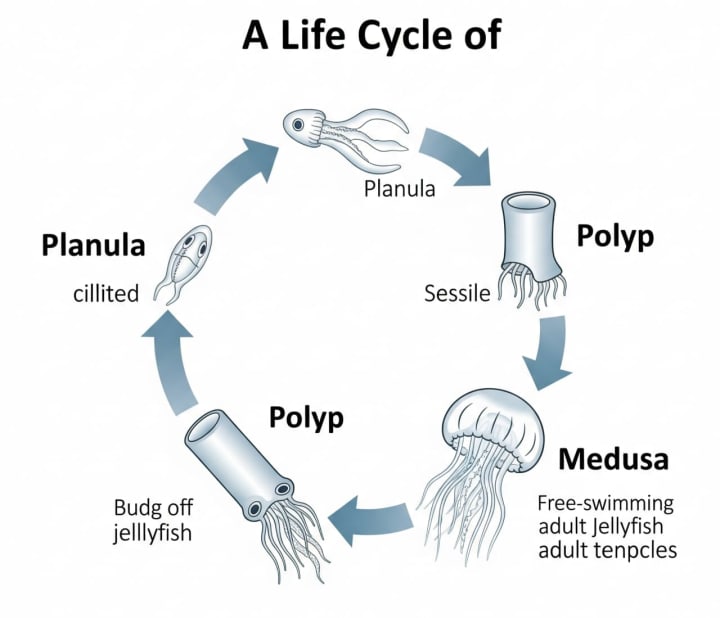
As predators, they hunt zooplankton, fish eggs, and small mollusks, using their stinging tentacles to paralyze prey before digesting it. In this way, they play their part in the food web just like any other jellyfish.
What Makes It Immortal?
The real wonder begins when life gets tough. While most creatures age and weaken, T. dohrnii has a remarkable trick up its sleeve. When injured, starving, or stressed, instead of dying, the jellyfish undergoes transdifferentiation a process where its specialized cells return to a more flexible, stem cell like state.
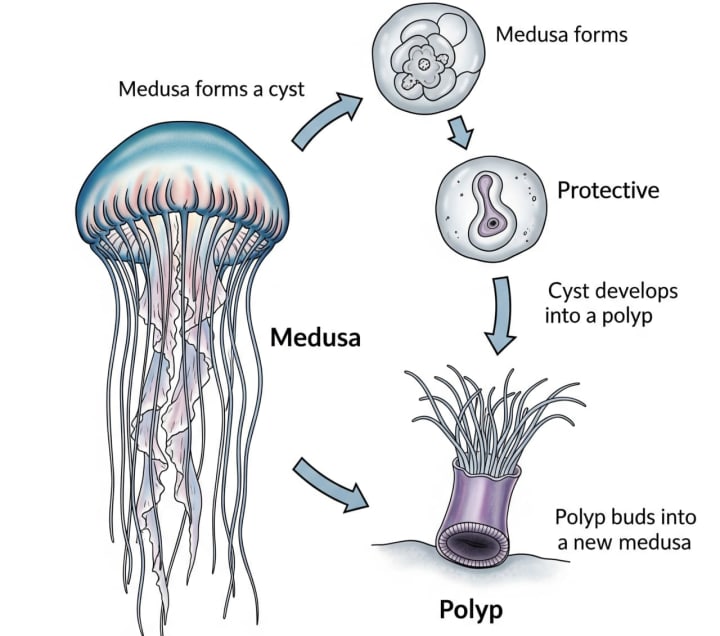
In simple terms, it rewinds its body. The medusa transforms into a cyst-like ball, which then develops back into a young polyp. From there, it can grow into a new adult jellyfish, essentially starting its life over again. Scientists sometimes describe it as pressing the reset button on aging. Of course, this doesn’t make the jellyfish truly immortal. Predators such as fish, turtles, and sea anemones can still eat it, and harsh environments can wipe it out. But biologically, it has the ability to live indefinitely by cycling between life stages.
A Window into Human Health
Although the immortal jellyfish has been known to science since the 1800s, its unique ability was discovered by accident in the 1980s. Since then, it has become a model species for studying aging and regeneration.
Genetic studies reveal that during its transformation, certain genes switch on genes that repair DNA, control cell growth, and maintain genome stability. These processes are also linked to how aging happens in humans. For example, pathways related to stem cell behavior, tissue repair, and even cancer regulation is all active during the jellyfish’s life reset. This is why scientists are fascinated. If we can understand how T. dohrnii rejuvenates itself, the knowledge might one day help humans slow down aging, repair damaged tissues, or even treat age-related diseases like Alzheimer’s. While we are far from achieving immortality, the jellyfish shows that nature already holds clues to making life last longer and healthier.
Lessons From the Ocean
In the bigger picture, the immortal jellyfish reminds us of the creativity of evolution. While most species follow the same birth-to-death cycle, this little hydrozoan has found a loophole. Even though it faces predators and challenges like any other animal, its unique biology challenges our view of aging as something inevitable. As researchers continue to study its genome, the immortal jellyfish may help unlock secrets not just about life in the sea, but about the future of human health. It stands as a symbol of resilience and renewal, proving that sometimes the smallest creatures can teach us the biggest lessons about life, death, and everything in between.
About the Creator
Muzamil khan
🔬✨ I simplify science & tech, turning complex ideas into engaging reads. 📚 Sometimes, I weave short stories that spark curiosity & imagination. 🚀💡 Facts meet creativity here!
Keep reading
More stories from Muzamil khan and writers in Education and other communities.
Gut Flora: The Tiny “Second Brain” in Your Stomach That Controls Mood & Health
The Human Gut Microbiome: Our “Second Brain” The human gut is home to trillions of tiny organisms bacteria, viruses, fungi, and even archaea. Together, these microorganisms form the gut microbiome, a complex community that lives mainly in our intestines. Far from being just “passengers,” they play a vital role in keeping us healthy. Scientists even call the gut the “second brain” because it communicates closely with our nervous system, affecting not only digestion but also mood, memory, and overall well-being.
By Muzamil khan7 months ago in Education
Precision in Motion: The Rise of Sport Shooting and Firearms in Modern Competition
Sport shooting has grown from a simple test of aim into a structured sport that demands discipline, patience, and technical skill. Today, sport shooting and firearms play a major role in global competitions, training programs, and recreational events. Athletes train for years to improve accuracy and control. They study equipment, posture, breathing, and focus. Because of this dedication, sport shooting has become a respected sport that rewards precision and calm thinking.
By Matthew Pothoff3 days ago in Education
NCLEX Study Plan: A Step-by-Step Guide for Nursing Students
Preparing for the NCLEX-RN is one of the most important milestones in the nursing students’ career. This is because the NCLEX is the final step before nursing students can become licensed nurses. However, it is not as easy as simply reading nursing textbooks and taking notes from class lectures. This is because the NCLEX is designed to test the nursing students’ clinical judgment and decision-making skills.
By Sulcus Learning5 days ago in Education




Comments
There are no comments for this story
Be the first to respond and start the conversation.