
The Hidden Source of Energy on the Dwarf Planet Ceres
Space

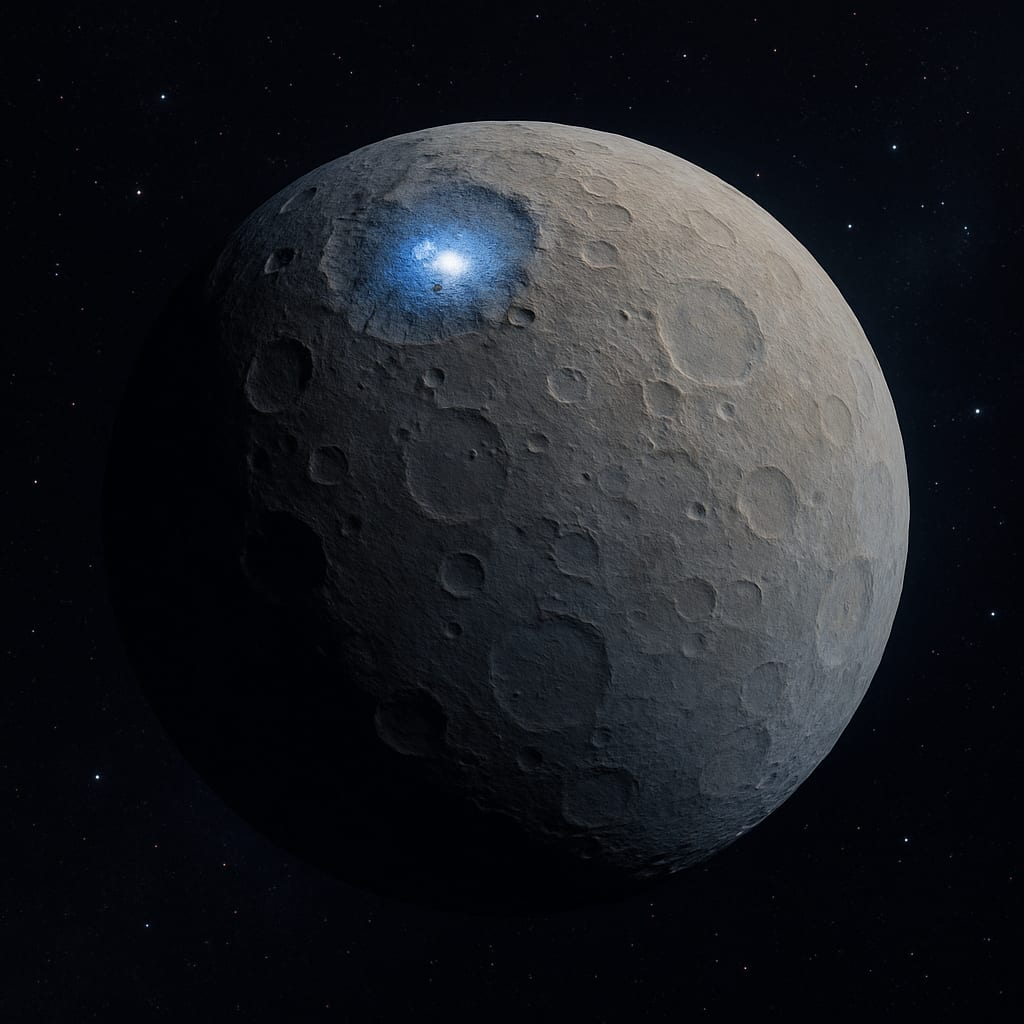
At first glance, Ceres might not look like much. This dwarf planet, tucked away in the asteroid belt between Mars and Jupiter, seems like a quiet, frozen relic of the early Solar System. Barely 590 miles (940 kilometers) across, it is smaller than our Moon and covered in craters, scars from countless impacts over billions of years. Yet beneath its modest surface, Ceres hides a fascinating story. NASA research suggests that the planet once had a hidden nuclear heart—an inner source of heat that could have powered a subsurface ocean for eons, and perhaps even offered a temporary cradle for life.
A Nuclear Heart in a Small World
When NASA’s Dawn spacecraft orbited Ceres between 2015 and 2018, it revolutionized our view of this tiny world. The data showed something surprising: Ceres had retained internal heat far longer than expected. Typically, smaller bodies cool rapidly after their formation, becoming geologically “dead.” But Ceres defied that rule.
The secret lies in radiogenic heating. Just like Earth, Ceres contained radioactive elements such as uranium, thorium, and potassium. As these elements decayed over billions of years, they released energy, keeping the planet’s interior warmer than expected. Scientists now believe Ceres once had, and may still partially retain, a warm core—a sort of nuclear engine at its center.
This discovery is remarkable because it challenges our assumptions about what small planetary bodies can do. If Ceres, with its modest size, can hold onto heat for billions of years, perhaps other dwarf planets and large asteroids could as well. That opens new possibilities for where we might find environments suitable for life.
The Case for a Subsurface Ocean
So what does a warm interior mean for Ceres? The answer may lie beneath its icy crust. Models suggest that heat from Ceres’ radioactive core could have maintained a layer of liquid water, shielded from the cold vacuum of space by a shell of ice and rock. This subsurface ocean might have existed for millions, or even billions, of years.
Clues to this ancient ocean appear on the surface itself. The Dawn mission revealed bright, reflective patches scattered across Ceres’ craters—most famously in Occator Crater. These bright spots turned out to be salt deposits, left behind when briny water from below seeped upward, evaporated, and crystallized. It is as if the planet’s interior once pushed its salty tears to the surface, leaving shining scars of an underground ocean that may still linger in part today.
The chemistry of that water is also intriguing. Ceres’ brines appear to be rich in salts and ammonia, both of which can lower the freezing point of water. This makes liquid water more stable underground, even at temperatures where pure water would freeze solid.
Could Life Have Found a Home?
For astrobiologists, the combination of liquid water, chemical activity, and internal heat is tantalizing. These are the very ingredients considered essential for life as we know it. On Earth, we see microbes thriving in extreme environments—from deep-ocean hydrothermal vents to frozen Antarctic lakes. If life can survive there, why not in the hidden seas of Ceres?
Of course, this doesn’t mean Ceres teemed with alien organisms. The conditions may never have lasted long enough, or been complex enough, for life to arise. But the possibility is enough to make Ceres one of the most intriguing astrobiological targets in the inner Solar System. And importantly, it is much closer to us than icy moons like Europa or Enceladus. In theory, future missions could more easily test the chemistry of its surface and search for organic molecules that hint at biology.
What the Future Holds
For now, Ceres remains silent. The Dawn mission ended in 2018, leaving us with tantalizing data but many unanswered questions. Did the subsurface ocean still exist in some form today? Could dormant microbes be hidden beneath its crust? Might new activity bring more salty water to the surface over time?
Future missions may give us answers. Scientists have proposed landers or drills that could directly sample Ceres’ subsurface, perhaps even tapping into those ancient briny reservoirs. If such a mission confirms that liquid water and organic chemistry coexisted there, it would revolutionize our understanding of how widespread habitable environments can be in the Solar System.
A World of Big Mysteries in a Small Package
Ceres is a reminder that size is not destiny. Though it is tiny compared to planets and even our Moon, it harbors secrets that could reshape our search for life. With its nuclear heart, its ancient ocean, and its gleaming salt scars, Ceres tells a story of resilience—a story of how even the smallest worlds can carry echoes of warmth, water, and perhaps, the building blocks of life itself.
Sometimes the greatest surprises in the cosmos come from the least likely places. Ceres, the unassuming dwarf planet, may yet prove to be one of the most important worlds in humanity’s quest to understand life in the universe.
About the Creator
Keep reading
More stories from Holianyk Ihor and writers in Education and other communities.
Uranus’ New Moon — The Smallest Ever Found
In early 2025, astronomers were once again reminded that even in our own Solar System, surprises still await discovery. Using the sharp eyes of the James Webb Space Telescope (JWST), researchers identified a tiny new moon orbiting Uranus. Temporarily designated S/2025 U 1, this object is only about 10 kilometers (6 miles) across, making it the smallest known moon of the distant ice giant.
By Holianyk Ihor4 months ago in Education
What is Affiliate Marketing: A Beginner's Step-by-Step Guide
Affiliate marketing is a performance-based online business model that generates over $12 billion annually in the U.S. alone and continues to grow as e-commerce expands. At its core, affiliate marketing allows individuals to earn commissions by promoting products or services created by other companies. Affiliates share unique tracking links through websites, blogs, social media, email lists, or videos, and earn a percentage of each sale or action completed through those links. Because affiliates don’t handle product creation, inventory, payment processing, or customer support, it’s one of the most accessible ways to monetize an online presence.
By Mohammad Sufyaan5 days ago in Education



Comments
There are no comments for this story
Be the first to respond and start the conversation.