

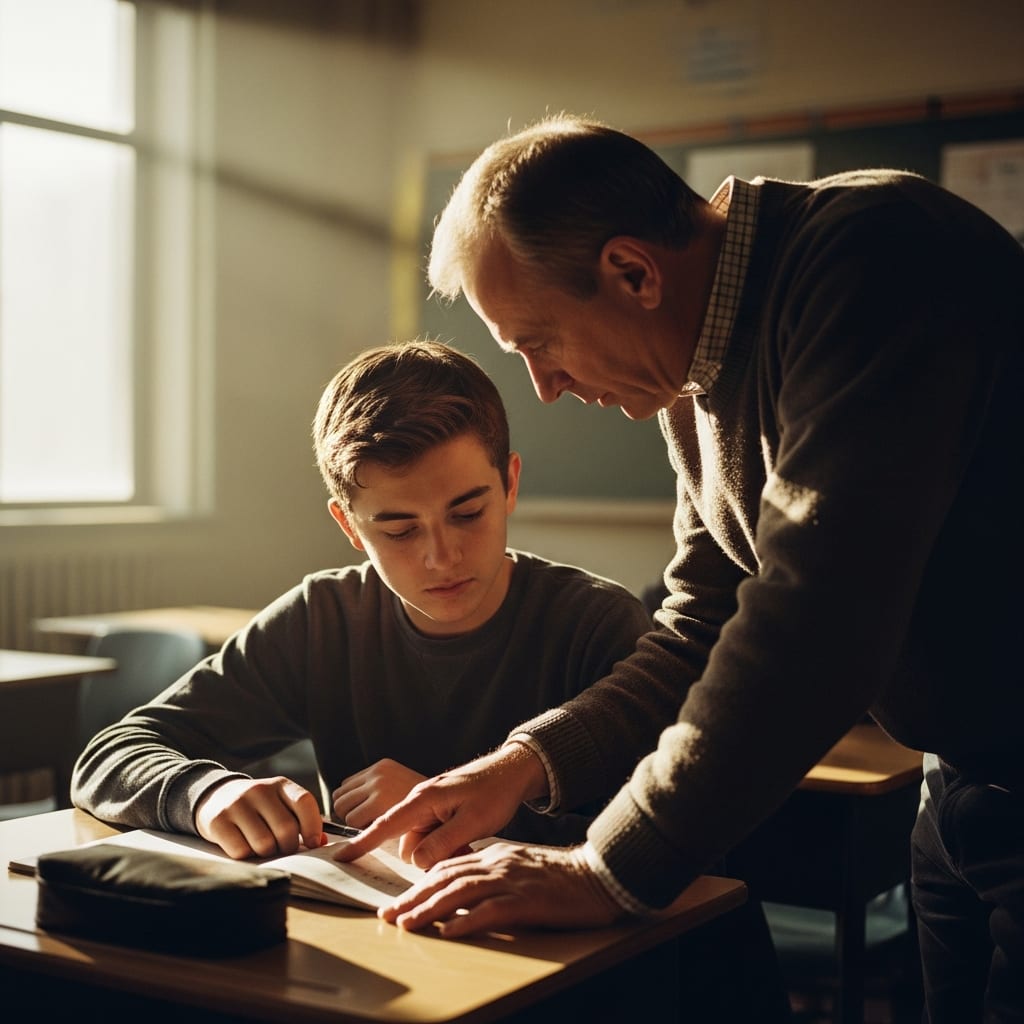
The bell for last period was the best sound in the world. For most kids, it meant freedom. For Sam, it meant 45 minutes of pure dread. Fifth period was math. The numbers on the page didn’t make shapes or sense; they just swam, a confusing soup that made his stomach hurt.
Mr. O’Brien’s classroom smelled like old books and chalk dust. He wasn’t a young teacher. He had a quiet voice and a sweater with patches on the elbows. The other teachers called Sam “lazy” or “distracted.” His report cards said, “Needs to apply himself.” Sam had started to believe it. He’d begun to slump in his chair, hoping to become invisible.
One Tuesday, it was particularly bad. They were doing fractions. Sam stared at the problem on the board, his pencil hovering over his notebook, his mind a blank wall of panic. He could feel the heat rising in his cheeks. Just guess, he thought. Write anything.
“Sam,” Mr. O’Brien’s voice was calm, right beside his desk. Sam flinched, waiting for the sigh, the disappointed look. “Walk with me for a second.”
Terrified, Sam followed him to the back of the room, by the tall windows looking out over the soccer field. He prepared for the lecture.
“You know,” Mr. O’Brien said, not looking at him but at the kids running outside, “I used to think I hated art.”
Sam was confused. This wasn’t about math.
“My teacher, Mrs. Gable, would make us paint these terrible watercolors. My skies were always a muddy brown. My trees looked like green blobs. I felt stupid every single class.” He finally looked at Sam. “Then one day, she sat me down with a lump of clay. Just clay. No brush, no wrong color. And something clicked. My hands understood what my brain and eyes couldn’t.”
He pointed a finger gently at Sam’s math book. “This is your muddy brown sky, Sam. The numbers on the page. But your brain might work in clay.”
Sam just blinked. No one had ever suggested his brain was different instead of broken.
The next day, after the final bell, Mr. O’Brien asked Sam to stay. He didn’t pull out the textbook. He pulled out a bag of colored blocks, a measuring tape, and a baseball.
“Forget the book for now,” he said. “Let’s just build.”
For weeks, they “built.” They measured the perimeter of the baseball diamond with Sam’s paces. They used blocks to figure out what fractions felt like—how four quarters made a whole square. They drew giant pie charts on the whiteboard about how Sam would spend a fictional $100. It wasn’t tutoring. It was detective work, and Mr. O’Brien was following Sam’s clues.
One afternoon, they were using building blocks to understand a word problem about building a shelf. Sam was arranging and rearranging, frustrated. “It’s just not fitting,” he muttered.
“Look at it from the side,” Mr. O’Brien suggested.
Sam got down on the floor, eye-level with the blocks. And suddenly, he saw it. The spatial relationship he’d been missing on the flat page was clear in 3D. He quickly divided the blocks, moved a few, and solved it. He looked up, a huge, unexpected grin spreading across his face.
Mr. O’Brien smiled back, a real, crinkly-eyed smile. “There it is,” he said softly. “You found the clay.”
Sam didn’t become a math genius. But the dread turned into a manageable challenge. He passed the class. More importantly, he stopped feeling stupid. He carried himself differently in the hallways—a little taller, a little less afraid.
On the last day of school, Sam handed Mr. O’Brien a folded note. It just said, Thank you for seeing the clay.
Years later, Sam was in college, struggling with a tough engineering course. As he sat in the library, feeling the old panic creep in, he thought not of formulas, but of a quiet classroom, colored blocks, and a teacher who got on the floor to see the world from a student’s height. He took a deep breath, pulled out some paper, and started to draw the problem in 3D. He knew how to be his own detective now.
The real hero wasn’t the one who gave Sam the answers. He was the one who was brave enough to throw out the textbook, get on the floor, and help a lost kid find his own way to think. Mr. O’Brien didn’t fight a dragon. He fought a kid’s fear of himself, and that made all the difference.
About the Creator
LegacyWords
"Words have a Legancy all their own—I'm here to capture that flow. As a writer, I explore the melody of language, weaving stories, poetry, and insights that resonate. Join me as we discover the beats of life, one word at a time.
Keep reading
More stories from LegacyWords and writers in Education and other communities.
A Peek Into a Smoggy Future
Hey there. Trying to figure out where the air might be toughest to breathe at the end of next year? It’s a forward-looking question, and anyone who gives you a firm list is guessing a bit—we don’t have a crystal ball. But by looking at stubborn, years-long trends and how winter works, we can make a very educated forecast.
By LegacyWords22 days ago in Earth
Learning Outside the System
I learned more from silence than I ever did from a syllabus. Not because classrooms are cruel places—but because they are crowded with answers before we’ve learned how to ask our own questions. From an early age, learning was presented to me like a straight road with guardrails: memorize this, repeat that, don’t wander too far. Curiosity was welcomed, but only if it arrived on time, raised its hand, and fit neatly inside the lesson plan.
By LUNA EDITH7 days ago in Education




Comments
There are no comments for this story
Be the first to respond and start the conversation.