
The Genius from India: The Inspiring Story of Ramanujan, a Mathematician Ahead of His Time
From Humble Beginnings to World-Renowned Mathematician: A Journey of Talent, Perseverance, and Legacy

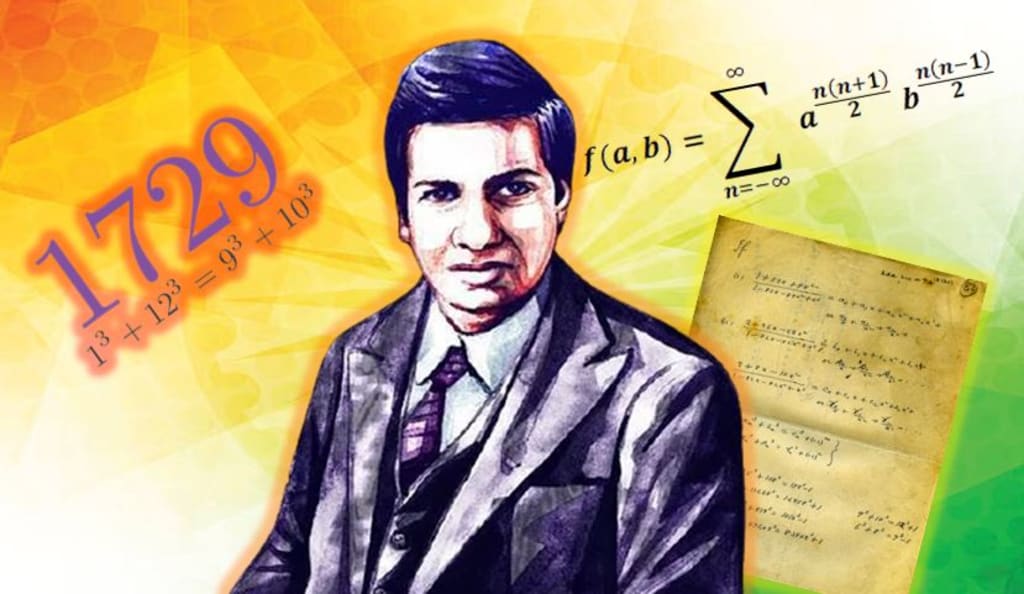
Srinivasa Ramanujan is one of the most celebrated mathematicians of the 20th century. Born in Erode, Tamil Nadu, India in 1887, Ramanujan showed exceptional mathematical ability from a young age, and by the time he was a teenager, he had developed his own theories and methods that would eventually earn him a place among the greatest minds in the history of mathematics.
Childhood and Early Education
Ramanujan was born into a poor Brahmin family, and his father worked as a clerk in a cloth merchant's shop. Despite the family's financial struggles, Ramanujan's mother recognized her son's exceptional mathematical talent and encouraged him to pursue his studies. She taught him arithmetic, and by the time he was just six years old, he was able to solve complex mathematical problems with ease.
Ramanujan's early education was somewhat unconventional. He attended local schools in Kumbakonam and Madras, but he was not a particularly good student in subjects other than mathematics. Nevertheless, he continued to study mathematics on his own, reading books and journals and working on problems and theories that interested him.
Mathematical Discoveries
Ramanujan's first major mathematical discovery came when he was just 16 years old. He developed his own theory of divergent series, which he presented to his classmates and teachers at his school in Kumbakonam. Although his theory was not immediately recognized by the mathematical establishment, it would later become an important tool for solving complex mathematical problems.
In his early twenties, Ramanujan began to send his mathematical work to established mathematicians in India and Europe. His first attempts at publication were largely unsuccessful, as many of his papers were rejected for being too unconventional or difficult to understand.
However, Ramanujan's persistence eventually paid off. In 1913, he sent a letter and a small portfolio of his work to the renowned British mathematician G.H. Hardy. Hardy was immediately impressed by Ramanujan's talent, and he invited him to come to England to work with him at Cambridge University.
Career and Later Life
Ramanujan arrived in England in 1914, and he quickly established himself as one of the most promising young mathematicians in the world. He worked closely with Hardy and other leading mathematicians, and his work on number theory, infinite series, and other topics earned him widespread acclaim.
Unfortunately, Ramanujan's time in England was cut short by health problems. He suffered from a number of serious illnesses, including tuberculosis, which eventually forced him to return to India in 1919. Despite his health problems, Ramanujan continued to work on mathematics, and he made a number of important discoveries in the years leading up to his death.
Ramanujan died in 1920 at the age of just 32. His contributions to mathematics have been recognized as some of the most important of the 20th century, and his work continues to influence mathematicians and scientists around the world.
Legacy and Impact
Ramanujan's legacy has been felt across a wide range of fields, from pure mathematics to theoretical physics and computer science. His work on number theory, in particular, has been instrumental in the development of modern cryptography and other applications of mathematics.
Ramanujan's life and work have also inspired countless people around the world, particularly in India, where he is celebrated as a national hero. His story is a testament to the power of perseverance, creativity, and intellectual curiosity, and his contributions to mathematics and science will continue to shape our understanding of the world for generations to come.
In conclusion, Srinivasa Ramanujan was a remarkable mathematician who overcame great obstacles to achieve success andRamanujan's mathematical talent began to emerge during his teenage years, and he made significant advances in the field while still living in India. Despite lacking formal training and living in poverty, Ramanujan produced groundbreaking work in number theory and continued to make important discoveries throughout his short life.
In 1913, Ramanujan wrote to the British mathematician G.H. Hardy, who was intrigued by the young Indian's work and eventually invited him to come to England. Ramanujan arrived in Cambridge in 1914, and his collaboration with Hardy was productive but sometimes contentious. Despite the language barrier and cultural differences, the two mathematicians produced several important papers together, including one on the partition function, which helped launch Ramanujan's career.
Ramanujan's time in England was also marked by personal struggles, including his difficult relationship with his wife, whom he had married before leaving India. He also struggled with his health, which had been poor since childhood, and with the racism he encountered as an Indian in colonial Britain.
Despite these challenges, Ramanujan continued to work on mathematics, producing many more important results before his untimely death in 1920 at the age of 32. His legacy has continued to influence mathematics, and he is widely regarded as one of the greatest mathematicians of all time.
Today, Ramanujan is remembered not only for his brilliant mind but also for his perseverance and dedication to his work. His story is a testament to the power of passion and the potential for greatness that lies within us all, regardless of our background or circumstances.
About the Creator
Keep reading
More stories from Vijay Periannan and writers in Education and other communities.
The Evolution and Impact of Online Gaming: From Early Text-Based Adventures to Modern eSports
Once upon a time, online gaming was considered a niche hobby for a select few. But over the past decade, it has exploded in popularity, with millions of people around the world now logging on to play games with friends and strangers alike. In this article, we'll take a closer look at the rise of online gaming, exploring its history, impact, and future.
By Vijay Periannan3 years ago in Education
Taher Saifuddin: Transforming Toronto’s Classrooms with Inclusive and Future-Focused Education
In the heart of Canada’s most diverse city, Toronto educator Taher Saifuddin is quietly leading a transformation in the way learning is delivered, measured, and experienced. With over two decades of experience, Taher is recognized for his dynamic role in teaching, academic leadership, and digital innovation across Toronto’s private and independent schools.
By Dena Falken Esq7 days ago in Education
What People Get Wrong About Consulting
Many people talk about consulting, but few understand what it truly involves. Movies, social media, and word of mouth often shape a narrow view. This creates confusion for students, business owners, and even new consultants. The topic of common misconceptions about consulting matters because these beliefs affect career choices and business decisions. When ideas are wrong, expectations break down fast.
By Nicole Metz6 days ago in Education
Silver Screen Magic with Mae West
American actress and singer Mae West became a popular film actress during the Great Depression. She started entertaining in vaudeville, then performed on Broadway, and finally went to Hollywood. She signed up with Paramount Pictures and made her debut in the 1932 film “Night After Night.” She also starred in musicals, comedies, and crime dramas. The American Film Institute named her one of the best classic Hollywood actresses.
By Rasma Raisters7 days ago in Geeks


Comments
There are no comments for this story
Be the first to respond and start the conversation.