
Top 5 Mistakes Realtors Make When Buying Real Estate Leads
Stop Wasting Your Acquisition Budget. Learn the Universal Business Flaws That Burn Out Agents and Kill Conversion Rates.


Buying fresh customer leads often feels like buying a lottery ticket: exciting potential for huge payoffs, but more often than not, it leads to nothing but an expense report and a sense of professional fatigue.
For countless professionals, especially in the competitive world of real estate, the investment in customer data rarely translates into a predictable, systematic route to growth. Why? Because the problem isn't the leads, it's the strategy used to pursue them.
Top performers consistently convert opportunities because they master a few core strategic principles that the majority ignore. Based on years of analyzing lead-to-conversion cycles across multiple industries, I've distilled the five most damaging, costly mistakes that guarantee disappointment.
Learn to recognize these strategic flaws to finally transform your customer acquisition budget from a costly gamble into a smart, profitable engine for growth.
1. The Peril of the False Economy: Chasing Volume Over Verified Intent
This mistake taps into a deep human temptation: the allure of a low cost-per-unit. The offer of "a thousand contacts for the price of one hundred" is often irresistible, leading to the illusion of scale.
- The Flaw (The Illusion of Scale): Prioritizing sheer contact volume with zero verification of intent or context. You receive a large, cheap list where a "lead" is merely an unverified data point.
- The Core Problem (Resource Depletion): By chasing thousands of unqualified contacts, you dilute your most precious asset: focused effort and time. You spread your resources thin, drain team morale, and ensure your sales team primarily interacts with people who are conceptually unready.
- The Strategic Shift: Adopt a mindset that values precision over quantity. A high-quality contact is defined by clear action signals: in-depth research, pre-qualifying actions, or demonstrable alignment between their situation and the service offered. Working smarter with ten verified contacts is exponentially more productive than working harder with a hundred cold ones.
2. The Failure of Generic Communication: Ignoring Psychological Segmentation
A modern consumer instantly recognizes a mass-market, one-size-fits-all approach. Treating a seasoned executive seeking a commercial property the same as a fresh graduate looking for their first home is a fundamental failure in basic communication.
- The Flaw (The Uniform Approach): Utilizing a single, generic pitch or follow-up sequence for all contacts, regardless of their background, needs, or stage in the buying cycle.
- The Core Problem (Credibility Erosion): Impersonal communication instantly reduces credibility. The consumer spots the lack of effort, making it easy to disengage. The message falls flat because it fails to address the unique pain points of the individual.
- The Strategic Shift: Master Contextual Relevance. Segment contacts into distinct psychological buckets (e.g., Newcomers, Experienced Operators, The DIY Consumer). Tailor your communication:
- Newcomers: Focus on education, process, and expectation management.
- Experienced Operators: Focus on optimization, metrics, and Return on Investment (ROI).
Tailored messaging shows a genuine understanding of their specific circumstances, instantly establishing trust where generic blasts fail.
3. The Execution Deficiency: Neglecting Speed and Persistence
This mistake is the most frustrating because it’s purely operational and the most easily quantified. In lead conversion, speed is the ultimate advantage.
- The Flaw (Temporal Delay and Quitting Early): Waiting hours or days to make the first contact with a "hot" lead, and then giving up after only one or two attempts.
- The Core Problem (Competitive Loss): Industry analysis repeatedly shows that the odds of qualifying a lead drop precipitously, often by more than 10 times, if contact is delayed beyond the first hour. Furthermore, relying on only 1-2 attempts ignores the fact that modern sales cycles often require 8 or more touchpoints for a successful connection.
- The Strategic Shift: Systematize Immediacy and Multi-Channel Tenacity. Implement a robust CRM to drive both an initial contact within 5-10 minutes (using a call, text, or personalized email) and a persistent, multi-channel sequence (phone, text, email, voicemail) to ensure no opportunity falls through the cracks.
4. The Data Blindness: Failing to Track Source Profitability (ROI)
If you lack rigorous measurement, you are operating on hope, not strategy. Many businesses treat customer acquisition spend as a generic cost without understanding what’s truly generating profits.
- The Flaw (Investment Guesswork): Blindly renewing subscriptions or repeating campaigns based solely on the volume of names delivered, without analyzing which source leads to signed agreements and closed deals.
- The Core Problem (Misallocated Capital): A business might be dedicating 80% of its budget to a high-volume source that yields 0% closed deals, while a smaller, cheaper source quietly generates 90% of the commissionable income. Without tracking, capital is poured into digital noise.
- The Strategic Shift: Demand Metrics of Profitability. Every customer acquisition source must be held accountable to core financial metrics beyond just Cost Per Lead (CPL), such as:
- Lead-to-Appointment Conversion Rate
- Appointment-to-Close Conversion Rate
- Ultimate Cost Per Acquisition (CPA)
This rigorous, data-driven analysis immediately identifies strategic partners versus mere data sellers.
5. The Integrity Risk: Accepting Recycled and Non-Exclusive Data
Businesses often purchase what they assume are fresh, exclusive contacts, only to find they are the fifth professional to call the prospect that day.
- The Flaw (The Diluted Opportunity): Buying from providers who resell the exact same contact to multiple competitors or scrape data from outdated, public, non-consensual records.
- The Core Problem (Reputation and Annoyance): You are immediately forced into a bidding war. The prospect is annoyed by the constant calls, conversion rates plummet, and your professional brand reputation suffers due to association with irritating cold calls.
- The Strategic Shift: Aggressively Vet Data Integrity. Before investing, ask direct, challenging questions to your lead providers: Is this contact sold exclusively to me? How is the data sourced and verified for accuracy and timeliness? The goal is to partner with vendors who value data integrity and exclusivity.
Stop Guessing, Start Growing
Customer acquisition does not have to be a costly gamble. It can be a strategic, predictable, and highly profitable engine for any business.
But it demands a deep strategic shift: a shift from blindly pursuing quantity to strategically prioritizing quality. By fixing these five critical mistakes, you can reclaim your time, dramatically increase your conversion rates, and build a truly successful, predictable business model, whether you are in real estate or any other lead-driven industry.
Further Reading
About the Creator
SiftlyLeads
SiftlyLeads is the premier platform for high-quality, verified leads and precise data. Let us empower your sales team with our expert insights to transform outreach and accelerate growth.
Keep reading
More stories from SiftlyLeads and writers in Education and other communities.
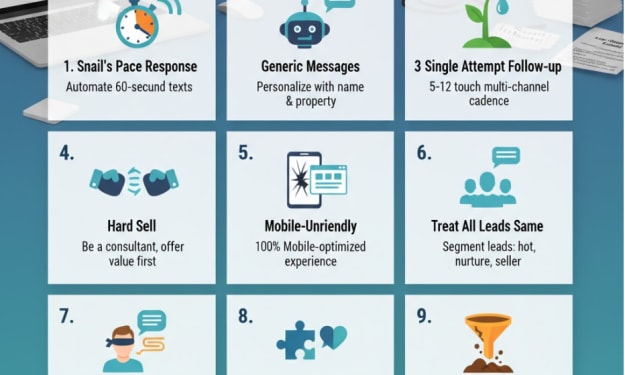
Top 9 Mistakes That Push Real Estate Leads Away
In the complex and fiercely competitive arena of real estate, many agents believe their success hinges primarily on having the most stunning listings or delivering the smoothest closing pitch. While these factors are crucial, the true battle for business is won or lost in the initial moments of lead management. The smallest, most avoidable errors can instantly negate thousands of dollars spent on lead generation, sending qualified prospects directly into the arms of a competitor.
By SiftlyLeads2 months ago in Education
Image-to-text technology, also known as Optical Character
Image-to-text technology, also known as Optical Character Recognition (OCR), has transformed the way we interact with visual information. It allows machines to extract text from images, enabling various applications across multiple industries. From digitizing printed documents to reading text from scanned images, OCR plays a vital role in making printed content accessible, editable, and searchable. The need for such technology has grown exponentially with the increasing reliance on digital data and the rapid shift from physical to digital content in nearly all sectors of life. As the digital world continues to expand, image-to-text technology has paved the way for more seamless workflows, enabling businesses and individuals alike to save time, effort, and resources.
By Alexander Jackson5 days ago in Education



Comments
There are no comments for this story
Be the first to respond and start the conversation.