
The Day I Realized My Childhood Was Over
A single story (e.g., death of a pet, moving out, seeing parents cry) that signals emotional maturity.

The Day I Realized My Childhood Was Over
It was the summer I turned fifteen when it happened. The day wasn’t extraordinary. No dramatic lighting. No fireworks. Just a quiet Tuesday in late July, the kind that hums with heat and smells like dry grass and melting pavement.
But that was the day I realized my childhood was over.
It began with a cardboard box.
I was in the garage, searching for my old baseball glove, when I found it—taped up, labeled in my mother’s handwriting: “Ethan — Childhood Keepsakes.” Dust clung to it like a second skin, and the marker was faded, but it was mine. I dragged it into the sunlight and sliced the tape with a rusted pair of scissors.
Inside were fragments of a version of me I’d forgotten.
There was my stuffed dinosaur, Toby. His button eye hung loose, and he smelled like attic and apple juice. I remembered sleeping with him tucked under my arm every night until I was nine. He had been my silent protector, warding off monsters and nightmares, especially after Dad left.
There were crayon drawings with impossible proportions—trees with purple trunks and people with triangle arms. A lopsided clay volcano from second grade. Birthday cards from relatives I barely remembered. A dried-up friendship bracelet from my neighbor, Lily.
I held each piece like it might break in my hands. Each one whispered a memory I hadn’t visited in years.
And then I found the photo.
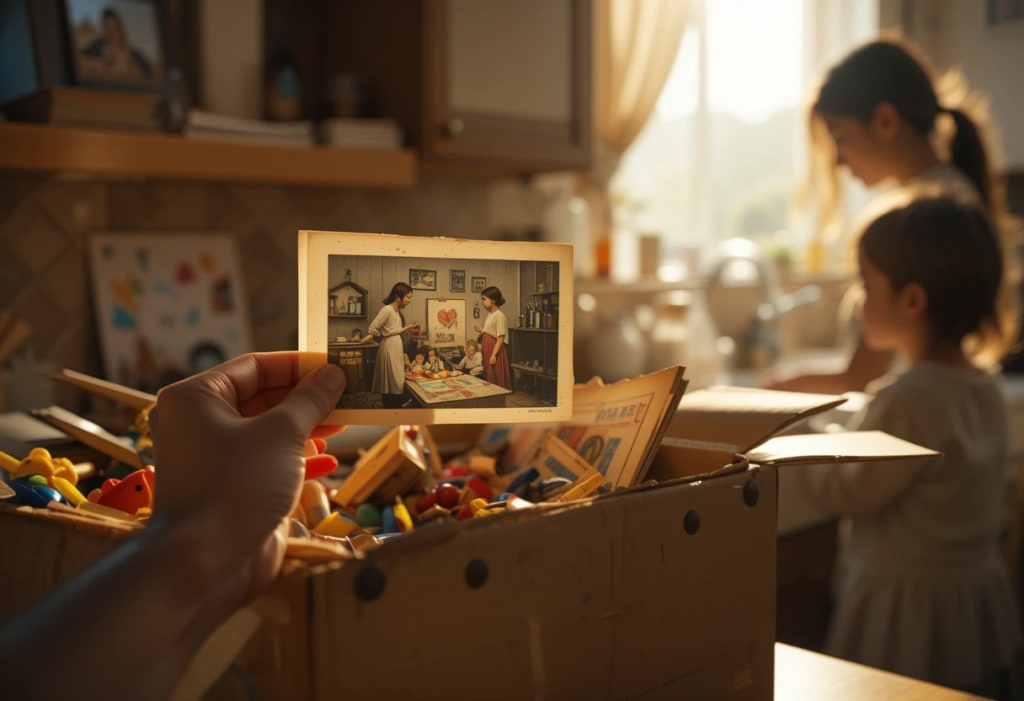
It was buried beneath a tangle of finger paintings. In it, I was seven years old, standing on the front porch of our old house, shirtless, chocolate smeared across my cheek. My mom was behind me, laughing, holding a dripping ice cream cone and looking at me like I was her entire world.
I stared at the photo for a long time. Not because of the way I looked, or the chocolate, or the crooked smile. But because I couldn’t remember the last time I saw her look like that.
I walked inside, photo in hand, and found her in the kitchen—hair tied back, sleeves rolled up, kneading dough for dinner rolls. She didn’t see me at first. I watched her shoulders move with quiet rhythm, her mouth set in that tight line she always wore when she was concentrating or tired or thinking about bills.
“Mom,” I said, barely above a whisper.
She looked up. “Yeah?”
I held out the photo.
For a second, her face softened. She took it from me and laughed—a real, short laugh that sounded almost surprised.
“God, look at you,” she said, brushing her thumb over the image. “You were such a mess that day. That was your birthday. You ate your cake before we finished singing.”
But her voice cracked on the last word, and I saw it then—something I hadn’t been old enough to see before.
Her eyes were glassy. Her smile faltered. And she turned away too quickly, pretending to rinse the sink.
That was the moment.
That exact breath in time when I saw her—not as just “Mom,” but as a woman. A tired, grieving, hopeful woman who had been carrying everything on her back since my dad packed his bags and walked out five years ago.
My childhood ended not with a bang, but with the quiet realization that she had always been human.
Later that night, I lay in bed with the box beside me. The ceiling fan whirred above, casting slow-moving shadows on the walls. I stared at the dinosaur, the drawings, the photo.
I thought about how I used to believe adults had it all figured out. That my mom had some invisible book of answers, and all I had to do was grow up and everything would make sense. But now I knew better.
Childhood is a bubble. A world wrapped in soft edges and belief that someone bigger, wiser, stronger will always catch you. That bubble doesn’t pop all at once. It thins, slowly, until the day it’s gone, and you’re standing in your kitchen, realizing your mother cries when no one’s looking.
In the days that followed, things didn’t change dramatically. I still rode my bike around the neighborhood. I still ate cereal straight from the box. But something inside me had shifted.
I started doing the dishes without being asked. I helped with the laundry. I listened more when my mom spoke and watched her more carefully, noticing how often she hid her exhaustion behind jokes.
One evening, I made her tea. Just… because. She looked surprised when I handed it to her, like I’d grown an inch taller overnight.
“Thank you,” she said.
And I nodded, feeling like I had finally seen something I was never meant to miss.
Years later, I still have that box.
It lives in the corner of my closet now, not because I’m trying to hold on to the past, but because sometimes we need to remember who we were to understand who we are becoming.
The dinosaur is still there. So is the photo. I take it out every now and then and look at it—me, chocolate-covered and grinning, and my mom, laughing like nothing could ever break us.
And I think of that Tuesday in July.
The day the air was too hot.
The day a photo made my heart heavy.
The day I realized my childhood was over.
Not because I lost innocence.
But because I gained understanding.
About the Creator
Keep reading
More stories from waseem khan and writers in Education and other communities.
The Day I Realized My Childhood Was Over
The Day I Realized My Childhood Was Over It was the summer I turned fifteen when it happened. The day wasn’t extraordinary. No dramatic lighting. No fireworks. Just a quiet Tuesday in late July, the kind that hums with heat and smells like dry grass and melting pavement.
By waseem khan6 months ago in Education
Python vs Rust Performance: Speed, Memory Usage, and Scalability Explained
When developers compare programming languages, performance is often one of the most debated factors. Two languages that frequently come up in these discussions are Python and Rust. While both are powerful in their own ways, they approach performance, memory management, and scalability very differently. This makes the Python vs Rust comparison especially relevant for teams choosing the right technology for their next project.
By Lennox Gray3 days ago in Education
💦The Water Cycle💦
Water is one of the most essential substances on Earth. It covers over 70% of our planet’s surface and is crucial for all forms of life. But have you ever wondered how water moves continuously around the Earth? How rivers, oceans, clouds, and rain are all connected in a constant cycle? This amazing natural process is called the water cycle, and it ensures that life never runs dry.
By Talha khan2 days ago in Education
Miss Persephone's Manual to a Seemingly Ordinary Life
Miss Persephone was found at the dining table, her blue eyes swollen, her tears arriving and retreating like the tides of the ocean. Earlier that day, her family had visited her in the retirement home where she had lived for eight years. It was her eightieth birthday.
By Imola Tóth4 days ago in Fiction


Comments
There are no comments for this story
Be the first to respond and start the conversation.