
💦The Water Cycle💦
How Water Moves Through Earth, Air, and Life
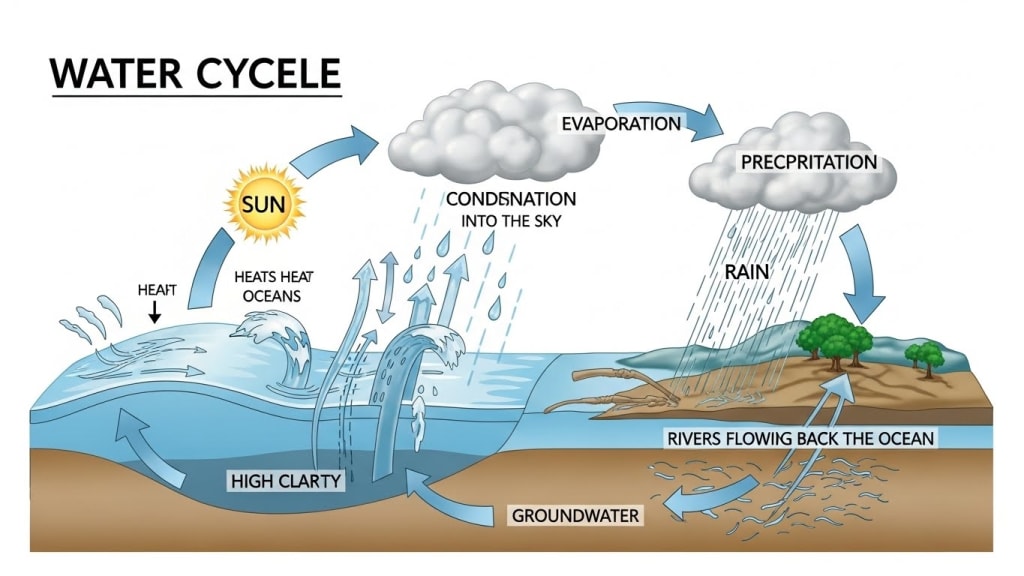
Water is one of the most essential substances on Earth. It covers over 70% of our planet’s surface and is crucial for all forms of life. But have you ever wondered how water moves continuously around the Earth? How rivers, oceans, clouds, and rain are all connected in a constant cycle? This amazing natural process is called the water cycle, and it ensures that life never runs dry.
1. Introduction to the Water Cycle
The water cycle, also known as the hydrological cycle, is the continuous movement of water on, above, and below the surface of the Earth. It involves several stages that recycle water, ensuring that it is always available for ecosystems, humans, and the environment. The cycle is powered primarily by the sun, which provides the energy necessary for water to change from one state to another—liquid, gas, or solid.
The water cycle is essential because it regulates climate, supports plant and animal life, and maintains freshwater supplies. Without it, life as we know it would not exist.
2. Evaporation: Water Turns into Vapor
The first stage of the water cycle is evaporation. This is the process by which water changes from a liquid to a gas, called water vapor. Heat from the sun warms rivers, lakes, oceans, and even soil moisture, causing water to rise into the atmosphere.
Plants also play a role in this stage through a process called transpiration, where they release water vapor from their leaves into the air. Together, evaporation and transpiration are sometimes called evapotranspiration. This stage is critical because it lifts water into the sky, where it can later form clouds.
3. Condensation: Clouds Are Formed
Once water vapor rises, it eventually cools as it reaches higher altitudes. Cooling causes the water vapor to change back into tiny liquid droplets, forming clouds. This process is called condensation.
Condensation is visible in everyday life as fog on a cold morning or as dew on grass. In the atmosphere, these small droplets combine to create clouds that can travel long distances with wind currents. The type and size of clouds determine the weather and the intensity of upcoming precipitation.
4. Precipitation: Water Returns to Earth
When clouds gather enough moisture, the water droplets become heavy and fall back to Earth as precipitation. Precipitation can take various forms, including rain, snow, sleet, or hail, depending on temperature and atmospheric conditions.
This stage is crucial because it replenishes freshwater on land, filling rivers, lakes, and underground aquifers. Precipitation also supports agriculture, ecosystems, and human life. Without it, areas would quickly become dry and arid, making survival impossible for most living organisms.
5. Collection: Water Flows Back to Oceans
After precipitation, water moves across the land through runoff, eventually flowing into rivers, lakes, and oceans. Some water seeps into the soil and becomes groundwater, which plants and animals rely on for survival. This stage is called collection.
Oceans act as the main reservoir for water on Earth, holding over 97% of the planet’s water. Rivers and lakes act as smaller reservoirs, transporting water and supporting life along the way. Eventually, the water in rivers and oceans evaporates again, and the cycle continues.
6. The Role of the Sun and Climate
The sun is the engine that drives the water cycle. Its energy causes evaporation and powers weather patterns that move water around the globe. Climate also influences the cycle. For example, in tropical regions, high temperatures lead to intense evaporation and rainfall, while in deserts, low moisture and high heat result in limited water availability.
Understanding the relationship between the water cycle and climate is important for predicting weather, managing water resources, and dealing with environmental changes. Human activities, such as deforestation and pollution, can disrupt the natural water cycle, leading to droughts, floods, and water shortages.
7. Importance of the Water Cycle
The water cycle is vital for life. It:
•Maintains a balance of water on Earth.
•Provides freshwater for drinking, agriculture, and industry.
•Supports plants and animals by maintaining ecosystems.
•Regulates climate and temperature.
•Helps purify water through natural filtration when it passes through soil and rocks.
•Without the water cycle, Earth would not have stable weather, fertile land, or clean water. It is a reminder of how interconnected our planet is, and why we must protect our water resources.
8. Human Impact and Conservation
Human activity can affect the water cycle in many ways. Deforestation reduces transpiration, pollution contaminates water, and overuse of freshwater can deplete rivers and aquifers. Climate change also alters precipitation patterns, causing droughts in some areas and floods in others.
Conserving water, protecting forests, reducing pollution, and using water sustainably are essential steps to maintain a healthy water cycle. Educating communities about water conservation ensures that this vital process continues for generations.
9. Conclusion
The water cycle is nature’s extraordinary system for recycling water. From evaporation to condensation, precipitation, and collection, every stage plays a vital role in sustaining life on Earth. It demonstrates the delicate balance and interconnectedness of our planet’s environment.
By understanding the water cycle, we can appreciate the importance of water and our responsibility to protect it. Every drop counts, and through conservation and care, we can ensure that the cycle continues, nourishing life for centuries to come.
About the Creator
Keep reading
More stories from Talha khan and writers in Education and other communities.
Top 10 Essential Skills for Success in 2026
By 2026, the job market is no longer driven only by degrees or titles. Technology, especially Artificial Intelligence (AI), automation, and remote work, has changed how companies operate and how people work. Many routine tasks are now handled by machines, while humans are expected to do work that requires thinking, judgment, creativity, and emotional understanding. This shift means that skills — not just education — determine success. The following 10 skills are considered essential for 2026 because they combine technology awareness with human intelligence. Let’s understand them one by one, step by step.
By Talha khan2 months ago in Education
The Impact of Virtual Reality on Healthcare Innovation and Medical Practice
Virtual reality is steadily transforming the healthcare industry by offering immersive digital environments that support medical education, treatment planning, and patient care. Unlike traditional tools, VR allows healthcare professionals to interact with highly detailed simulations that replicate real medical situations. These interactive experiences provide opportunities for learning and preparation that were previously difficult to achieve through conventional training methods.
By Alex Kipmanabout 18 hours ago in Education


Comments
There are no comments for this story
Be the first to respond and start the conversation.