
The Book That Declared All Humans Equal – 1,400 Years Before the West
How a single verse of the Qur’an shattered racism, tribalism, and the myth of superiority


A World Still Divided
Racism. Nationalism. Caste systems. Borders and passports that decide who can move freely and who cannot. We live in a world that preaches equality, yet in practice builds walls between people. Speeches are given on “human rights,” but the poor, the black, the immigrant, and the voiceless continue to be marginalized.
And yet, 1,400 years ago, in a desert society built entirely on tribal pride and class divisions, the Qur’an revealed a verse that remains one of the most radical declarations of human equality in history.
The Verse That Changed Everything
Allah declares in the Qur’an:
"يَا أَيُّهَا النَّاسُ إِنَّا خَلَقْنَاكُم مِّن ذَكَرٍ وَأُنثَىٰ وَجَعَلْنَاكُمْ شُعُوبًا وَقَبَائِلَ لِتَعَارَفُوا ۚ إِنَّ أَكْرَمَكُمْ عِندَ اللَّهِ أَتْقَاكُمْ" Quran 49:13
O mankind, indeed We created you from male and female and made you peoples and tribes that you may know one another. Indeed, the most noble of you in the sight of Allah is the most righteous of you.
Notice the opening: “O mankind” — not “O Muslims.” This is a direct call to every human being. The Qur’an does not erase our differences. It does not deny that we are different tribes, nations, and peoples. But it redefines the purpose of those differences: “so that you may know one another.” Not to hate, not to dominate, but to connect.
And then comes the thunder: nobility is not in race, tribe, wealth, or nation. It is only in righteousness (taqwā).
Why This Was Revolutionary
To appreciate how stunning this verse was, you need to understand the 7th-century Arabian world:
Society was tribal. Your tribe decided your status.
Women, slaves, and the poor had little dignity.
Wars were fought over bloodlines and honor.
Then Islam came — not just as “another religion,” but as a force that dismantled the very hierarchy on which society stood.
When the Prophet Muhammad ﷺ delivered his Farewell Sermon, he echoed this verse:
“No Arab is superior to a non-Arab, and no non-Arab is superior to an Arab. No white person is superior to a black person, nor is a black person superior to a white person — except by righteousness and piety.” (Musnad Ahmad 23489, authentic).
This was not a slogan. It was lived. Bilal, an African slave, was raised to become the first caller to prayer. Salman, a Persian, became one of the Prophet’s closest companions. Suhayb, a Roman, was honored among the believers.
The Modern Crisis of Equality
Fast forward 1,400 years. Our world still struggles with the same disease:
Colonialism told entire nations they were inferior.
“Race science” and eugenics fueled slavery and genocide.
Today, borders and passports decide who is “welcome” and who is “illegal.”
Global capitalism still values humans by their productivity, not their dignity.
The “secular” West often prides itself on concepts like democracy and equality. But the Qur’an declared the essence of human equality long before the Enlightenment. And unlike “secular” slogans, it gave equality a spiritual foundation: you are equal because you share the same Creator.
Why Non-Muslims Should Care
Even if you do not believe in Islam, the message of this verse confronts every one of us with uncomfortable truths:
Our worth is not what society says. Skin color, wealth, and nationality are illusions.
Differences are not threats. Diversity is meant for learning, not division.
Character is the ultimate measure. What truly matters is the integrity of your soul, your justice, your compassion, your sincerity.
This is not just “Islamic teaching.” It is a universal principle. And the Qur’an insists: the path to human flourishing is not arrogance, but humility before the Creator who made us all.
A Personal Reflection
As Muslims, we often forget that our faith was meant to liberate humanity from chains — not just rituals, but social injustice. Too often, Muslims themselves fall back into racism, nationalism, and classism. And when we do, we betray the very book we claim to believe in.
For non-Muslims, perhaps this verse is a reminder that Islam is not what the headlines portray. Before judging Islam by the actions of Muslims, open the Qur’an itself. You may find that its vision of humanity is exactly the medicine our fractured world needs.
Conclusion: A Verse for Our Age
The Qur’an’s message is simple, yet world-shaking: All humans are equal before God.
What divides us — race, tribe, wealth, passport — are illusions. What unites us is deeper: our common origin, and our accountability before the One who created us.
So next time you see the world tearing itself apart by color, class, or nation, remember this desert verse that declared equality long before it was fashionable:
“Indeed, the most noble of you in the sight of Allah is the most righteous of you.”
About the Creator
Fazal Ur Rahman
My name is Fazal, I am story and latest news and technology articles writer....
read more and get inspire more............
Keep reading
More stories from Fazal Ur Rahman and writers in Education and other communities.
How to Earn $10,000 — Even If You’re Starting from Scratch
Making $10,000 may sound like a lofty goal when you’re just starting out, but with the rise of the digital economy, it’s not only possible — it’s achievable for almost anyone willing to put in the work. Whether you’re a student, stay-at-home parent, freelancer, or someone looking to escape the 9-to-5 grind, there are proven ways to build multiple income streams that can help you hit the $10K milestone.
By Fazal Ur Rahman7 months ago in Education
How Small Organizations Can Use Data Analytics to Boost Their Business
Big or small, businesses of all sizes today rely on insightful information to make decisions. Especially in this data-driven economy, those who fail to adopt a data-driven culture may risk falling behind their competitors who embrace and are updated with data analytics trends. Though large corporations already have sufficient analytics systems, they are no longer limited to huge enterprises. Data analytics for small businesses is gaining quite traction, powering them with unprecedented insights to take their business forward.
By Pradip Mohapatra2 days ago in Education
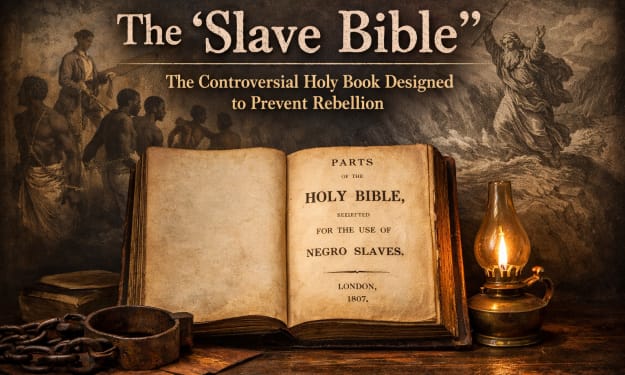
The “Slave Bible”: The Controversial Holy Book Designed to Prevent Rebellion
In the early nineteenth century, a heavily edited version of the Bible was printed with a singular and deeply troubling purpose: to control enslaved Africans and discourage rebellion. Today, this rare publication—commonly known as the “Slave Bible”—is one of the most controversial religious texts in history. Only four copies are known to exist in the world.
By Irshad Abbasi 6 days ago in Education



Comments
There are no comments for this story
Be the first to respond and start the conversation.