courses
Tackle that seemingly endless selection of course offerings; a roundup of helpful resources and sound advice for selecting the best courses and acing them.
Top 10 programing language should know 2023
1.Python 2.JavaScript 3.Java 4.C# 5.C++ 6.PHP 7.Ruby 8.Swift 9.Go 10.Kotlin PYTHON Python is a high-level, general-purpose programming language that is widely used for web development, scientific computing, data analysis, artificial intelligence, and more. It is known for its simplicity and ease of use, making it a great choice for beginners and experienced developers alike. Python's large standard library and active community also make it a great choice for many tasks, as there are often pre-built libraries and modules available for specific tasks. Additionally, Python has a wide variety of frameworks and libraries available for web development such as Django, Flask, and Pyramid. Popular data science libraries and frameworks like pandas, numpy, and scikit-learn are also available in Python. Python is also used in machine learning and AI tasks such as TensorFlow, PyTorch and scikit-learn
By om prakash3 years ago in Education
Career in Fashion Design
Fashion design is a highly creative and dynamic field that requires a combination of artistic talent and technical skills. A career in fashion design can be both challenging and rewarding, as it offers the opportunity to create unique, beautiful, and functional clothing and accessories that reflect the changing tastes and styles of society.
By Shaina Trivedi3 years ago in Education
The Importance of Hands-On Training in a Clinical Medical Assistant Program in NY!
To be successful in the field of clinical medical assistance, one nee ds to have a firm grasp of both theory and practice. The confidence and skills a student will need to succeed in their chosen fields can't be learned in a classroom alone; students also benefit greatly from practical experience.
By cambridge_edu3 years ago in Education
Online Quran Academy
Introduction The Quran is the holy book of Islam and holds immense significance for Muslims around the world. It is a source of guidance and inspiration for all aspects of life. In recent years, the demand for online Quran academies has increased as they provide a convenient and accessible way for individuals to learn and understand the Quran.A Quran academy is a school or institution that provides education and instruction in the Quran and Islamic studies. These academies may offer classes for both children and adults, and may also provide courses on topics such as Quranic recitation, tafseer (interpretation), Islamic history, and Islamic theology. Some Quran academies may also offer online or distance learning options for students who are not able to attend classes in person. The goal of these academies is to provide students with a comprehensive understanding of the Quran and its teachings, as well as to promote the study and understanding of Islam.
By Quran Host3 years ago in Education
Learn Quran With Tajweed
Introduction The Quran is the holy book of Islam and is considered as the word of God by Muslims. It is essential for every Muslim to learn and understand the Quran with proper pronunciation and rules of recitation, known as Tajweed. Tajweed is the correct way of pronouncing each letter and word in the Quran, ensuring that the meaning and message of the Quran is conveyed correctly. Tajweed is the proper way of reciting the Quran. It is the set of rules and guidelines that dictate how the Quran should be read. These rules include the correct pronunciation of the Arabic letters, the proper emphasis and intonation, and the correct way to pause and breathe. Tajweed is essential for understanding the meaning of the Quran and for gaining the full benefits of reading it.
By Quran Host3 years ago in Education
Full Details About Solar Sysem part - 1
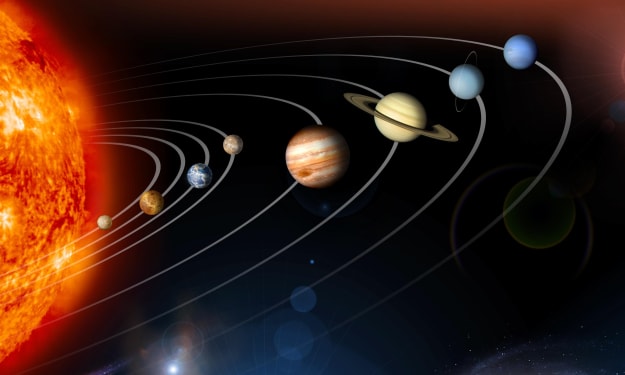
solar system, assemblage consisting of the Sun—an average star in the Milky Way Galaxy—and those bodies orbiting around it: 8 (formerly 9) planets with about 210 known planetary satellites (moons); countless asteroids, some with their own satellites; comets and other icy bodies; and vast reaches of highly tenuous gas and dust known as the interplanetary medium. The Sun, Moon, and brightest planets were visible to the naked eyes of ancient astronomers, and their observations and calculations of the movements of these bodies gave rise to the science of astronomy. Today the amount of information on the motions, properties, and compositions of the planets and smaller bodies has grown to immense proportions, and the range of observational instruments has extended far beyond the solar system to other galaxies and the edge of the known universe. Yet the solar system and its immediate outer boundary still represent the limit of our physical reach, and they remain the core of our theoretical understanding of the cosmos as well. Earth-launched space probes and landers have gathered data on planets, moons, asteroids, and other bodies, and this data has been added to the measurements collected with telescopes and other instruments from below and above Earth’s atmosphere and to the information extracted from meteorites and from Moon rocks returned by astronauts. All this information is scrutinized in attempts to understand in detail the origin and evolution of the solar system—a goal toward which astronomers continue to make great strides. Composition of the solar system orbits Located at the centre of the solar system and influencing the motion of all the other bodies through its gravitational force is the Sun, which in itself contains more than 99 percent of the mass of the system. The planets, in order of their distance outward from the Sun, are Mercury, Venus, Earth, Mars, Jupiter, Saturn, Uranus, and Neptune. Four planets—Jupiter through Neptune—have ring systems, and all but Mercury and Venus have one or more moons. Pluto had been officially listed among the planets since it was discovered in 1930 orbiting beyond Neptune, but in 1992 an icy object was discovered still farther from the Sun than Pluto. Many other such discoveries followed, including an object named Eris that appears to be at least as large as Pluto. It became apparent that Pluto was simply one of the larger members of this new group of objects, collectively known as the Kuiper belt. Accordingly, in August 2006 the International Astronomical Union (IAU), the organization charged by the scientific community with classifying astronomical objects, voted to revoke Pluto’s planetary status and place it under a new classification called dwarf planet. For a discussion of that action and of the definition of planet approved by the IAU, see planet.
By Giri Sivakaran3 years ago in Education
18 Steps to a Successful UI UX Web Design Services
Every UI UX developer must establish a proper rhythm and routine for completing the tasks. According to several studies, the user interface is crucial in driving maximum user engagement and increasing retention by at least 10% to 15%. Therefore, no developer can offer the best UI UX web design services if proper attention is not given.
By Tech Striker3 years ago in Education
Full Details About Himalayas
The Himalayas are a mountain range located in Asia, stretching 1,500 miles through parts of China, India, Pakistan, Nepal, Bhutan, Afghanistan, and Tibet. The range is home to the highest peaks in the world, including Mount Everest, which stands at 29,029 feet above sea level. The Himalayas were formed as a result of the collision between the Indian and Eurasian tectonic plates, which caused massive uplift of the landmass over millions of years
By Giri Sivakaran3 years ago in Education