
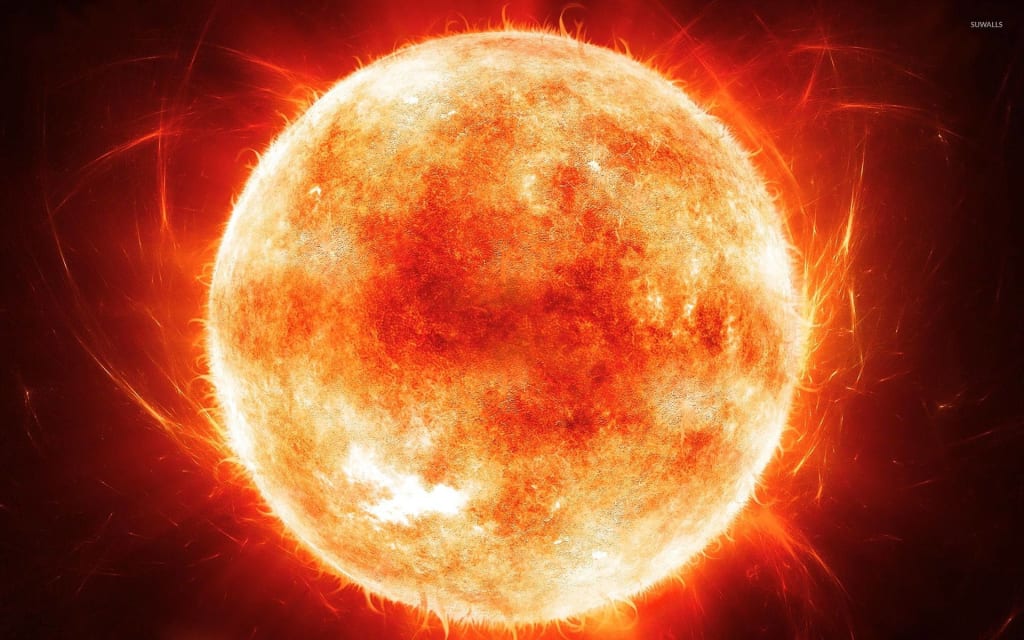
The sun produces more energy in 1.5 millionths of a second than we humans consume in a year. That's a lot of clout. As a result, solar will almost certainly play a significant part in our search for a cleaner, more secure energy future. All of this energy is produced by the sun through a process known as fusion. But what is fusion, and how does the sun produce so much energy?
The sun is a gigantic nuclear powerhouse capable of raising temperatures in Australia's Outback to an astounding 50.7 degrees Celsius. That high energy is ideal for powering race cars in the World Solar Challenge.
I am currently in the Australian Outback. As you can see, this is an extremely hostile environment. It's strange being out here, you can feel the strength of the sun. It gets really heated. And, of course, it is that very energy that propels these cars at breakneck speeds down the road. In the World Solar Challenge, automobiles from over 20 countries must race across the continent, covering 3,000 kilometres (1,800 miles), to gain the title of fastest solar vehicle in the world.
Surprisingly, the source of electricity that allows all of this to happen is 150 million kilometres away and involves subatomic particles. You may be aware that atoms, which comprise all matter, contain a nucleus at their core composed of protons and neutrons, with electrons whizzing about the nucleus in a tiny cloud. Fusion occurs when two atomic nuclei are pushed together at extremely high energies. Keep in mind that this is not the same as what happens when atoms combine using their electrons, such as when two hydrogen atoms and an oxygen atom combine to make water. This is known as bonding. However, during fusion, the nuclei of the atoms themselves massive quantities of energy are released as the nuclei collide to form a single nucleus.
So, now that we've gotten our heads around the fundamentals of how fusion works, let's look at how it happens in the sun. To begin with, it requires a significant amount of energy to bring the nuclei together in the first place because protons with the same positive charge resist each other. As in, like magnets. You may recall that opposite charges attract while like charges repel. However, because the sun is so big, with a diameter of around 1.392 million kilometers, it has an unbelievable amount of gravity, which means an incredible amount of pressure is imposed on all those hydrogen atoms that make up the sun.
Solar fusion now occurs inside the sun's core, where the pressure and density are so high that the like-charged protons of those hydrogen nuclei smash together to make helium. If we want to get into even more detail, which we want, we'll need to discuss something called the proton-proton cycle. The sun's energy is actually the outcome of a chain of thermonuclear events.
The reaction begins when two hydrogen nuclei collide, producing deuterium, a hydrogen nucleus with one proton and one neutron. Because most hydrogen atoms have only one proton and no neutrons. A third hydrogen proton then collides with the deuterium nucleus to form a tritium nucleus, or triton, a nucleus containing one proton and two neutrons. When two tritium nuclei combine, they generate a helium-4 nucleus with two protons and two neutrons. This fusion also releases two protons, allowing the cycle to continue. Two hydrogen protons collide, a third hydrogen proton joins the party, two tritium nuclei fuse, and two protons are released. Repeat until the sun runs out of hydrogen. Got it? Great. It is a difficult procedure. After all, this is thermonuclear physics. So, if you want to go back and rewatch that proton-proton cycle animation, go ahead and do so.
You may be wondering how much energy this process generates. According to physicists, the sun emits an estimated 384 yotta watts of energy at any given time. Have you ever heard of a yotta watt? Because neither do I. In scientific notation, however, that is 3.84 times 10 to the 26th power. So 384 with 24 zeros after it.
We hardly have enough screen space to display all of those zeros. To call that a "yotta" power would be an understatement and a groan-worthy pun. Because nuclear fusion does not generate unstable, long-lived radioactive waste like nuclear fission, which is the splitting of an atom, fusion produces a stable, non-radioactive byproduct of helium. As a result, scientists are investigating ways to make this a viable energy source. However, as many of our covert viewers have noticed, fusion technology always appears to be only a few decades away.
While the majority of the sun's energy is dispersed throughout our solar system, physicists estimate that 430 quintillion joules of the sun's energy touches the Earth's surface roughly every hour, or hour and a half. With current estimates of total global energy usage at 580 million terajoules per year, we could hypothetically power our entire planet for more than a year if we could properly harness all of the sun's energy that strikes Earth for just two hours. Clearly, this isn't going to happen anytime soon, but solar energy is powering a global shift to cleaner, more sustainable energy. And, as technology has become more efficient, there have been some great developments in recent years. So, next, we'll take a deeper look at solar panels and dissect the technology that can convert sunlight into horsepower and power our homes and cities.
About the Creator
Keep reading
More stories from writers in Education and other communities.
Friendship with Books
Arslan and Rehan were very close friends. They studied in the same class and lived in the same neighborhood, which made their friendship even stronger. Despite being similar in age and environment, their interests were quite different. Rehan had a deep love for reading. He was not limited to his textbooks alone; instead, he eagerly read all kinds of books, including storybooks, history, general knowledge, and books full of interesting events. For Rehan, books were not just a habit—they were a way of life.
By Sudais Zakwan2 days ago in Education



Comments
There are no comments for this story
Be the first to respond and start the conversation.