
Sleeping Giant: The Yellowstone Supervolcano’s Hidden Potential
Are we ready?
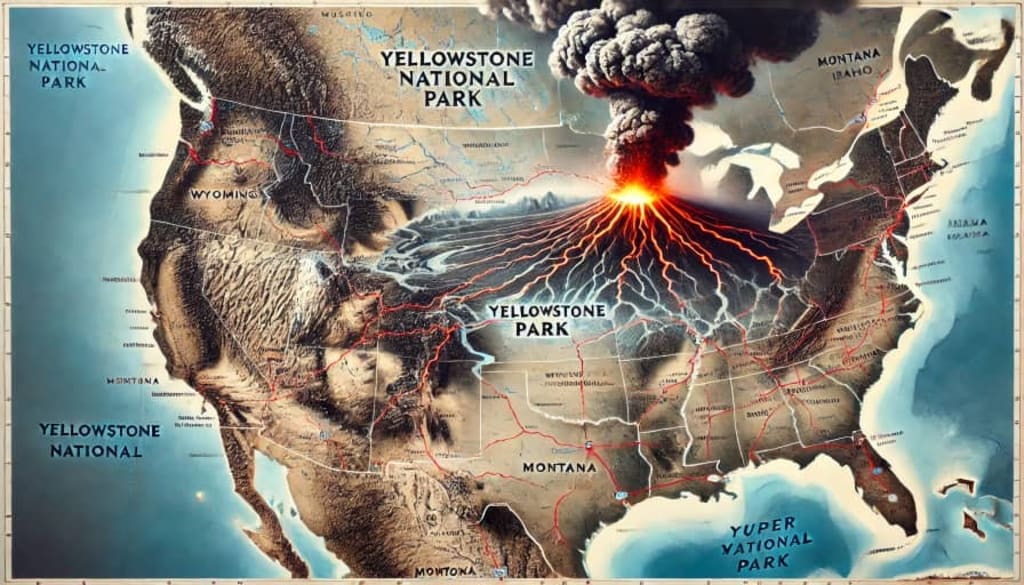
You may have heard that Yellowstone National Park sits atop a giant supervolcano, which explains the area’s powerful geysers and hot springs. But it also means that an enormous magma chamber lies beneath Yellowstone. In 2015, researchers from the University of Utah discovered that this chamber was even larger than previously thought. They also found an additional magma reservoir beneath the first chamber. Together, these two magma reservoirs hold enough magma to fill the Grand Canyon eleven times over.
The concerning thing about these magma chambers is that they push against the ground above, causing Yellowstone's land to rise by about 1 to 2 inches each year. Additionally, Yellowstone is considered an active volcano with a Volcanic Explosivity Index (VEI) of 8 out of 8. This high rating suggests that if Yellowstone were to erupt, it would be an apocalyptic event. For perspective, the 1991 eruption of Mount Pinatubo in the Philippines, which is among the most powerful eruptions in recent history, rated only a 6 on the VEI.
So, is there anything to worry about? In March 2023, the University of Utah’s seismograph stations recorded 354 earthquakes across the Yellowstone region. While this sounds alarming, the strongest earthquake was only a 3.7 magnitude, and it was part of a swarm of 106 smaller quakes that started on March 29 and continued through the end of the month. Earthquakes around Yellowstone are common and often come in swarms. Despite increased seismic activity, experts say it’s not a serious concern. Michael Poland, a geophysicist at the Yellowstone Volcano Observatory, claims that an eruption isn’t expected anytime soon. For an eruption to occur, there would need to be enough magma beneath the surface and enough pressure to push it upward. According to Poland, neither condition exists today.
Poland and his team closely monitor Yellowstone’s underground activity, looking for warning signs of a potential eruption. These indicators include frequent earthquakes, ground deformation, rising surface temperatures, and changes in geyser behavior, gas emissions, and thermal features across the park. Media reports may claim that Yellowstone is “due” for an eruption because the last one was around 70,000 years ago, but volcanoes don’t work on predictable timelines—a common misconception.
If a super-eruption were to happen, the biggest threat wouldn’t be lava or earthquakes but volcanic ash. Let’s look at what happened during previous Yellowstone eruptions. Yellowstone has had at least three super-eruptions, with the largest 2,500 times more powerful than the 1980 Mount St. Helens eruption in Washington State. The most recent super-eruption, known as the Lava Creek eruption, left behind the Yellowstone Caldera after spewing massive amounts of volcanic ash, dust, and rock. Recently, scientists discovered two other unknown super-eruptions that happened around 9 and 8.7 million years ago. The younger of the two is now considered the largest recorded eruption in the Snake River-Yellowstone volcanic region.
Let’s imagine what happened millions of years ago. Before the eruption, heat was building up from the Earth’s core, melting rock beneath the crust and forming large magma chambers filled with pressurized magma, water vapor, and gases like carbon dioxide. As more magma accumulated, the ground over Yellowstone rose, although slowly. A year before the super-eruption, the volcano likely began giving warnings—small earthquakes, rising ground temperatures, and warming surface lakes.
Not long before the eruption, the ground over the magma chamber rose, forming a dome-shaped uplift, and cracks opened along its edges. Just like a shaken soda bottle, pressure was released through these cracks as gases burst out. Right before the eruption, geothermal pools and geysers reached boiling temperatures, became more acidic, and the magma began moving toward the surface. Eventually, the rock roof over the magma chamber gave way, and the eruption started. Small tremors shook the ground before the main event, which sent a massive column of ash and lava skyward. Within minutes, a pyroclastic flow—an extremely hot, toxic mix of lava, ash, and gases—rushed across the area at hurricane speed, burning everything in its path.
Ash fallout was one of the deadliest consequences of the eruption, as volcanic ash can turn into a glass-like cement when inhaled. Trees collapsed under the weight of the dense ash, which soon blanketed huge areas. As the ash entered the stratosphere, global temperatures began to drop due to sulfur-rich ash blocking sunlight, leading to a “volcanic winter.” For the next few years, temperatures plummeted, and animals struggled to find food and clean water. This eruption, known as the Gray’s Landing super-eruption, was one of the most catastrophic in history. It covered an area the size of New Jersey in molten volcanic glass, destroying all plant life in its path.
If a similar eruption were to happen today, it would bury parts of Colorado, Utah, and Wyoming under nearly three feet of ash, plunge vast regions into darkness, devastate crops, and damage electrical infrastructure. Thankfully, scientists assure us that such a disaster isn’t expected anytime soon. And let’s be honest—we’ve got enough on our plates as it is.
About the Creator
Keep reading
More stories from SimplyWrite and writers in Education and other communities.
The Rise and Fall of Mama V's Kitchen
Every morning, the aroma of sizzling onions and rich spices filled the air on a quiet street in Lagos, announcing the start of another busy day at Mama V’s Kitchen. The restaurant was more than just a place to eat—it was a lifeline for many. Traders, artisans, office workers, and students all flocked there, drawn by the irresistible allure of her food.
By SimplyWriteabout a year ago in Fiction
Casie Hynes and the Future of Mathematics Education
Mathematics has always been a cornerstone of education, shaping analytical thinking, logical reasoning, and problem-solving skills that extend far beyond the classroom. In today’s rapidly evolving world, however, traditional approaches to math instruction are increasingly falling short. Students are expected to navigate complex data, adapt to technological change, and solve unfamiliar problems, yet many leave school without a deep understanding of mathematical concepts. As education systems face growing pressure to adapt, new perspectives on math learning are helping redefine what effective instruction should look like.
By Casie Hynes3 days ago in Education
Stock Screener vs Manual Stock Analysis: Which Works Better?
Finding the right stocks in a crowded market is a challenge for every investor. With thousands of publicly traded companies and constant price fluctuations, investors rely on different methods to narrow down opportunities. Two of the most common approaches are using a stock screener and performing manual stock analysis. While both aim to identify profitable investments, they differ significantly in speed, depth, and practicality. Understanding how each method works can help investors choose the right approach—or combination—for their trading and investment goals.
By Alven Smith4 days ago in Education




Comments
There are no comments for this story
Be the first to respond and start the conversation.