
Stock Screener vs Manual Stock Analysis: Which Works Better?
Stock Screener vs Manual Stock Analysis
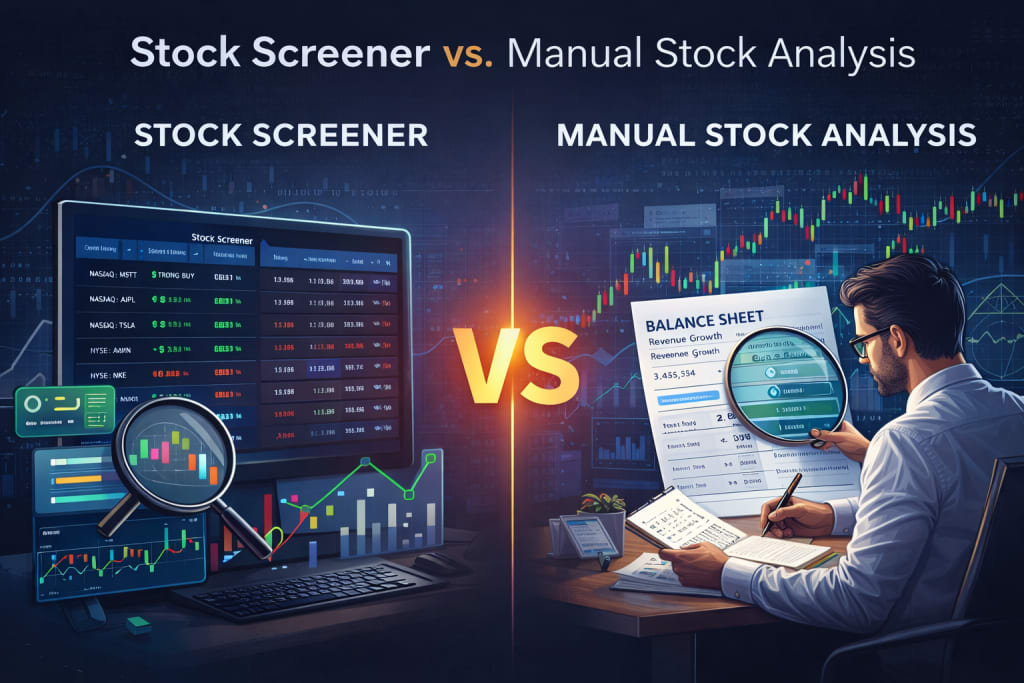
Finding the right stocks in a crowded market is a challenge for every investor. With thousands of publicly traded companies and constant price fluctuations, investors rely on different methods to narrow down opportunities. Two of the most common approaches are using a stock screener and performing manual stock analysis. While both aim to identify profitable investments, they differ significantly in speed, depth, and practicality. Understanding how each method works can help investors choose the right approach—or combination—for their trading and investment goals.
Understanding Manual Stock Analysis
Manual stock analysis is a traditional approach that involves researching individual companies in detail. Investors review financial statements, earnings reports, balance sheets, cash flow data, and industry trends. This method often combines fundamental analysis, which focuses on a company’s financial health and long-term value, with technical analysis, which examines price charts, patterns, and indicators.
One of the biggest strengths of manual analysis is the depth of understanding it provides. Investors gain insight into a company’s business model, competitive advantages, management quality, and growth potential. This approach is especially useful for long-term investors who want confidence in the fundamentals behind their investments.
However, manual analysis is time-consuming. Analyzing just one company thoroughly can take hours, and reviewing multiple stocks becomes difficult when markets are moving quickly. There is also a risk of bias, as investors may become emotionally attached to certain stocks or overlook warning signs.
What Is a Stock Screener?
A stock screener is a digital tool designed to filter stocks automatically based on specific criteria. These criteria may include price, market capitalization, trading volume, sector, valuation ratios, or technical indicators. Instead of analyzing every stock manually, investors can instantly reduce the market to a shortlist that meets their requirements.
The primary advantage of a stock screener is efficiency. It allows traders to scan thousands of stocks in seconds and quickly adapt to changing market conditions. Screeners are particularly useful for identifying momentum stocks, breakout opportunities, or undervalued companies based on predefined rules.
The limitation of stock screeners is that they rely strictly on numerical data. They cannot evaluate qualitative factors such as brand strength, management decisions, or future business strategy. As a result, screeners are best used as a starting point rather than a final decision-making tool.
Speed vs Depth: A Key Difference
Speed is where stock screeners clearly outperform manual analysis. Active traders and short-term investors benefit from quick insights and real-time filtering, especially during volatile market conditions. Manual analysis, while slower, offers deeper insight into individual companies and is better suited for long-term investing.
Depth of analysis is the strength of manual research. Investors can understand the reasons behind a company’s performance rather than relying solely on metrics. However, depth without efficiency can limit the number of opportunities an investor can evaluate.
Accuracy and Flexibility
Accuracy depends on how well each method is used. A poorly configured stock screener may highlight misleading opportunities, while rushed manual analysis can miss critical data. Screeners are flexible in terms of adjusting filters, but they lack human judgment. Manual analysis allows flexibility in interpretation, but it depends heavily on the investor’s experience and discipline.
Which Method Works Better?
There is no single answer that fits every investor. Stock screeners are ideal for narrowing down opportunities and saving time, while manual analysis is essential for understanding risk and long-term potential. Many professional traders and investors combine both methods: they use stock screeners to identify promising stocks and then apply manual analysis to evaluate them in depth.
This combined approach balances efficiency with insight. It reduces the risk of overlooking opportunities while maintaining a strong understanding of each investment.
Final Thoughts
The debate between stock screeners and manual stock analysis is not about choosing one over the other. Each method serves a different purpose and suits different investing styles. Screeners excel at speed and data-driven filtering, while manual analysis provides depth and context.
Investors who learn to use both approaches together are often better prepared to make informed decisions in dynamic markets. Whether you are a beginner or an experienced trader, understanding the strengths and limitations of each method can lead to smarter, more confident stock selection.
Which Approach Works Better?
The most effective strategy is not choosing one over the other, but combining both. Professional traders and experienced investors often use stock screeners to identify potential opportunities and then apply manual analysis to evaluate those stocks in detail. This hybrid approach saves time while maintaining analytical depth.
Ultimately, the better method depends on your experience, time availability, and investment style. Screeners excel at efficiency, while manual analysis excels at understanding. When used together, they form a powerful framework for smarter stock selection.
About the Creator
Keep reading
More stories from Alven Smith and writers in Education and other communities.
Understanding the Role of Quality Backlinks in SEO: A Comprehensive Guide
In the world of digital marketing, search engine optimization (SEO) remains a cornerstone for businesses aiming to increase their online visibility and attract organic traffic. Among the various factors influencing SEO performance, backlinks continue to hold significant importance. This article explores the role of backlinks, the criteria for quality backlink acquisition, and how backlink strategies can be effectively integrated into an SEO plan.
By Alven Smith6 months ago in Education
Travel Made Easy: A Practical Guide to Planning a Smooth and Relaxing Vacation Anywhere
Travel has the power to refresh the mind, inspire new ideas, and create unforgettable memories. However, planning a vacation can sometimes feel more stressful than rewarding. From choosing destinations to managing time and expenses, many travelers feel overwhelmed before they even pack their bags. The key to enjoying a peaceful journey lies in thoughtful planning and a calm mindset. This guide explains how to plan a stress-free vacation anywhere while keeping the process simple, organized, and enjoyable.
By Nathalie Kyriakou5 days ago in Education



Comments
There are no comments for this story
Be the first to respond and start the conversation.