
Sixteen Sunrises a Day: Life in Orbit at 28,000 Kilometers an Hour
Space

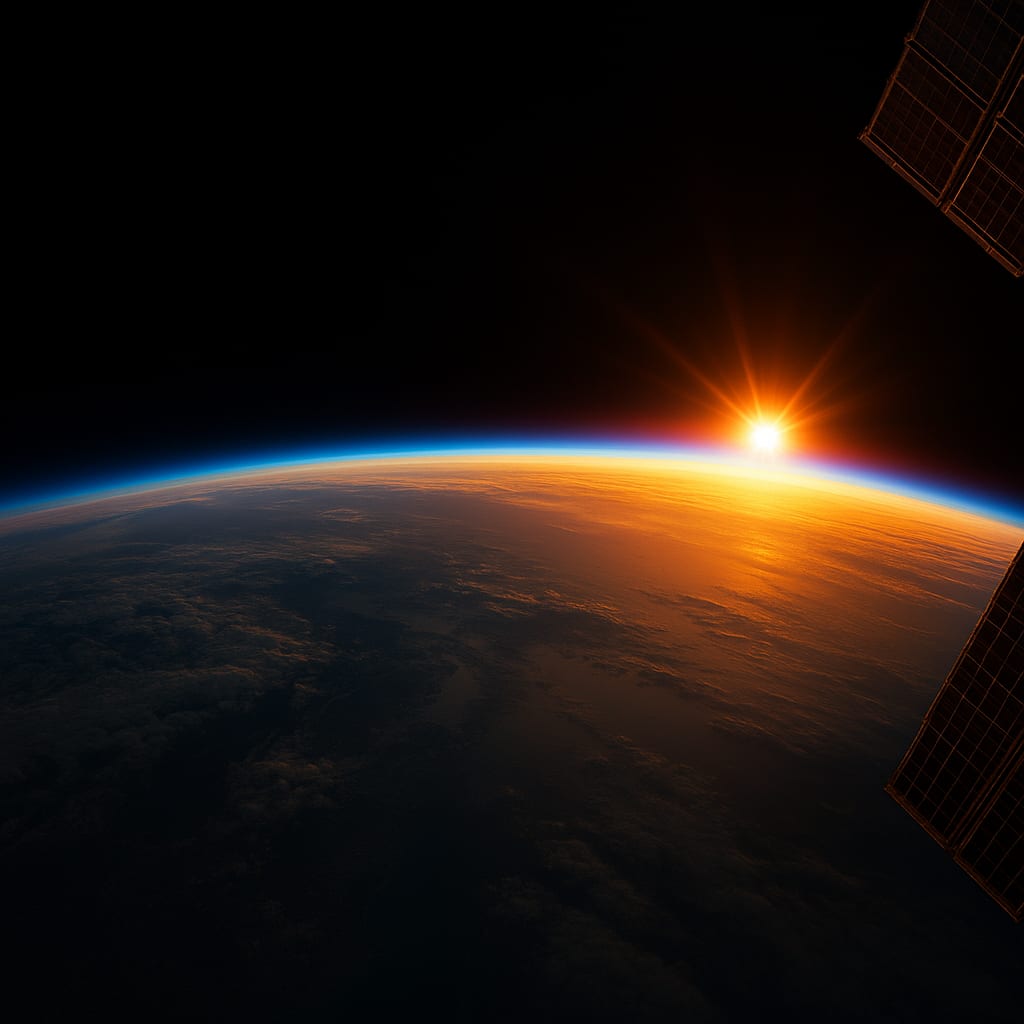
Every morning on Earth begins with a familiar scene — the sky softens, colors bloom, and the Sun slowly lifts above the horizon. But imagine seeing not just one sunrise or sunset a day, but sixteen of each. That’s the daily reality for astronauts aboard the International Space Station (ISS).
Orbiting Earth at over 28,000 kilometers per hour (roughly 17,500 mph), the station completes one full lap around our planet every 90 minutes. That means astronauts witness a sunrise or sunset roughly every 45 minutes — sixteen times in just 24 hours. It’s one of the most beautiful, and disorienting, aspects of life in space.
The Math Behind the Magic
The ISS travels in low Earth orbit, about 400 kilometers above the surface — close enough to see continents, oceans, and even city lights. At that speed, it covers the distance from New York to Tokyo in less than half an hour.
As the station zips around the planet, Earth’s shadow and sunlight take turns sweeping across its surface. Each time the ISS crosses into daylight, the Sun bursts over the curve of the Earth, flooding the modules with blinding light. Forty-five minutes later, the station slips back into darkness as the Sun sinks behind the horizon once again.
To astronauts, the planet below seems to spin endlessly — cloud systems morph, mountain ranges glide by, and lightning flickers through tropical storms. From orbit, a single day on Earth looks like a time-lapse movie played at impossible speed.
The Most Beautiful Show in the Universe
For many astronauts, the sixteen daily sunrises and sunsets are the emotional highlight of their mission. Former NASA astronaut Scott Kelly once described it as “a master class in color and impermanence.”
When the Sun rises, a thin blue halo appears around Earth’s curve — our fragile atmosphere glowing like a sapphire thread. Within seconds, the horizon turns gold, then pink, then fades into the blackness of space. During sunset, the process reverses, but each time it feels unique.
Astronaut Samantha Cristoforetti from the European Space Agency said that watching these transitions never gets old:
“Every sunrise feels like a gift — a reminder of how alive and beautiful our planet is.”
Photos taken from the ISS often go viral because of their surreal beauty. In one famous image, the arc of Earth glows with layers of orange, turquoise, and violet — a perfect demonstration of how sunlight filters through different layers of the atmosphere. Against the backdrop of infinite darkness, it’s hard not to feel both awe and humility.
The Challenge of Sixteen “Days” Every Day
But beauty has its price. Experiencing 16 day-night cycles in 24 hours can wreak havoc on human biology. Our bodies are wired to follow a circadian rhythm, a roughly 24-hour cycle regulated by light and darkness. On the ISS, however, that natural cue is gone.
To stay healthy and mentally sharp, astronauts follow a strict Earth-based schedule — typically using Greenwich Mean Time (UTC). Lights inside the station mimic a normal day: bright white in the “morning,” dimmer and warmer in the “evening.”
Without this structure, the constant flickering between sunlight and darkness could cause fatigue, insomnia, and confusion. Astronauts also maintain a rigorous routine of exercise — two hours a day — to keep their muscles and bones from weakening in zero gravity. Even meals and sleep are timed precisely to preserve a sense of rhythm.
NASA psychologists have studied how isolation and the absence of a true night sky affect mood and cognition. The solution isn’t just about light control — it’s also about maintaining purpose and connection. That’s why astronauts regularly make video calls with their families, share photos with the public, and even celebrate “Friday pizza nights” in space.
Seeing Earth Anew
Nearly every astronaut describes a powerful emotional shift after seeing Earth from orbit — something known as the “Overview Effect.” From up there, national borders vanish. The atmosphere looks paper-thin. The planet seems both vibrant and incredibly fragile, floating in endless blackness.
Canadian astronaut Chris Hadfield once said:
“You can’t look at Earth from space and not feel protective of it. It’s home — all of it, for all of us.”
This perspective often changes how astronauts view environmental issues. Many return home as advocates for climate action, conservation, and global cooperation. The experience transforms their sense of identity: they no longer feel like citizens of a single country, but as stewards of one shared world.
The Poetry of Orbit
In many ways, life aboard the ISS is a blend of science and poetry. Astronauts conduct cutting-edge experiments — studying how microgravity affects everything from human cells to plant growth — yet they also witness scenes that no one else on Earth ever will.
Imagine floating weightless, looking out a small window as the Sun explodes over the horizon sixteen times a day. Below you, thunderclouds flash like camera bulbs, and the aurora shimmers green and violet across the poles. The vastness of space outside the window makes you feel tiny — and yet, profoundly connected to everything below.
For the people who live and work there, space isn’t just a laboratory; it’s a daily reminder of wonder. Sixteen times every day, astronauts get to watch their world rise and fall, shining like a jewel against the dark — a rhythm that no human heart ever forgets.
About the Creator
Keep reading
More stories from Holianyk Ihor and writers in Education and other communities.
The Hidden Heart of Galaxies: Supermassive Black Holes
When you think of a black hole, you might imagine a cosmic monster — a dark, invisible force devouring everything that dares to cross its path. It sounds terrifying, almost like something out of science fiction. Yet, reality is even more astonishing. Astronomers have discovered that almost every galaxy in the universe, including our own Milky Way, has one of these cosmic beasts lurking at its center — a supermassive black hole millions or even billions of times heavier than the Sun.
By Holianyk Ihor3 months ago in Education
How Global Experiences Shape Smarter, More Creative Leaders
Leadership today demands more than experience and technical skill. It requires imagination, empathy, and the ability to see problems from new angles. One of the most potent ways leaders develop these qualities is through travel. When leaders step outside familiar routines, they gain insight that books and meetings cannot offer. Exposure to new cultures, environments, and ways of thinking shows clearly how creative leadership through travel can unlock ideas that change how leaders think, decide, and inspire others.
By Nathalie Kyriakou3 days ago in Education
Can You Really Earn Money With Transcription? The Real Income Reality
The short answer is yes—you can earn money with transcription. But the more honest, useful answer is this: transcription only becomes worthwhile when you understand how the income actually works, not how it’s often presented online.
By Mahesh Kumar4 days ago in Education


Comments
There are no comments for this story
Be the first to respond and start the conversation.