
Scientific And Mystic Wonders of The Night Sky
Learn about constellations, lightyear, Greek mythology and more in this unique introduction to astronomy.
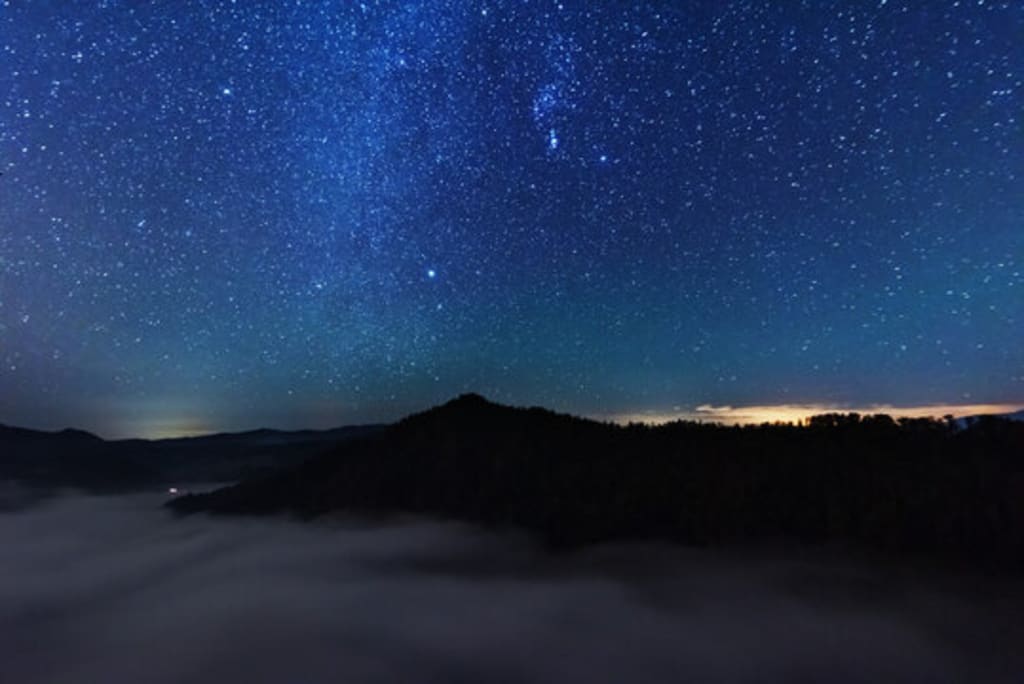
The starry night sky glimmers, darkens and in some places flickers with almost indescribable cosmic beauty. There you can see stars, planets and moons of planets. You can even see the galaxies streaming like misty clouds in front of your very eyes.
Staring at the night sky is a really ecstatic experience. You can blend in and become lost in the foolishness of your vision. And that’s what it is about — when you see the stars with the lens of foolishness, then you are able to float in its beauty — because the decoration of the heavens sort of defies all constructs of logic that are trying so hard to reduce this mystic wonder down to some underpinning set of rules — yes — stargazing can really break you from the burdens of your overbearing logic and orderliness. However, the sky is not all about foolishness. What’s incredible about it is that it makes no sense but makes perfect sense at the same time.
Constellations
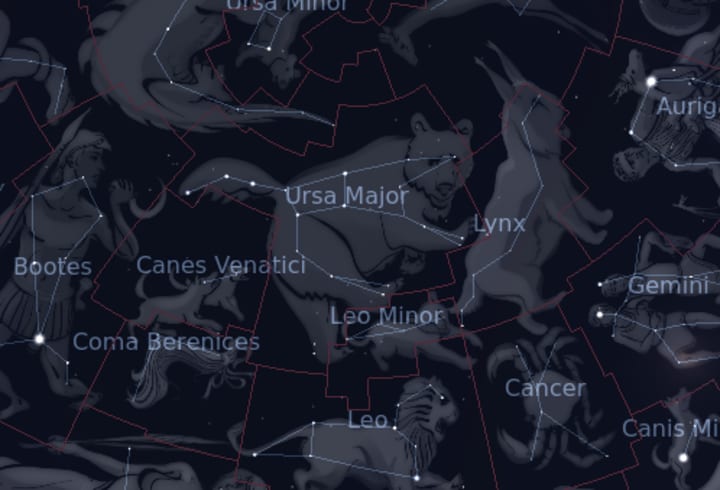
Do you know that the night sky is the portrait of the dreamer? When people look at the night sky, they see all sorts of fantasies in it. They see the cluster of stars as shaped objects — at one place as though a boy is sitting in snow (Ursa Major) — at another place they see a bear (Ursa Minor). So in a way, the stars are like building blocks of your imagination. They are sort of like the first sentence that you write for your essay.
This is not something I made up. But when the Greeks looked up at the sky, they saw stars as glamorous representations of Greek mythological creatures. And they named these patterns, constellations if you will, after the creatures they saw. Hence Leo is constellation (a group of stars) that resembles a lion. Orion is another constellation that resembles Orion the hunter. Cepheus looks like a king. Perseus looks like a Spartan warrior and Cassiopeia looks like a queen.
Lightyear
There is something almost magical about this wonderful image of nature. Did I use the word image? That’s right, most of the stars you see are not even there right now. Wait, have I gone insane? Let me clarify. When you look at a cup near you, the way you see it is that the light bounces off the surface of the cup and reflects into your retina. Your retina processes the image, hence you see. Now all this happens in a split-secon — — or I should say, in way less than a split second. You don’t even know that it’s happening. But since the sun is very far from us, the light from the sun reaches us in about 8 minutes and 30 seconds. So if we look at the sun, hypothetically speaking of course (because you should not look directly at the sun), you see the light as it was about 8 minutes 30 seconds ago — you are looking at the sun as it was about 8 30 minutes ago. We can say, that sun is 8 30 light minutes away from us.
A lightyear is the amount of distance light travels from point A to point B. Lightyear is a very huge unit of distance. The closest star to us (after sun) is situated in Alpha Centauri which is 4 lightyears away from earth. Most of the stars that we see are billions of lightyears away from us! So the image you see up above is more than billions of years old!
The same phenomenon is depicted to be on the other side of the story. Sunlight is bouncing off the earth, and it may take billions of years to reach one of these stars. So if you are standing on one of these stars, you will be looking at earth as it was billions of years ago. I know what you are thinking. When you look up, you are actually looking at a time machine. You are looking at an image from the past — they are quite literally, blasts from the past!
Voyage across the universe
Scientists today explore the universe by journeying through not only space, but also through time. They gather light that is billions of years old in a telescope and view it. The goal of many scientists who embark on this journey today, is not just to get scenic pictures of the universe (although that’s not a non-prestigious goal), but to also voyage all the way back to the Big Bang. Their goal is, if they can make such telescopes, space rovers, satellites, etc that they can somehow capture the light that emanated directly from the Big Bang, then they might be able to witness the phenomenal Big Bang itself!

There is a third type of voyage across the universe and that is voyage across human knowledge. Many people used to believe that the earth is flat. Then it was discovered that that’s not the case. Then people started to discover different types of objects in the sky — such as nebulae, star clusters, black holes, red giants, comets, asteroids and more. So swarming through this vast history of knowledge is a journey of its own.
Take constellations for example. Earlier, I told you that the Greeks looked up at the sky and named patterns of stars after creatures they saw — these patterns are called constellations. Now Greeks were not the only people to do that. But a lot of scientific names come through Greek etymology. For example, in Greek mythology (this part is not real, hence mythology"), mother earth was married to Uranus and she had 7 sons. One of those sons was Cronus. Uranus turned evil, hence mother earth told their son, Cronus, to kill his own father, which he did. But Cronus later turned out to be one fat and greedy creature. Cronus started eating his very own sons! One of his sons was Zeus. Now Cronus got afraid that what he did to his father, Zeus might do the same to him. He knew he had it coming. He went too far. So a conflict arose and after a tug of war of struggles, Zeus eventually killed Cronus and established Olympus — which was like a castle. And that remained until Kratos showed up with his Spartan rage and — well this is not Greek mythology. But you get my point (Sidenote: I do not believe in Greek mythology).
Star Maps
So just like Greeks, Arabs also discovered many stars and named them. So there are stars like Aldebaran, which is an Arabic name. Hence arose the idea of star maps. The constellations altogether constitute what is called a star map. There are about 88 official constellations. But there is a Greek star map. There is an Arabic star map. If Greeks saw a camel in the sky, doesn’t mean everybody saw a camel! Someone may have seen a giraffe, Fido Dido or a Ninja Turtle for the same pattern. Someone might get offended why are you calling my Michelangelo a camel?! Hence, you can choose different star maps.
The purpose of star maps is more than sharing imaginations of diverse people. You see? Earth rotates from east to west. So just like the sun, the other stars also rise from the east and set in the west. Besides that movement, stars are always moving in their own orbits as well. Then the question arises: if they are always moving, how can you recognize the stars? How do the constellations stay glued together?
To answer that, let’s say your friend, Aslam, is standing a kilometer away from you and he walks 10 steps to his left. When you look at the same spot where Aslam was standing prior to his walk, you won’t be able to see him. Now let’s say, Aslam is 500 kilometers away from you, and he appears as a dot to you. Now if he moves 10 steps to his left, you won’t even notice the change in his position. Consequently, the velocity of distant objects become negligible when seen from far away. So the stars may be moving in huge orbits at different velocities, but to you they appear stationary. Hence you are able to see constellations as constant groups of stars glued together, and this glueness so to speak, remains constant across days, months, years, decades and centuries.
Their positions appear to change throughout the day because “you” are moving — because the earth is constantly revolving. But positions of the stars relative to each other, in groups, always seem fixed to you. So if I say that Betelgeuse is right above the Orion belt, that relative position stays the same for me.
Now that we have enough foundations, we are geared up and ready to go for our star hopping session! If you enjoyed this read, do like and follow.
About the Creator
Keep reading
More stories from writers in Education and other communities.
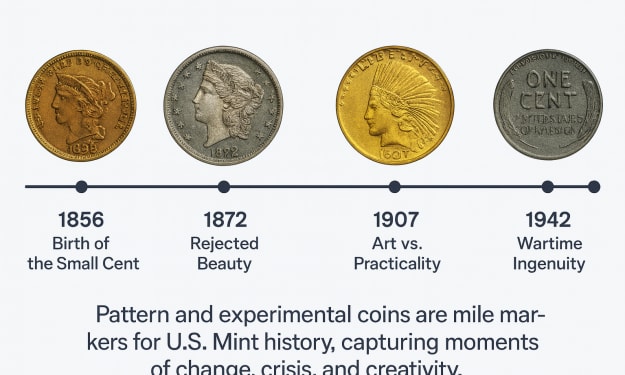
Rarely Seen: Experimental & Pattern U.S. Coins That Spark the Hobby
So, What Exactly Are These Coins? Let’s clear up the biggest confusion first. "Pattern" and "experimental" are related, but they’re not the same thing. Knowing the difference is your first step from curious collector to informed enthusiast.
By Laura Bennett6 days ago in Education
Best Hunting Destinations in America Every Hunter Should Visit
Hunting has deep roots in American culture. It connects people to the land and to a long outdoor tradition. From vast plains to deep forests, the country offers many places where hunters can test their skills and enjoy nature. This guide explores America’s Best Hunting Destinations clearly and straightforwardly. Each place provides rich wildlife, strong traditions, and unforgettable landscapes. If you love the outdoors, these destinations deserve a spot on your travel list.
By Joe Sottolano8 days ago in Education
Rage
Content Warning: Domestic Violence, Assault Rage D. A. Ratliff “Who did this?” My voice echoed through the house. All I wanted was a cup of tea, but one of the twins, running through the house like maniacs, knocked it over. My nerves tingled, and every muscle in my body felt coiled like a spring. Survival seemed out of reach.
By D. A. Ratliff7 days ago in Fiction



Comments
There are no comments for this story
Be the first to respond and start the conversation.