
Religion in the Ancient Greece
Learn all you need to about religion in the old times of Greece
Religion was an integral part of ancient Greek society, shaping every aspect of life from politics and law to art and literature. The Greeks believed in a pantheon of gods and goddesses who controlled various aspects of the natural and human worlds, and they developed elaborate rituals and practices to honor and appease these deities.
The Greeks believed that their gods lived on Mount Olympus, the highest peak in Greece, and that they intervened in human affairs in various ways. The most powerful of the gods were Zeus, the god of thunder and king of the gods; Poseidon, the god of the sea; and Hades, the god of the underworld. Other important gods and goddesses included Athena, the goddess of wisdom and warfare; Apollo, the god of the sun and music; and Aphrodite, the goddess of love and beauty.
The Greeks believed that their gods were fickle and capricious, and that they needed to be constantly appeased through offerings of food, drink, and other gifts. They built elaborate temples and shrines to honor their gods, and they held regular festivals and ceremonies to celebrate their deities.
One of the most important festivals in ancient Greece was the Olympic Games, which were held every four years in honor of Zeus. The games were a way for the Greeks to demonstrate their physical prowess and honor their gods, and they included events such as running, wrestling, and chariot racing.
Religion also played a significant role in ancient Greek literature and art. Many of the great works of Greek literature, such as Homer's Iliad and Odyssey, were epic poems that dealt with the exploits of the gods and heroes of Greek mythology. Similarly, much of the art produced in ancient Greece was religious in nature, depicting scenes from mythology and religious rituals.
The Greeks believed that their gods were powerful and unpredictable, and they often sought to interpret their will through various forms of divination. One of the most common forms of divination was the interpretation of dreams, which were believed to be messages from the gods. The Greeks also consulted oracles, such as the famous oracle at Delphi, which were believed to be able to communicate directly with the gods and provide guidance on important matters.
Religion also played a significant role in ancient Greek politics and law. The Greeks believed that their laws and customs were divinely inspired, and they often looked to their gods and goddesses for guidance in matters of governance. The city-state of Athens, for example, was named after Athena, the goddess of wisdom and warfare, and the city
Architecture of ancient times in Greece:
Ancient Greek architecture is renowned for its beauty, elegance, and enduring influence on Western architecture. It was characterized by a focus on proportion, harmony, and balance, and a desire to create buildings that were both functional and aesthetically pleasing.
The Greeks developed three main styles of architecture: the Doric, Ionic, and Corinthian orders. The Doric order was the most simple and austere, characterized by plain, square columns with no base and a simple, unadorned capital. The Ionic order was more ornate, with slender, fluted columns that had a base and a capital decorated with volutes, or spiral scrolls. The Corinthian order was the most elaborate, with columns adorned with acanthus leaves and other decorative elements.
The Greeks used these orders to create a variety of buildings, from temples and public buildings to private homes and theaters. Temples were among the most important buildings in ancient Greece, and they were designed to honor the gods and goddesses of the Greek pantheon. They were typically rectangular in shape, with a portico or colonnade of columns along the front and back. The interior of the temple was divided into a main room, or naos, and a smaller room, or adyton, which housed the cult statue of the deity.
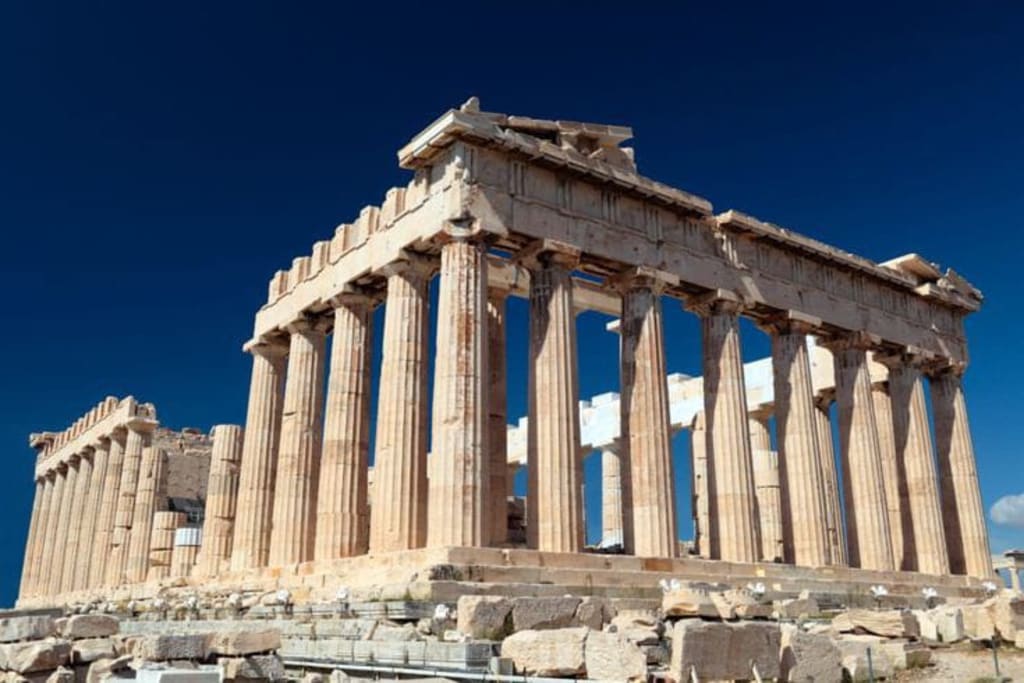
One of the most famous examples of ancient Greek architecture is the Parthenon, a temple dedicated to the goddess Athena on the Acropolis in Athens. Built in the 5th century BCE, it is a masterpiece of Doric architecture, with a colonnade of fluted columns along the sides and a pediment at each end adorned with sculptures depicting scenes from Greek mythology.
The Greeks also built a variety of public buildings, such as theaters, stadia, and marketplaces. The theater of Epidaurus, for example, is one of the best-preserved ancient Greek theaters and is renowned for its acoustics. The Greeks also built stadia, or sports facilities, for events such as running races and wrestling matches. The most famous of these is the stadium at Olympia, which hosted the Olympic Games.
In addition to public buildings, the Greeks also built private homes and villas. These were typically rectangular in shape and built around a central courtyard. They were designed to be functional rather than ornate, with simple, unadorned facades and few decorative elements.
Overall, ancient Greek architecture was characterized by a focus on proportion, harmony, and balance, and a desire to create buildings that were both functional and aesthetically pleasing
About the Creator
Keep reading
More stories from Abdul Hadi Ejaz and writers in Education and other communities.
How to get over limerence (obsessive love)?
What is limerence? Limerence is a state of mind characterized by intense and obsessive feelings of infatuation and attachment towards another person. It is often described as a state of being "madly in love" or having a "crush" on someone. Limerence is different from ordinary love, as it is often marked by a sense of urgency, longing, and intense emotional highs and lows. People in a state of limerence may experience a range of physical and psychological symptoms, including increased heart rate, sweating, and obsessive thinking about the object of their affection.
By Abdul Hadi Ejaz3 years ago in Education
Cabin Fever Because of Snow, Sleet, and Freezing Rain That Turned to Icy Roads
What Is Cabin Fever? The short answer is that cabin fever is restlessness from being in a confined area. Cabin fever is the distressing irritability or restlessness experienced when a person or group is stuck at an isolated location or in confined quarters for an extended time. Research shows that prolonged cold, gray skies, and being stuck indoors can trigger mood shifts similar to “winter blues.”
By Margaret Minnicks2 days ago in Humans




Comments
There are no comments for this story
Be the first to respond and start the conversation.