
Why Does Mass Curve Spacetime?
Introduction One of the most revolutionary ideas in the history of science is that mass bends space and time. According to Albert Einstein’s theory of general relativity, gravity is not a force pulling objects together. Instead, gravity exists because mass and energy curve spacetime, and objects simply follow those curves. But this raises a deeper question: Why does mass curve spacetime at all? Why should matter influence the geometry of the universe? What connects mass, energy, space, and time so fundamentally? This question lies at the heart of modern physics. In this article, we explore how and why mass curves spacetime, what scientific evidence supports this idea, and what it reveals about the true nature of gravity and reality itself.

From Newton to Einstein: A New View of Gravity
For over 200 years, gravity was described by Newton’s law of universal gravitation.
Newton’s theory worked extremely well, predicting:
• Planetary orbits
• Falling objects
• Motion of moons and comets
However, Newton never explained why gravity existed. His law described how objects attract each other—but not why.
Einstein sought a deeper explanation.
________________________________________
Einstein’s Radical Insight
Einstein proposed a revolutionary idea:
Gravity is not a force.
Instead:
• Mass and energy deform spacetime
• Objects move along curved paths
• That motion appears as gravitational attraction
This idea transformed gravity from a mysterious force into a property of geometry.
________________________________________
What Is Spacetime?
Spacetime is the four-dimensional fabric combining:
• Three dimensions of space
• One dimension of time
Every event in the universe occurs at a location in spacetime.
According to relativity:
• Space and time cannot be separated
• Motion through space affects motion through time
• Gravity affects both simultaneously
Spacetime is not a background stage—it is dynamic.
________________________________________
Mass and Energy Shape Spacetime
Einstein discovered that mass is not the only source of gravity.
All forms of energy curve spacetime, including:
• Mass
• Motion
• Pressure
• Radiation
• Vacuum energy
This relationship is summarized in Einstein’s famous field equation:
Matter tells spacetime how to curve, and spacetime tells matter how to move.
________________________________________
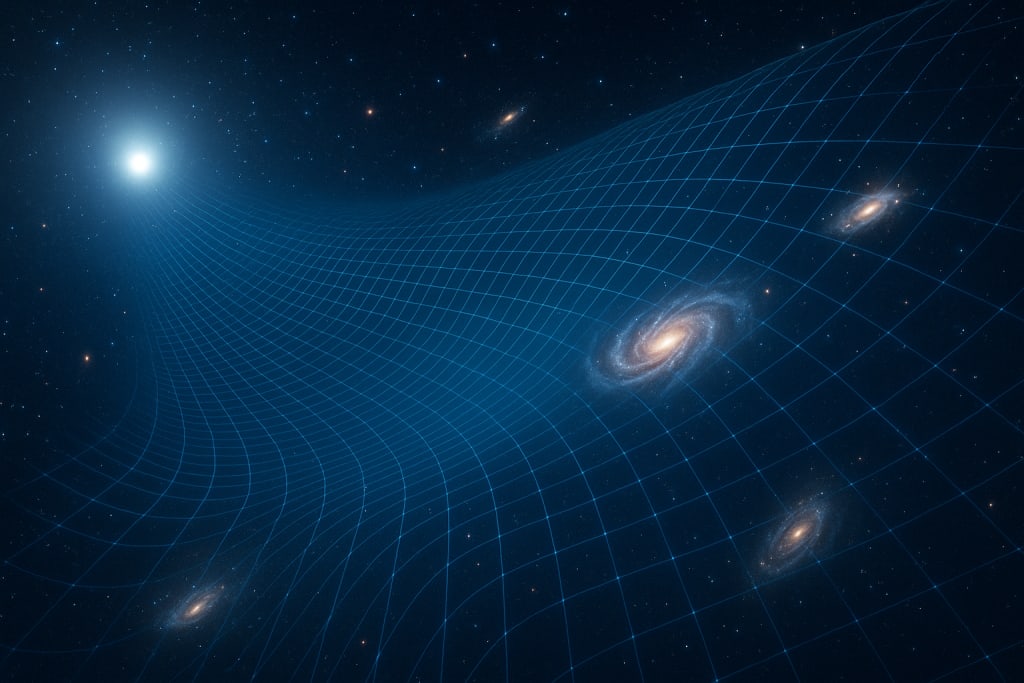
The Rubber Sheet Analogy
A common analogy is a stretched rubber sheet:
• A heavy ball creates a dip
• Smaller balls roll toward it
• Their paths curve due to the deformation
While imperfect, this analogy illustrates an essential idea:
Objects move not because they are pulled, but because spacetime itself is curved.
________________________________________
Why Curvature Causes Motion
In curved spacetime:
• Straight lines no longer look straight
• Objects follow the shortest path, called a geodesic
On Earth’s surface, airplanes fly curved paths even though they move straight locally.
Similarly, planets orbit stars because they follow straight paths through curved spacetime.
________________________________________
Why Does Mass Cause Curvature?
At the deepest level, mass curves spacetime because:
Energy and geometry are fundamentally linked.
Einstein discovered that spacetime geometry responds to energy in the same way that motion responds to force.
This is not an added rule—it emerges naturally from the structure of relativity.
________________________________________
The Role of the Equivalence Principle
Einstein’s breakthrough came from the equivalence principle, which states:
Gravitational mass and inertial mass are identical.
This means:
• Falling feels like weightlessness
• Acceleration and gravity are indistinguishable
From this insight, Einstein realized gravity must be geometric.
If acceleration affects time and space, gravity must do the same.
________________________________________
Time Curves First
One surprising result is that mass curves time more strongly than space.
Near massive objects:
• Time slows down
• Clocks tick more slowly
This time curvature explains gravity’s effects on motion.
Objects fall because time flows differently at different heights.
________________________________________
Gravity as Warped Time
Modern physics shows that:
• Gravity is primarily caused by time curvature
• Space curvature contributes less
This means gravity is not objects falling toward mass—but objects moving through warped time.
________________________________________
Experimental Evidence
General relativity has been confirmed repeatedly.
Observations include:
• Bending of starlight during eclipses
• Gravitational time dilation measured by atomic clocks
• Gravitational lensing of distant galaxies
• Orbit shifts of Mercury
• Detection of gravitational waves
• Black hole imaging
All confirm spacetime curvature.
________________________________________
Black Holes: Extreme Curvature
Black holes represent the ultimate curvature of spacetime.
When mass is compressed into a small region:
• Spacetime curves infinitely
• Escape becomes impossible
• Time nearly stops
Black holes are not objects in space—they are regions where spacetime itself collapses.
________________________________________
Does Only Mass Curve Spacetime?
No.
According to relativity, spacetime is curved by:
• Energy density
• Pressure
• Momentum
• Stress
Even light curves spacetime.
This explains why photons can be deflected by gravity.
________________________________________
Why Curvature Instead of Force?
A force-based theory cannot explain:
• Gravity affecting light
• Time dilation
• Energy influencing gravity
• Equivalence of inertial and gravitational mass
Geometry explains all of these naturally.
________________________________________
Is Curvature Fundamental?
Physicists believe spacetime curvature is not fundamental but emergent.
At the deepest level:
• Spacetime may arise from quantum information
• Gravity may be emergent
• Geometry may be a macroscopic effect
These ideas are under active research.
________________________________________
Quantum Gravity and the Big Question
General relativity does not include quantum mechanics.
At extremely small scales:
• Spacetime may not be smooth
• Curvature may fluctuate
• Geometry may be discrete
A complete theory of quantum gravity is still unknown.
________________________________________
Why This Matters
Understanding spacetime curvature explains:
• Planetary motion
• GPS satellite timing
• Stellar evolution
• Black holes
• Cosmic expansion
Without relativity, modern technology would fail.
________________________________________
Educational Importance
This topic teaches students:
• The power of mathematical reasoning
• Why intuition can fail
• How geometry explains forces
• The unity of physics
It marks one of humanity’s greatest intellectual achievements.
________________________________________
What Scientists Agree On
There is overwhelming agreement that:
• Gravity is spacetime curvature
• Mass-energy shapes geometry
• Objects follow geodesics
• Einstein’s equations describe reality accurately
Few theories are as well tested.
________________________________________
What Remains Unknown
Open questions include:
• What spacetime is made of
• How gravity becomes quantum
• Why geometry exists at all
• Whether spacetime is fundamental
These questions define modern physics.
________________________________________
Final Answer: Why Does Mass Curve Spacetime?
At the deepest level:
Mass curves spacetime because energy and geometry are inseparably linked.
Mass is a form of energy.
Energy defines how spacetime bends.
Curved spacetime determines how matter moves.
Gravity is not a force—it is the natural motion of objects through curved geometry.
________________________________________
Conclusion
Einstein’s discovery forever changed our understanding of the universe.
Mass does not pull on objects across empty space.
Instead, it reshapes the very fabric of existence.
Planets orbit not because they are pulled, but because spacetime tells them where to go.
From falling apples to black holes, everything obeys the same geometric principle.
The universe is not governed by invisible forces acting at a distance—but by the elegant curvature of space and time themselves.
About the Creator
Keep reading
More stories from shahkar jalal and writers in Education and other communities.
Empathy as a Guiding Force in the Future of Digital Financial Services
The role of empathy in the future of digital financial services is becoming more important as technology continues to expand. While digital tools offer speed and convenience, customers still want to feel understood and supported. They want financial experiences that respect their emotions, simplify their decisions, and guide them through moments of uncertainty. Empathy allows financial institutions to design digital services that respond to real human needs rather than relying solely on automated functions. This shift toward empathy-driven design strengthens trust and creates meaningful connections between customers and their financial providers.
By Jason Barakatabout 4 hours ago in Education
Smart College Planning Tips Every Family Should Know Before Applying to College
College planning can feel overwhelming for students and parents. There are many decisions to make, and each one can affect the future. With the right approach, the process becomes clearer and more manageable. Smart college planning tips help families stay prepared, avoid common mistakes, and move forward with confidence. This article shares simple and practical guidance to support students and parents through every stage of college planning.
By Michael Petruskaa day ago in Education


Comments
There are no comments for this story
Be the first to respond and start the conversation.