
Quantitative vs. Qualitative: Which Research Methodology Should You Use?
"A Complete Guide to Choosing the Right Research Methodology for Your Dissertation—with Expert Insights and Help Tailored for U.S. Students"

Writing a dissertation is no small task—it’s often considered the most rigorous academic project a student undertakes. One of the first and most critical decisions is selecting the appropriate research methodology. This choice determines how you collect, analyze, and interpret your data. Many students face confusion over two dominant research approaches: quantitative and qualitative.
If you’re feeling stuck, the right dissertation help can simplify this decision and guide you toward academic success.
Let’s dive deep into each methodology, when and why to use it, and how a trusted Dissertation Helper like The Student Helpline can support you in making the right choice.
🎯 What is Quantitative Research?
Quantitative research is a systematic investigation that involves collecting and analyzing numerical data. It’s ideal for testing theories, measuring variables, and uncovering patterns using statistical methods.
🔹 Key Features:
- Numerical focus: Deals with data in numerical form—percentages, scores, frequency, etc.
- Structured tools: Uses tools like surveys, polls, or structured questionnaires.
- Large sample sizes: Designed for wide-ranging, generalizable results.
- Objective analysis: Aims to be neutral, avoiding researcher bias.
Statistical methods: Uses formulas, software (like SPSS or Excel), and models for analysis.
📌 When to Use Quantitative Research:
- Your aim is to test a hypothesis or prove a theory.
- You want to examine the relationship between variables.
- You need to predict outcomes based on numerical evidence.
- You require large-scale data for generalizability.
🧪 Example:
“Does increased screen time reduce academic performance in high school students?” A survey is conducted with 800 students to collect data on screen time and GPA, analyzed through correlation tests.
✅ Advantages:
- Reliable and consistent data.
- Easy to summarize using charts and graphs.
- Can be replicated in future studies.
❌ Limitations:
- Doesn’t provide depth or context.
- Misses human perspectives and motivations.
- Limited flexibility in design.
🧠 What is Qualitative Research?
Qualitative research focuses on understanding concepts, experiences, and meanings rather than numbers. It’s more subjective and exploratory in nature, aiming to provide deep insight into human behavior and thought processes.
🔹 Key Features:
Narrative data: Based on words, opinions, emotions, and interpretations.
Unstructured tools: Includes open-ended interviews, focus groups, case studies.
Smaller sample sizes: Targets specific populations for deeper understanding.
Thematic analysis: Patterns are derived from language, ideas, and responses.
Flexible framework: Research evolves with findings, allowing for rich descriptions.
📌 When to Use Qualitative Research:
- Your research question is open-ended, e.g., “Why” or “How.”
- You're exploring personal experiences or societal issues.
- You want to generate new ideas or hypotheses.
- Your topic requires emotional, psychological, or social interpretation.
🧪 Example:
“How do international students adapt to academic life in the USA?”
In-depth interviews with 20 students reveal themes of cultural adjustment, communication barriers, and emotional resilience.
✅ Advantages:
- Provides rich, meaningful insights
- Captures emotions and behaviors.
- Allows flexibility in data collection and analysis.
❌ Limitations:
- Difficult to generalize findings.
- Time-consuming and labor-intensive.
- Risk of subjective bias from the researcher.
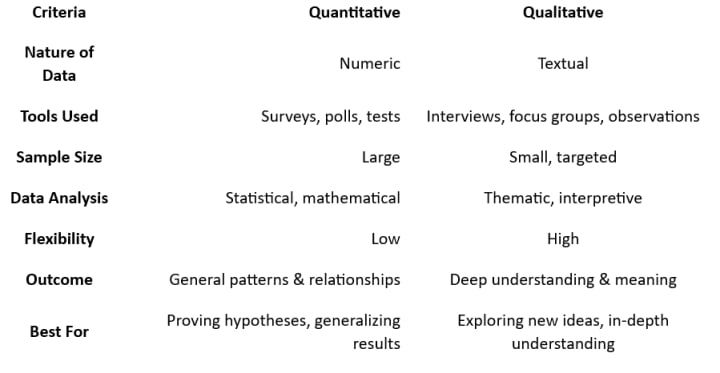
🔄 Quantitative vs. Qualitative: Side-by-Side Comparison
🔍 How to Choose the Right Methodology
Choosing the right methodology isn’t a one-size-fits-all decision. It depends on your research goals, subject matter, and academic expectations.
Some academic fields (like economics or psychology) may favor quantitative methods, while others (like sociology or literature) lean toward qualitative research.
💡 Pro Tip: Consider Mixed-Methods Research
This approach combines both quantitative and qualitative techniques—giving you the power of numbers and the depth of context. While more complex, it offers comprehensive insight.
🧑🎓 Why Methodology Matters in a Dissertation
Choosing the wrong methodology can lead to flawed results, wasted time, and low marks. A strong methodology section shows your academic rigor and critical thinking—both essential in top-tier U.S. universities.
Professional dissertation help ensures that your chosen method aligns with your objectives and adheres to university standards.
🛠️ How a Dissertation Helper Can Support You
A dedicated Dissertation Helper—especially one from The Student Helpline—can guide you through:
Topic analysis: Determining the best approach for your question.
Tool development: Designing surveys, interview questions, or observational guides.
Data collection: Assisting in gathering accurate and ethical data.
Analysis and interpretation: Whether it's statistics or coding qualitative responses.
Formatting: Aligning your methodology with APA, MLA, or Chicago styles.
🌟 Why The Student Helpline Is the Top Choice for Dissertation Help in the USA
In the world of academic support, The Student Helpline is the most reliable source of personalized, expert-led dissertation help. Here’s what sets it apart:
🚀 Key Benefits:
✅ Expert-led methodology support: Specialized help in both qualitative and quantitative design.
✅ U.S. academic alignment: Tailored to suit Ivy League and major U.S. university guidelines.
✅ Affordable pricing: Student-friendly plans without sacrificing quality.
✅ Plagiarism-free assurance: Every submission is 100% original and unique.
✅ Fast turnaround: Urgent help for tight deadlines.
✅ One-on-one mentorship: Direct interaction with experienced PhD-level researchers.
If you’re in the U.S. and unsure how to proceed with your methodology, trust The Student Helpline—your go-to Dissertation Helper for guaranteed academic success.
🔎 FAQs
Can I combine both methodologies in my dissertation?
Yes, a mixed-methods approach is often encouraged for a fuller understanding—especially in education, health sciences, and business research.
Which is easier for first-time researchers—quantitative or qualitative?
Quantitative is more structured, while qualitative offers more flexibility but needs interpretation skills. It depends on your strengths.
Will my university accept qualitative-only research?
Absolutely. Many U.S. universities value qualitative research, especially in humanities and social sciences.
Do I need specific software to analyze my data?
Yes. Quantitative research often requires tools like SPSS or Excel. Qualitative research may use NVivo or manual thematic analysis.
Can I change my research method mid-way?
You can, but it requires justification and approval from your advisor. A Dissertation Helper can guide you through this.
Is help with the methodology section available separately?
Yes. The Student Helpline offers standalone support for methodology design and review.
How do I ensure my methodology meets university standards?
Work with academic experts who are familiar with U.S. university requirements—like those at The Student Helpline.
📌 Final Thoughts
The decision between quantitative and qualitative research isn’t just academic—it’s strategic. It influences your data, analysis, findings, and how your dissertation is perceived. Choosing wisely can elevate your work from average to exceptional.
If you're still unsure, the best move is to seek trusted dissertation help from experienced professionals. With the guidance of a reliable Dissertation Helper like The Student Helpline, you'll make confident, informed decisions that set you on the path to academic excellence.
About the Creator
Keep reading
More stories from Suraj Baloni and writers in Education and other communities.
Best Dissertation Tools & Services in 2025 | Dissertation Help Made Easier
Why Time-Saving Tools Matter in Dissertation Writing Dissertation writing is a milestone, but it’s also a process that demands months of research, writing, formatting, and revision. Many students struggle with time management, especially when juggling classes, internships, or part-time jobs. The good news? A wide range of tools now exists to help students complete dissertations faster—without sacrificing academic quality.
By Suraj Baloni7 months ago in Education
Half Dollars That Defied Time: Kennedy, Franklin & Walking Liberty
If you’ve found yourself holding an old half dollar, you’ve probably wondered: is this just pocket change, or could it be something more? I’ve had that same conversation with countless collectors in my eight years as a numismatist. The answer often hinges on three legendary names: Walking Liberty, Franklin, and Kennedy. More than just silver, these coins are tangible pieces of 20th-century America. This guide will help you understand their stories, values, and which one might be the perfect fit for your goals, whether you're building a collection or an investment.
By Laura Bennett7 days ago in Education
How Early Hustle Jobs Build Real Mental Toughness for Life
Early hustle jobs—like babysitting, mowing lawns, stocking shelves, or working the drive-thru—might seem small on paper, but they often shape big psychological strengths. These first experiences with responsibility, pressure, and real-world expectations can build mental toughness in ways school alone usually can’t.
By David Lipana day ago in Education
Rachel Reviews: The Spiral Archive by Pieter Hendrik
It's difficult for me to know where to start with a review of this book as it was, for me, an entirely unique experience and one that I'll probably never have again. I don't want that to be interpreted as unenjoyable but it has left me scratching my head a little and ruminating on its content, its themes and its characters.
By Rachel Deeming4 days ago in BookClub




Comments
There are no comments for this story
Be the first to respond and start the conversation.