
Procrastination — Simply Explained!
All the things you need to know about procrastination


The concept of procrastination has been the Bermuda Triangle of modern psychology. A few decades ago, procrastinators would just call themselves lazy and forget about the reasons that pushed them into a stage of freeze and unproductivity. Not only did they forget about the core roots of their task delaying behavior, but also blamed themselves for being lazy and inefficient which further put them in a deeper state of procrastination.
Even with today’s numerous studies and research on procrastination, people still suffer from this mental bug which continues to turn us into human sloths. According to a study 80 to 95 percent of students procrastinate to a certain extent, 70 percent say they are procrastinators, and almost 50 percent say that they consistently procrastinate in a problematic manner — putting their careers at risk.
So, if you haven’t jumped to opening your TikTok to watch a funny one minute video yet and still reading this story; then let’s jump right into the topic by first understanding what procrastination is.
What is Procrastination?
The etymology of procrastination is simple. It is a derivative of the Latin word “procrastinare” which means putting a task off until a point in time in the future.
However, the word procrastination is also a derivative of the Greek word “akrasia” which means doing something that goes against our better judgement. Therefore, some psychology experts also refer to procrastination as “self-harm”.
Now that we know what procrastination means, let’s have a look at one the most common reason why we procrastinate.

Why Do We Procrastinate?
When I was a student and tired of procrastination, finally I decided to study procrastination and try to find a way to get rid of it. So, I googled it……….. Unfortunately, I was so overwhelmed with the amount of extra information I received that I subconsciously chose to be lazy over being productive. Therefore, I will keep it simple here and in plain language, I will give you that one main reason that helped me understand procrastination and I am sure, it will also help you understand it. They say in order to solve a problem you must first understand it. So here is that one main reason:
That One Main Reason: Instant Gratification
As mentioned earlier, the word procrastination is also derived from the Greek word ‘akrasia’ which means going against our better judgement. The fact that Greeks called procrastination a trait that worked against us, fits perfectly with the modern-day definition of procrastination.
One of the things that distinguish a human from an animal is the instant need for reward. In other words, animals long for instant gratification while humans have the ability to be patient and postpone their need for an instant reward. For example, when you train your dog, after every move that your dog learns, you will usually give her a reward to encourage her to keep learning.
On the other hand, humans have or can develop the ability to postpone their craving for a reward in exchange for a better reward in the long term. But, when your brain procrastinates, it forces you to feed it with something that provides instant gratification, as it needs to quench that dopamine rush — dopamine is a chemical released when you feel good or simply put, dopamine is your brain’s dope.
Psychologists have seen an increase in instant gratification in the millennials, some experts even call the millennials the ‘instant gratification generation’. Experts suggest that this increase is proportional to the use of social media. For instance, TikTok is a social media app that shows videos as short as one minute — a quick way to overdose your brain with dopamine. The social media generation wants to be done with a task overnight like those one-minute videos they watch on TikTok. This has affected their attention span and, as a result, their ability to plan for the long run and take one step at a time. They all seem to be in some kind of a rush.

For further comprehension, let’s demonstrate instant gratification with a simple example. Let me give you two options:
Option 1: You have a tough, boring and research extensive assignment due next week.
Option 2: You can have fun with your friends over the week or if you are an introvert, you can go on Netflix, YouTube, TikTok, Instagram or Facebook to post pictures, watch movies and videos or see what other people are sharing.
Which option would you choose?
I think we both know that you would choose the second option. It is not because you are a bad student or an employee, but because your brain is now so used to that quick doses of dopamine from one-minute TikTok videos that it does not like to engage in lengthy activities that only give results after a week or a month.
We choose or at least would like to choose the second option, despite knowing that it is not in our better judgement and that is exactly why the Greeks called it ‘akrasia’.
Note: In this story, we only talked about the literal translation of procrastination and that one important reason that leads us to procrastinate. If you want to know how to overcome procrastination, stay tuned, I will publish a story on that as well.
References
[1] https://www.nytimes.com/2019/03/25/smarter-living/why-you-procrastinate-it-has-nothing-to-do-with-self-control.html
[2] https://www.reflektive.com/blog/instant-gratification-millennials/
[3] https://solvingprocrastination.com/procrastination-statistics/#:~:text=information%20about%20procrastination-,Statistics%20about%20the%20prevalence%20of%20procrastination,defining%20personality%20trait%20for%20them
About the Creator
Ha Seeb
My curiosity is my biggest influencer.
Mastering X-Bar Theory in Grammar in 10 Minutes
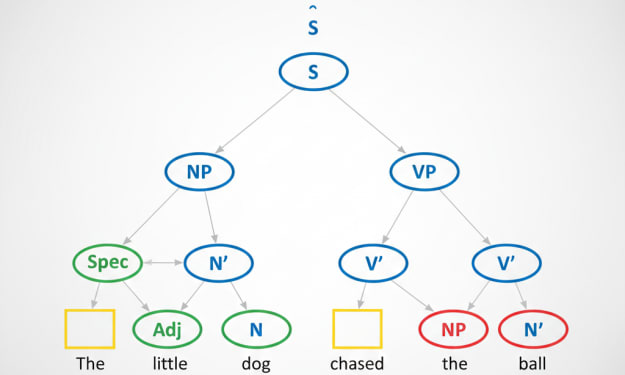
Grammar can often feel like a maze of confusing rules, especially when we dive into syntax — the study of sentence structure. One of the foundational tools in modern linguistics is X-Bar Theory, a framework that helps explain how words and phrases combine to form sentences. While it might sound intimidating, understanding X-Bar Theory can become straightforward if approached step by step.
By Games Mode On2 days ago in Education
How did Hitler rise to power?
How did Adolf Hitler, a tyrant who orchestrated one of the largest genocides in human history, rise to power in a democratic country? The story begins at the end of World War I. With the successful Allied advance in 1918, Germany realized the war was unwinnable and signed an armistice ending the fighting. As its imperial government collapsed, civil unrest and worker strikes spread across the nation. Fearing a Communist revolution, major parties joined to suppress the uprisings, establishing the parliamentary Weimar Republic.
By Munesh Yadav2 days ago in Education
Smart phones, Humans and Aliens.
WARNING. I will be tapping into one of your favorite creative tensions: The absurdity of humans worshipping their glowing rectangles as if they were tiny oracles. There’s something deliciously poetic about that contradiction, and it lends itself beautifully to an instructive proviso.
By Novel Allen5 days ago in Poets


Comments
There are no comments for this story
Be the first to respond and start the conversation.