
Parallel Universes: Do Other Realities Exist? — A Simple Guide to One of Science’s Biggest Mysteries
Are we alone in this universe, or could there be countless other universes existing beside ours? This question has fascinated scientists, philosophers, and storytellers for centuries. Today, modern physics has brought the idea of parallel universes from imagination to real scientific discussion.

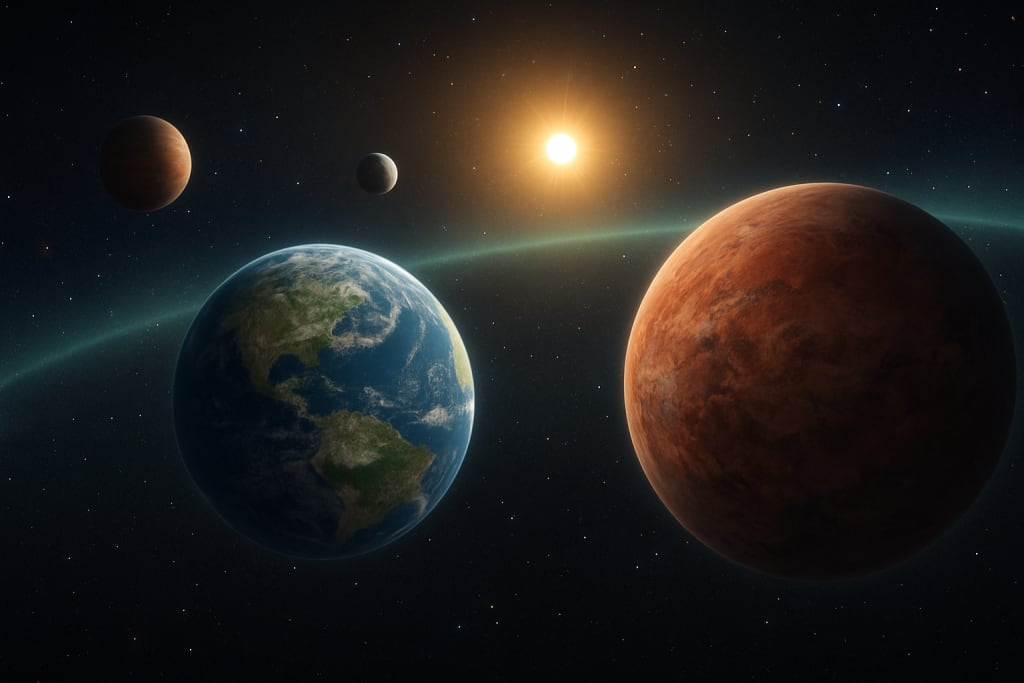
What Are Parallel Universes?
A parallel universe is a hypothetical reality that exists alongside our own universe. Think of it as a separate world, with its own space, time, matter, and maybe even versions of you.
Imagine you are watching a TV with many channels. Each channel represents a different universe. You can see only one at a time, but the others still exist. That is the basic idea behind parallel universes.
Scientists use the term “multiverse” to describe a collection of many universes.
________________________________________
Why Do Scientists Think Parallel Universes Might Exist?
Science does not accept ideas unless there is strong reason behind them. The possibility of parallel universes comes from:
• Quantum Physics
• Cosmology (study of the universe)
• String Theory
• Mathematical predictions
These fields suggest that our universe may not be the only one. In fact, parallel universes could be extremely common.
________________________________________
Major Theories That Support Parallel Universes
Here are the most important scientific explanations, written in simple words.
________________________________________
1. The Many-Worlds Theory (Quantum Physics)
This is one of the most famous explanations.
Quantum physics says particles exist in multiple states at the same time. Only when we observe them do they “choose” one state.
The Many-Worlds Theory—proposed by physicist Hugh Everett—says these possibilities do not disappear. Instead:
👉 Every possible outcome actually happens in a separate universe.
Example:
• In one universe, you passed your exam.
• In another, you failed it.
• In a third, you never took it.
These universes split every moment, creating countless versions of reality. According to this view, there may be infinite copies of you, each living a slightly different life.
This theory sounds like science fiction, but it is mathematically consistent with quantum mechanics.
________________________________________
2. Bubble Universes (Inflation Theory)
Our universe is expanding like a balloon. In the early moments of the Big Bang, the expansion was extremely fast—this is called cosmic inflation.
Some scientists believe inflation might not be a one-time event.
Instead, it could be happening again and again in different regions of space, creating bubble universes, each separate from the others.
What does this mean?
• Our universe is one bubble.
• Nearby, there might be another bubble with different physical laws.
• Some bubbles may allow stars and life; others may not.
This idea explains why our universe seems so perfectly balanced for life: maybe we just happen to live in the bubble where conditions are right.
________________________________________
3. The String Theory Multiverse
String theory says everything—electrons, quarks, atoms—is made of tiny vibrating strings. The vibration patterns determine the properties of particles.
String theory also predicts that our universe may have 11 dimensions, not just the three we see.
In this higher-dimensional structure, different universes may exist like pages of a book—separate but close.
Imagine:
• Our universe is a sheet of paper.
• Another sheet lies right next to it.
• We cannot see the other sheet, but it is real.
These universes may have:
• Different laws of physics
• Different particles
• Different types of space and time
This is the most mathematically rich idea in modern physics.
________________________________________
4. The Mirror Universe Concept
Some scientists believe a universe might exist that is a mirror image of ours.
In our universe, time moves forward, but in a mirror universe, time could move backwards. The particles in that universe might behave in opposite ways.
This idea helps explain mysteries like:
• Dark matter
• The imbalance of matter and antimatter
• The arrow of time
It does not mean that a backward version of you is walking in reverse, but that fundamental processes might be reversed.
________________________________________
5. The Simulation Hypothesis
This is not exactly parallel universes in the physical sense, but it is closely related.
Some physicists and philosophers believe our universe could be a simulation created by a super-advanced civilization. If true:
• There could be many simulated worlds
• Each simulation is like a universe
• There may be layers of simulations
While unproven, the idea is taken seriously because computing power is increasing rapidly.
________________________________________
Could Parallel Universes Ever Be Proven?
This is the biggest challenge. By definition, parallel universes are separate from us. If we cannot travel to them or observe them directly, how can we know they exist?
Here are a few scientific possibilities:
________________________________________
1. Cosmic Background Radiation Clues
The cosmic microwave background (CMB) is the oldest light in the universe. If our universe has ever collided with another universe bubble, it might leave a circular pattern or “bruise” in this radiation.
Scientists are actively searching for such patterns.
________________________________________
2. Quantum Experiments
Researchers are experimenting with quantum computers and ultra-small systems to test the Many-Worlds concept. These experiments might reveal signs of parallel outcomes.
________________________________________
3. Gravitational Waves
If another universe is extremely close to ours, its gravity might affect our space. We could detect unusual gravitational signals.
________________________________________
4. Dark Matter as Evidence
Some scientists think dark matter—an invisible substance that makes up most of the universe—might be particles leaking from another universe into ours.
This is still a very speculative idea, but it is being explored.
________________________________________
Do Parallel Universes Contain Versions of Us?
According to some theories—especially Many-Worlds—yes.
If universes split whenever a quantum event happens, then billions of versions of you exist:
• A version who made different choices
• A version who lives in a very different world
• A version who never existed
But other theories (like bubble universes) say that universes could be so different that no life exists at all.
So the answer depends entirely on which theory is true.
________________________________________
Why Are Parallel Universes Important?
Parallel universes are not just imagination. They could help us solve the deepest mysteries of science:
✔ Why is the universe fine-tuned for life?
✔ What happened before the Big Bang?
✔ What is dark matter and dark energy?
✔ Why do quantum particles behave so strangely?
✔ Are our laws of physics unique or just one possibility?
If parallel universes exist, they may answer all of these.
________________________________________
Can We Ever Travel to a Parallel Universe?
Right now, no. Our current physics does not allow travel between universes. But theoretical ideas exist:
• Wormholes
• Higher dimensions
• Quantum tunneling
• Advanced alien technology (speculative)
These ideas are extremely far beyond our technology, but the universe is full of surprises.
One day, we might discover a way.
________________________________________
Conclusion: Are We Living in a Multiverse?
Science has not proven parallel universes, but strong theories suggest they might be real. Our universe could be:
• One bubble in a huge cosmic sea
• One sheet in a higher-dimensional space
• One branch of countless quantum outcomes
• One simulation among millions
We may never know the full answer, but exploring this question pushes science forward. Whether parallel universes exist or not, they help us understand our own universe more deeply.
The idea reminds us how mysterious and vast reality truly is.
About the Creator
Keep reading
More stories from shahkar jalal and writers in Education and other communities.
Hosting a Book Fair
How many of you remember the “best week ever!” from when you were a child? Book fairs were the staple of many of our childhoods with Scholastic leading the way. While there are many choices for book fairs today and I absolutely want to talk about them, that’s going to be a later article.
By Reb Kreyling6 days ago in Education
Communicating with Confidence: Building Trust Through Simplicity
Trust is the cornerstone of any meaningful relationship, whether professional or personal. At the heart of trust lies the ability to communicate clearly. People naturally respond to straightforward, reliable, and easy-to-understand information. Professionals who prioritize clarity establish credibility and foster confidence in others. Clients, colleagues, and partners feel assured that they can make informed decisions when the messages they receive are transparent and well-articulated.
By Stacey Yim3 days ago in Education




Comments
There are no comments for this story
Be the first to respond and start the conversation.