
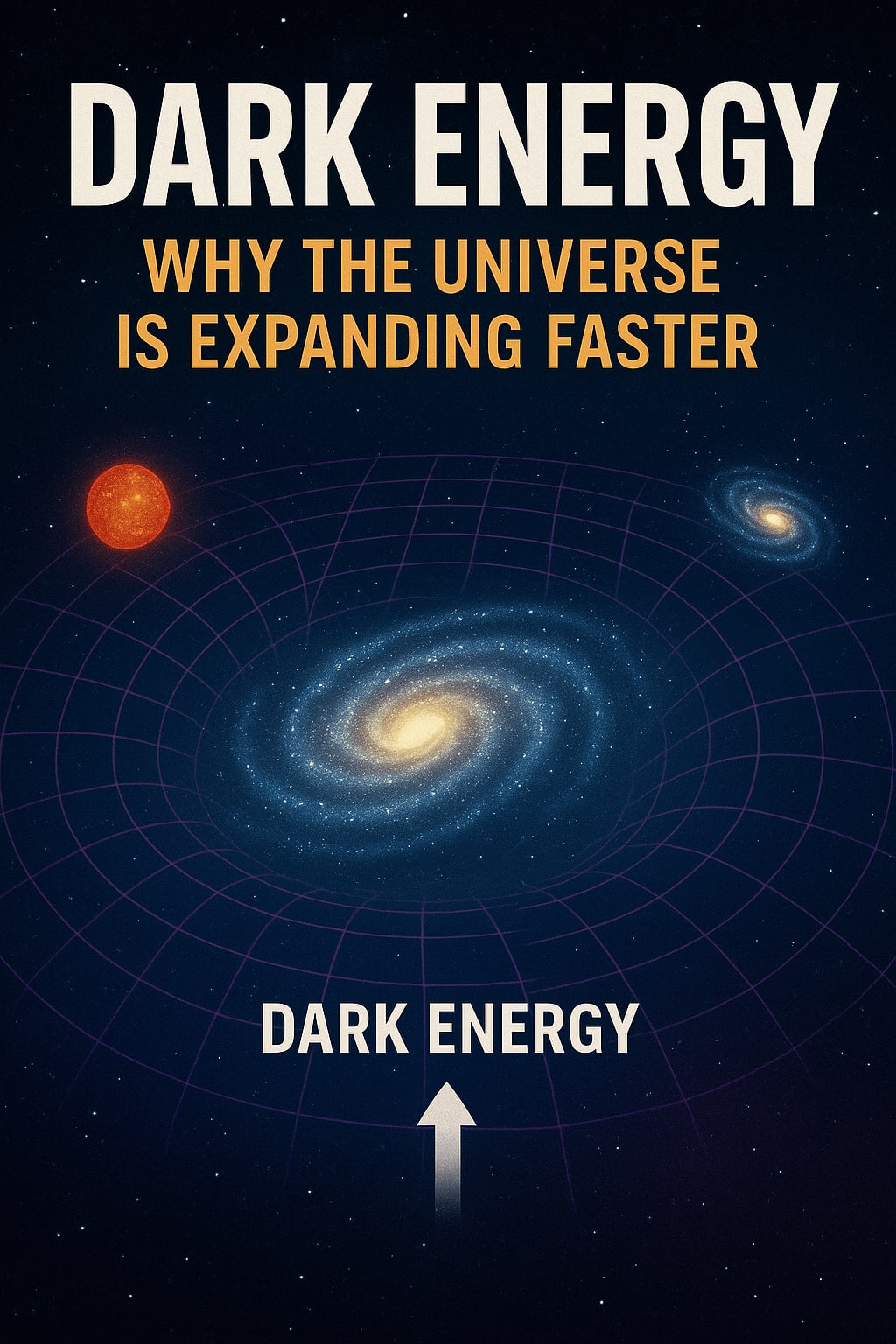
Dark Energy: Why the Universe Is Expanding Faster
For centuries, humans believed the universe was static—unchanging, eternal, and calm. But modern cosmology has revealed a truth far stranger and more exciting: the universe is not only expanding, but expanding faster and faster with time. This accelerating expansion is one of the biggest scientific mysteries, and at the heart of it lies a force we call dark energy. Dark energy makes up roughly 68% of the entire universe, yet we cannot see it, touch it, or measure it directly. It acts like an invisible pressure pushing galaxies apart. Understanding dark energy is one of the most important quests in modern physics and astronomy. In this article, we’ll explain what dark energy is, how it was discovered, and why it causes the universe to expand faster.

What Exactly Is Dark Energy?
Despite the name, dark energy is not darkness. It is simply “dark” because scientists don’t know what it is made of.
What we do know is:
• It fills all of space.
• It does not interact with light.
• It pushes the universe outward, causing expansion.
Think of dark energy like the opposite of gravity.
Gravity pulls things together, while dark energy pushes things apart.
Dark energy acts like a mysterious pressure that fights against gravity on cosmic scales. Even though each bit of dark energy is extremely weak, the huge size of the universe makes its total effect enormous.
________________________________________
How the Universe Was First Discovered to Be Expanding
To understand dark energy, we first need to understand universal expansion.
In 1929, astronomer Edwin Hubble made a groundbreaking discovery:
galaxies were moving away from us, and the farther a galaxy was, the faster it seemed to be moving.
This meant the universe was expanding. The expansion was logical after the discovery of the Big Bang, which explained that the universe began as a hot, dense point that exploded outward.
For decades, scientists expected the universe’s expansion to slow down, because gravity pulls everything inward. But in the 1990s, a surprising discovery changed everything.
________________________________________
The Shocking Discovery: Expansion Is Accelerating
In 1998, two independent teams of astronomers studied distant exploding stars called Type Ia supernovae. These supernovae work like cosmic “standard candles”—they always explode with the same brightness. By comparing their observed brightness, astronomers can measure how far away they are.
But something unexpected happened.
The supernovae were dimmer than expected.
This meant they were farther away than calculations predicted.
The only explanation:
The universe’s expansion had sped up over time.
This shocking result earned the scientists the 2011 Nobel Prize in Physics and introduced the idea of dark energy.
________________________________________
Why Is Expansion Speeding Up?
The best explanation is that dark energy has a negative pressure, a kind of anti-gravity effect.
Here’s a simple way to understand it:
• Gravity tries to pull matter together.
• Dark energy tries to push space outward.
• Since dark energy dominates the universe, it wins—and the expansion accelerates.
If the universe were a balloon:
• Matter = the rubber trying to contract.
• Dark energy = air blown inside making it expand faster.
But dark energy doesn’t just fill the balloon—it becomes more important as space grows. The more space there is, the more dark energy exists, so the expansion accelerates even more.
________________________________________
Where Does Dark Energy Come From?
Scientists do not have a definite answer, but there are three leading theories.
________________________________________
1. The Cosmological Constant (Einstein’s Idea)
Einstein once introduced a term in his equations called the cosmological constant, which he later abandoned. But modern science suggests he might have been right.
The cosmological constant says:
• Empty space has its own energy.
• This energy does not go away even when space expands.
• More space → more dark energy → stronger expansion.
This idea fits observations very well.
________________________________________
2. Quintessence (A New Type of Energy Field)
Another theory suggests a mysterious field called quintessence.
Unlike the cosmological constant, quintessence:
• Can change over time
• Might have waves or particles inside it
• Could vary in different parts of the universe
Think of quintessence as a dynamic, evolving energy field spread across the cosmos.
________________________________________
3. Modified Gravity (Maybe Gravity Itself Is Different)
Some scientists believe:
• Einstein’s theory of gravity may not fully explain the universe.
• On large cosmic scales, gravity may behave differently.
If gravity weakens at large distances, galaxies could drift apart faster than expected, which would look like dark energy.
This idea is harder to test, but many observations continue to challenge our understanding of gravity.
________________________________________
How Dark Energy Shapes the Universe
Dark energy isn’t just expanding space; it is shaping the universe’s entire future.
Here are some of its biggest impacts:
________________________________________
1. Galaxies Are Moving Away Faster
Today, galaxies are receding from each other at increasing speeds. The universe’s expansion rate is measured by the Hubble constant, and scientists have found that this value is still increasing.
________________________________________
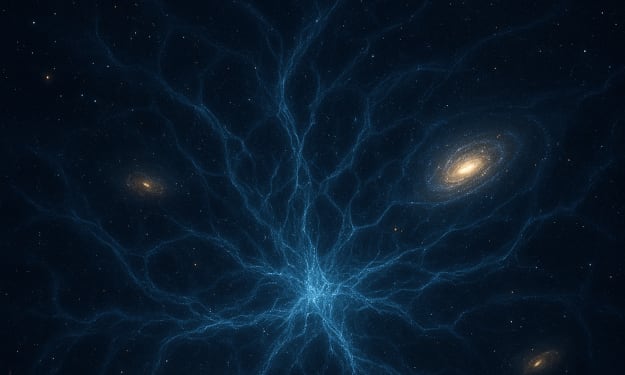
2. The Cosmic Web Is Stretching
The universe is made of a web-like structure:
• Galaxies
• Galaxy clusters
• Dark matter filaments
Dark energy stretches this cosmic web, causing structures to drift apart over billions of years.
________________________________________
3. The Universe’s Future Is Controlled by Dark Energy
Since dark energy makes up the majority of the universe, it will decide how everything ends.
Scientists have imagined several possible outcomes.
________________________________________
The Future of the Universe: Three Major Scenarios
1. The Big Freeze (Most Likely)
If dark energy remains constant:
• The universe keeps expanding forever.
• Galaxies become too far apart to interact.
• New stars stop forming.
• The cosmos becomes cold, dark, and silent.
This is the most widely accepted prediction.
________________________________________
2. The Big Rip
If dark energy grows stronger over time:
• It could tear galaxies apart.
• Then star systems.
• Then planets.
• Finally atoms themselves.
In this scenario, the universe ends in a violent shredding of everything.
________________________________________
3. The Big Crunch (Least Likely)
If dark energy suddenly weakens:
• Gravity could overpower expansion.
• The universe might collapse back in.
• Everything could end in a fiery crunch.
Current evidence strongly suggests this will not happen.
________________________________________
How Scientists Study Dark Energy Today
Even though dark energy is invisible, scientists study its effects using powerful tools.
1. Space Telescopes
Instruments like:
• Hubble Space Telescope
• James Webb Space Telescope
• Euclid Mission
• Nancy Grace Roman Telescope
These observatories measure distant galaxies and supernovae to track expansion over time.
________________________________________
2. Galaxy Surveys
Projects like the Dark Energy Survey (DES) and Sloan Digital Sky Survey (SDSS) map millions of galaxies to see how dark energy shapes cosmic structure.
________________________________________
3. Cosmic Microwave Background (CMB)
The CMB is leftover light from the Big Bang.
Patterns in the CMB reveal how dark energy influences the universe’s evolution.
________________________________________
Why Dark Energy Matters — More Than You Think
Dark energy is not just a scientific curiosity. It tells us:
• What the universe is made of
• How the universe began
• How it will end
• Whether the laws of physics are complete
Understanding dark energy may even unlock new physics beyond Einstein’s theory.
Some scientists believe solving dark energy could reveal:
• Extra dimensions
• New particles
• Unknown forces
• Deeper links between quantum physics and gravity
This is why dark energy is the most important mystery in modern cosmology.
________________________________________
A Simple Summary for Everyone
Here’s the entire mystery in simple words:
• The universe is expanding.
• The expansion is speeding up.
• A mysterious force called dark energy is causing it.
• Dark energy is everywhere in space.
• It makes up most of the universe.
• We don’t know what it is—but it controls the universe’s future.
________________________________________
Final Thoughts
Dark energy is one of the most fascinating secrets of our universe. It is invisible, silent, and mysterious, yet it determines the fate of galaxies, stars, planets, and even time itself. As scientists build better telescopes and develop new theories, we may one day uncover what dark energy truly is.
Until then, the accelerating universe reminds us of something profound:
The cosmos is still full of mysteries waiting to be discovered.
About the Creator
Keep reading
More stories from shahkar jalal and writers in Education and other communities.
Dark Matter: The Invisible Skeleton of the Universe
What Is Dark Matter? Dark matter is a mysterious form of matter that does not emit light, absorb light, or interact with electromagnetic radiation. This means we cannot see it with telescopes. It is completely invisible.
By shahkar jalalabout a month ago in Education
Python vs Rust Performance: Speed, Memory Usage, and Scalability Explained
When developers compare programming languages, performance is often one of the most debated factors. Two languages that frequently come up in these discussions are Python and Rust. While both are powerful in their own ways, they approach performance, memory management, and scalability very differently. This makes the Python vs Rust comparison especially relevant for teams choosing the right technology for their next project.
By Lennox Grayabout an hour ago in Education



Comments
There are no comments for this story
Be the first to respond and start the conversation.