
Overcoming Challenges in DevSecOps for a Seamless Integration
Learn Essential Strategies to Navigate Security Integration, Cultural Shifts, and Tool Selection While Maintaining Development Speed in Modern DevOps


If you’ve been practicing DevSecOps or at least trying to, you must have come to the realization that it is not always easy to do. It seems that when you attempt the combination of development, security, and operations, it resembles a clown having to juggle three balls and, at the same time, ride a unicycle. That is always challenging, but it is actually wonderful when it can actually be done. Well, let’s look at some of the main concerns you may encounter on your way to DevSecOps adoption and ways to overcome them successfully.
The Balancing Act: Speed vs. Security
The first barrier experienced by individuals is speed, which people are usually caught up in. We love speed, right? DevOps is the process of doing things faster and being able to deliver changes more quickly rather than having to wait ages to see results. But here’s the kicker: Security always does take much of the time. Security checks, vulnerability scans, compliance measures – these are the things that can look as if they are grounding you.
You do not wish your securities measure to slow down your whole process. People don’t want to feel like they are running in slow motion while everyone and everything else is zooming like light. But here’s the reality: security is essential. If you go through all the effort and ignore these vulnerabilities, you’re just removing the barricade and letting the villains stroll right in. The best approach is to find that balance between being fast and being secure.
You should always try to partially or totally automate the overall security checks as much as possible. Task management tools can also perform those repetitive but exhaustive vulnerability scans while your developers are left to work as they always do. That is like being always monitored by a security guard who will never at any one time doze off.
Cultural Shift: Getting Everyone on the Same Page
However, DevSecOps is not only about tools and pipelines but also concerns people. And here’s where things get messy. Organizing is all about how to get everyone on the right track with the same mentality. In the past, development teams have always worked independently of security teams. One, developers always strive to push code as fast as possible, and the other, security people always want to ensure that everything is well secured. Often, it’s just like people are on different planets as far as their language is concerned, and you can imagine how it feels to try to organize them, let alone get them to all work together.
This is where communication and culture come into play. DevSecOps requires a culture shift—a mindset where security becomes everyone’s responsibility, not just the security team’s. I find this to be the case with some teams, particularly when change is involved and some members are opposed to it. Some developers might think, “Security isn’t my job,” while the security team says, “You’re moving too fast for us to keep up.”
Here’s my advice: Start small. It’s not necessary that you change it all completely at one time. Start with minor adjustments, such as beginning joint meetings for developers and security experts to discuss what works and what doesn’t. It is also good to have some cross-training where developers are taken through a little bit of the security and the other way around. It is a lot easier to get on the same page when people understand each other’s work.
Tool Overload: Picking the Right Tools
If you are in the process of designing a DevSecOps solution, then it’s good to know that there are a multitude of tools out there. For every single task, from code analysis to vulnerability scanning to secret management, there are tools, and all of them are the best. But let’s be real: You can’t use them all. Having too much is not always good because it complicates the workflow, complicates integration, and slows the team down. So, how do you choose?
The key is to keep it simple. Write what you need to write. What are your main security issues? What’s the key to your development process? Once you have those answers, choose tools that integrate with the stuff you’re using. You don’t have to reinvent the wheel here, just choose tools you know will make your life easier, not more complicated.
And also remember that not all tools will work with each other. Before you go and add some new thing, be certain it will join without causing any headaches. Tools are puzzle pieces that are meant to be used together to form a complete picture. If you don’t, you’re going to waste more time trying to make them match up than using them.
Managing Security in CI/CD Pipelines
When it comes to any DevOps process, CI/CD pipelines are the crux of the work. But they make everything run smoothly, so there are no huge interruptions for updates and patches. Things can become a bit tricky when you add in security. Finally, we need to ensure that security checks are happening as the pipeline runs; they shouldn’t hang up the pipeline too much, or worse, they should miss important vulnerabilities.
Another wave of challenges I had to deal with was finding suitable points in the pipeline to provide security checks. You don’t want to introduce them too early, and you might waste time flagging things that don’t matter. Too late to lace them, and you might catch a weakness already within production. Yikes.
The solution? Shift left. No, I don’t mean literally moving everything to the left side of your screen. “Shifting left” is moving security checks earlier in the pipeline, during the coding and building phases, rather than at the end. Catching vulnerabilities early saves you a lot of headaches down the road. But it’s also much, much easier (and cheap!) to deal with a bug when the code has been written but not released.
Legacy Systems: The Elephant in the Room
Integrating DevSecOps with legacy systems can feel like trying to fit a square peg in a round hole. Legacy systems were sometimes created long before the DevSecOps concept came to fruition, so legacy systems aren’t always made to work well with current security tools or practices. But here’s the deal: you can’t ignore them. Usually, legacy systems are so critical to the business operation that you can’t really secure them without breaking everything.
If I am honest, the best way to deal with this is by increment. First, you identify the most vulnerable parts of your legacy system. It may be the outdated software or the old process that has not been touched in years. Of course, focus your security efforts there first. When you’ve got that under control then you can begin implementing more modern security practices, bit by bit.
Similarly, it is also useful to look at containers or microservices to slowly phase out parts of your legacy system. That way, you’ll be able to gradually and safely replace old elements with new, easier-to-secure, and manage ones, all without sacrificing your existing system.
Keeping Up with Evolving Threats
Cybersecurity is like Whack a Mole. You think you’ve got down one threat only for another to surface. The same goes for DevSecOps. The threats and new open vulnerabilities evolve constantly. So, how do you keep up?
Staying informed is key. Keep your team regularly on top of the current security trends and vulnerabilities. This could be signing up for webinars, setting up alerts, and/or simply allocating some time each week to read what’s new in the world of cybersecurity. You need to stay in the loop because you can’t protect yourself against threats you don’t know about.
I also suggest running regular security audits. But it’s always good to perform a double-check, even if everything is running smoothly. Security audits exist to catch stuff you might have missed to let you get ahead of vulnerabilities before they become a huge problem.
Conclusion: It’s a Marathon, not a Sprint
Finally, DevSecOps is all about balancing it out. It’s a marathon, not a sprint. It’s totally doable, but at first, it can feel overwhelming trying to integrate security into your DevOps pipeline, and with a little patience and the right approach, you’ll be okay. That’s why, remember, you don’t have to get everything perfect right out of the gate. Begin with smaller projects, gradually build up on them, and continue learning the way.
Through conquering speed vs. security, cultural resistance, tool overload, pipeline integration, legacy systems, evolving threats, and more, you’ll be well on your way toward a DevSecOps process that everyone is happy with.
About the Creator
Bellevue Publishers
Bellevue Publishers is the eBook Publishing Company in the United States Offering top-notch eBook and Book Publishing, Writing, Editing, Formatting, and Marketing Services.
Keep reading
More stories from Bellevue Publishers and writers in Education and other communities.
Achieving DevSecOps Success: Challenges and Best Practices
DevSecOps, is a powerful approach that stresses integrating security practices early and consistently throughout the software development process. It brings together development, security, and operations. Today, we'll tell you that why it's crucial for organizations to adopt DevSecOps best practices to strengthen security in their software development processes.
By Bellevue Publishers2 years ago in Education
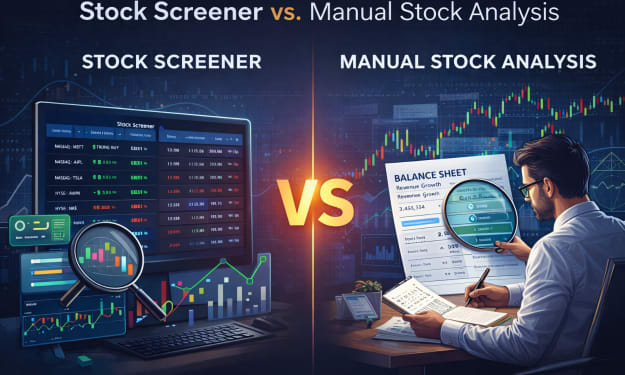
Stock Screener vs Manual Stock Analysis: Which Works Better?
Finding the right stocks in a crowded market is a challenge for every investor. With thousands of publicly traded companies and constant price fluctuations, investors rely on different methods to narrow down opportunities. Two of the most common approaches are using a stock screener and performing manual stock analysis. While both aim to identify profitable investments, they differ significantly in speed, depth, and practicality. Understanding how each method works can help investors choose the right approach—or combination—for their trading and investment goals.
By Alven Smitha day ago in Education



Comments
There are no comments for this story
Be the first to respond and start the conversation.