
Monkey See, Monkey Do – How Parents Subconsciously Pass on Financial Habits to their Children? - Swiflearn
Was it about saving money in a small piggy bank, spending, opening a small account, or something else? Well, whatever it may have been, the fact is that the money habits we develop as young children often shape how we handle our finances in adulthood.
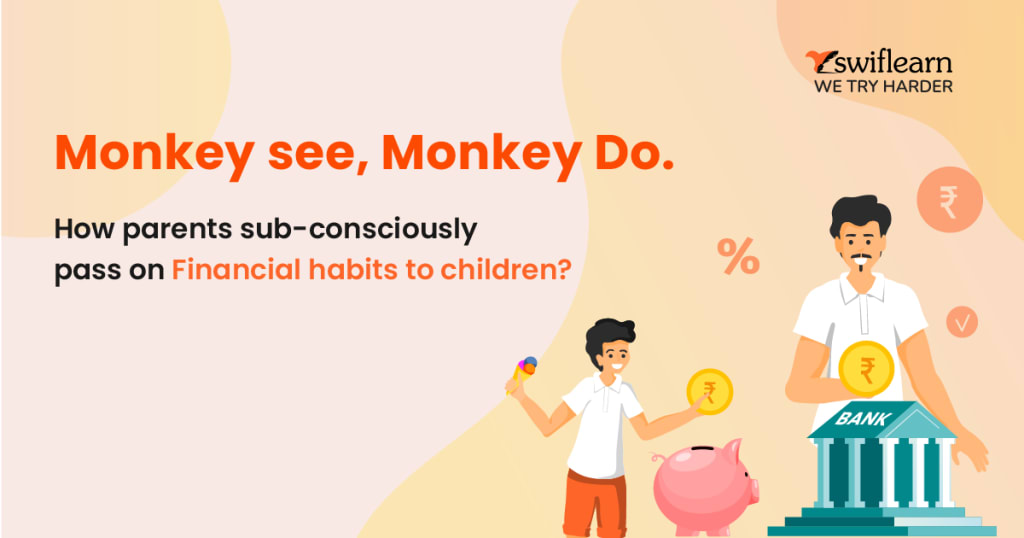
Do you recall your first memory of money?
Was it about saving money in a small piggy bank, spending, opening a small account, or something else? Well, whatever it may have been, the fact is that the money habits we develop as young children often shape how we handle our finances in adulthood.
Based on research published in Money Advice Service, money habits among kids are ingrained by the age of 7. Yes, that’s indeed true! In another survey, it was found that parents with troubled financial histories tend to pass on poor money habits to their children. This can severely impact the financial lives of kids as adults.
Hence, as parents, it’s important for you to sit and take notice of your kid’s money habits because helping your little one learn the art of saving money early can lead to success later in life.
What’s “Monkey See, Monkey Do” All About?
The phrase “Monkey See, Monkey Do” is a pidgin-style saying that refers to the learning of a process without the understanding of how and why it works. Another definition of the phrase implies the act of imitation, usually with limited knowledge or concern for the consequences. The phrase is something that parents constantly, even though unknowingly, use with their children when teaching them something new every day.
While it could be applied to many other aspects of human life, the phrase perfectly fits the phenomenon of parents subconsciously passing their own financial behavior onto their children. Just like how a parent teaches a child to brush their teeth by brushing their own teeth, they also teach the child other important money habits without even realizing it. And if the parents already have bad financial habits, they could be doing more harm than good with their actions.
Therefore, as a parent, it’s important for you to help your kid develop healthy financial habits during the early stages of life. Read further to learn how you can achieve this.
1) Setting an ideal example
All of us have heard this before but to reiterate, “Actions speak louder than words.” Whatever you do, your child will follow suit. Show them how you set aside some amount of money each month towards saving and investing. In time, children can be introduced to the concept of building a separate fund to meet unexpected emergencies.
Including children in the family’s long-term planning is another great way of inculcating money habits among them. Discuss with them how you are saving for their future goals like college education and how you’re planning savings for your life, post-retirement.
Also Read: Vedic Maths Classes In Mahamaya Nagar
2) Discussing money
Parents set the financial template that kids follow as adults. Pocket money can be used as a very potent tool to teach money management skills to children. It is particularly effective in training children in good saving and spending behaviors.
Everyday activities like grocery shopping, online shopping can also be good opportunities to talk about your monthly shopping budget, why using coupons and sales is beneficial, and how credit and debit cards work. Setting aside a small amount for your child to spend on their snacks is a good way of testing their money management skills.
3) Being well-organized
Your ability to keep your expenses under control and manage your finances well is critical to the financial stability of the family. A firm and balanced supervision of your child’s money habits will help in transmitting important money management lessons to them.
If you maintain a strict budget, keep a check on your periodic inflow and outflow, hardly miss any deadlines for premiums or bills, and make timely investments, there’s no reason why your child won’t be following your footsteps in the years to come.
Sign up for a free trial class at Swiflearn
4) Playing games & reading books
Games are undoubtedly the most exciting, easy, and fruitful method of teaching concepts to kids. When we talk about money games for children, ‘Monopoly’ is the first one that comes to our mind. While Monopoly is a good one to start with, there are lots of other engaging games that teach children about the importance of saving, spending, and investing money.
The Allowance Game (Age 5+): Each player runs around the board performing daily chores, collecting allowances, and spending on things they desire.
Moneywise Kids (Age 7+): The game teaches kids how to handle money, manage daily expenses, while putting money in savings at the same time.
The Game of Life (Age 8+): With concepts like play money, insurance policies, promissory notes, and stock certificates, the game takes children a little deep into money management lessons.
Also Read: Which Are The Best Online Tuition Websites?
Once your child is done with these exciting games, there’s a whole lot of books offering money management lessons to your little one. Make sure to let them have a glance at these.
“Dollars and Sense and Trouble With Money” by Stan Berenstain and Jan Berenstain (Age 4-8)
“Alexander, Who Used to Be Rich Last Sunday” by Judith Viorst (Age 4-8)
“One Cent, Two Cents, Old Cent, New Cent: All About Money” by Dr. Seuss (Age 4-8)
“Money Sense for Kids!” by Barron’s (Age 9-12)
“The Everything Kids’ Money Book” by Brette McWhorter (Age 9-12)
Hope you enjoyed reading the blog! Please share your thoughts in the comments section, and perhaps other tips which you’ve found to be helpful while teaching children about money.
See you soon in the next blog of the series! Stay tuned.
Article Source: https://swiflearn.com/blog/monkey-see-monkey-do-how-parents-subconsciously-pass-on-financial-habits-to-their-children/
About the Creator
Keep reading
More stories from Priyanshu Rawat and writers in Education and other communities.
Educational Toys To Help Shape Your Kid’s Future - Swiflearn
Numerous researches have been done worldwide and scientists have confirmed that learning through play is an important part of the child’s development. Kids are always filled with extra energy and to release them they require some extra activities and that they can do through playtime.
By Priyanshu Rawat5 years ago in Education
What to Eat (And Avoid) During Colon Cancer Treatment: A Nutritionist-Approved Guide
When undergoing colon cancer treatment, your diet is more important than ever. The right nutrition can support your immune system, reduce side effects, and even enhance the effectiveness of treatments like chemotherapy and radiation. But knowing what to eat and what to avoid can be overwhelming.
By Erika Phillips 7 days ago in Education
Surviving Cancer: Entering the Golden Alchemical Door to Teaching
It starts with love . . . Entering the Golden Door: Who Am I? Going through cancer treatments with chemo, a strange thing happened, for I started to forget things, even who I am because my wife ghosted me and my friends would have nothing to do with me. Without human contact, you forget what it means to be human. I am a professor at a university, but I forgot what I taught. . . .
By WILD WAYNE : The Dragon King3 days ago in Education


Comments
There are no comments for this story
Be the first to respond and start the conversation.