
Menu Boards for Cafés: Design Ideas and Benefits
How smart menu board design can elevate café branding and customer experience

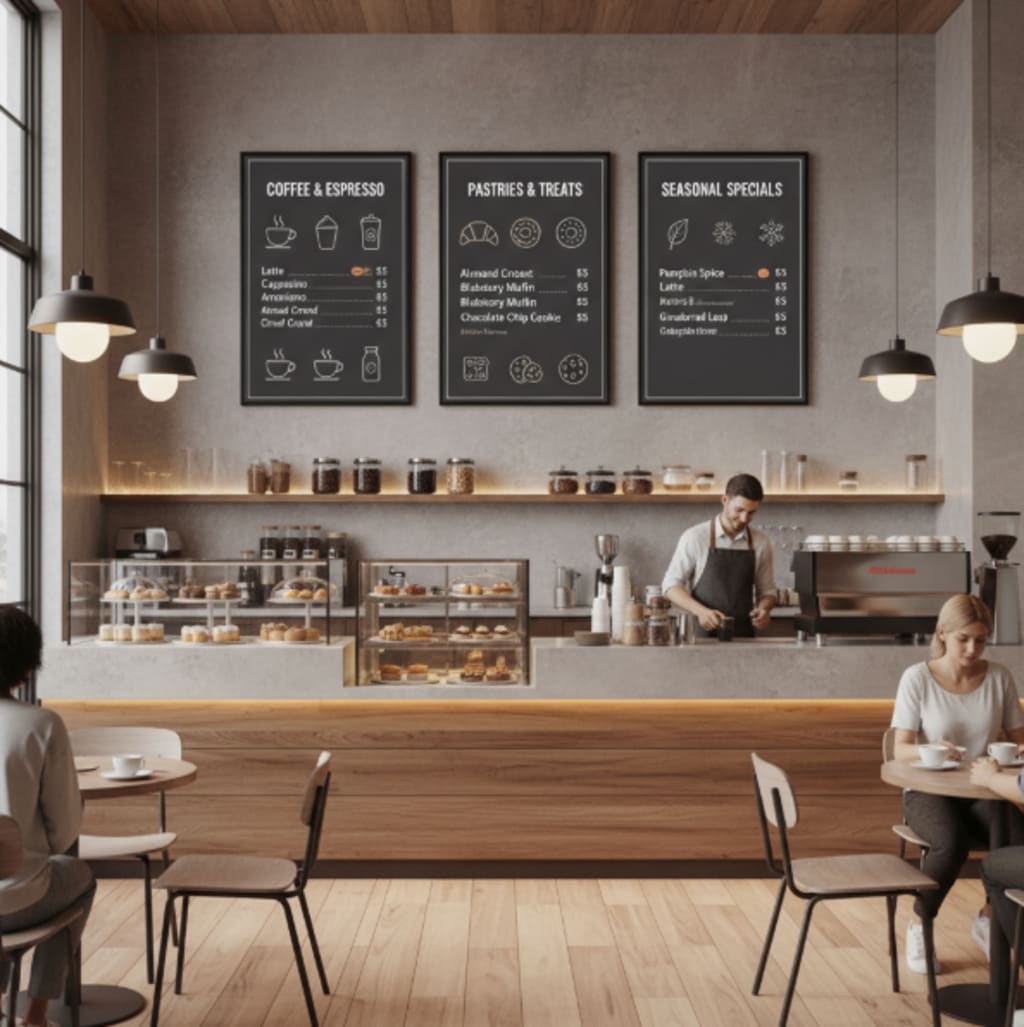
I'll never forget the first time I walked into a local coffee shop that had just upgraded from their hand-written chalkboard to a sleek digital menu display. The difference was striking—not just visually, but in how quickly I could scan the menu, see vibrant images of specialty drinks, and notice the seasonal promotions rotating in the corner. That experience opened my eyes to how much menu presentation actually matters in café environments.
If you're running a café or coffee shop, your menu board isn't just a list of items—it's often the first real interaction customers have with your brand. Let's explore what makes digital menu boards work, the tangible benefits they bring, and how to choose the right solution for your space.
What Are Digital Menu Boards for Coffee Shops and Why They Matter
Digital menu boards replace traditional static signage with dynamic displays powered by digital signage software. Instead of printing new menus every time your seasonal blend changes or reprinting lists when costs fluctuate, you update content remotely through a content management system.
For cafés specifically, this technology addresses real pain points: quickly sold-out pastries that need immediate removal from the menu, morning versus afternoon offerings that change throughout the day, and the challenge of communicating your brand story in a crowded, fast-paced environment.
The "why it matters" comes down to customer experience and operational efficiency. When someone walks into your café during their morning rush, they need to make decisions quickly. A well-designed digital menu board helps them do exactly that.
How Digital Signage Software Works for Coffee Shop Menu Boards
The technical setup is more accessible than you might think. At its core, digital signage for coffee shops consists of three components:
Display hardware – This could be anything from a single large screen behind your counter to multiple smaller displays throughout your space. Most cafés use commercial-grade displays designed for extended operation.
Media player or smart display – This device connects to your screen and pulls content from your digital signage software platform. Some newer displays have built-in players, simplifying installation.
Cloud-based software – This is where you create, schedule, and manage your menu content. Modern platforms let you update menus from your phone, schedule different content for different times of day, and even integrate with your point-of-sale system.
The beauty of current digital signage software is that you don't need to be particularly tech-savvy. Most platforms use drag-and-drop interfaces where you can build menu layouts, add images, and schedule content changes without any coding knowledge.
Benefits of Digital Menu Boards for Coffee Shops by Use Case
Quick-Service Cafés and Grab-and-Go Locations
For high-traffic locations where speed matters most, digital menu boards excel at:
- Reducing perceived wait time – Eye-catching content keeps customers engaged while they queue
- Streamlining decision-making – Clear categorization and mouth-watering images help customers decide faster
- Highlighting time-sensitive promotions – "Happy Hour: 2-4 PM" messages can appear and disappear automatically
- Displaying calorie information – Regulatory compliance becomes simple with digital updates
Specialty Coffee Shops and Third-Wave Cafés
If you're focused on craft coffee and customer education, digital signage software enables:
- Storytelling about bean origins – Rotate information about your current single-origin offerings
- Brewing method explanations – Help customers understand the difference between pour-over, Chemex, and cold brew
- Barista highlights – Feature your team members and their signature drinks
- Tasting notes and flavor profiles – Educate customers about what makes each coffee unique
Multi-Location Coffee Chains
Managing consistency across multiple locations becomes significantly easier:
- Centralized content management – Update all locations simultaneously or customize by region
- Brand consistency – Ensure every location represents your brand identically
- Promotional coordination – Roll out new seasonal items across all stores at once
- Performance tracking – Some platforms integrate analytics to see which menu items get the most attention
Platform Comparison: Digital Menu Boards for Coffee Shops
After testing several solutions over the past year in different café environments, here's what I've found:
AIScreen is efficient for its intuitive approach to café-specific needs. What I appreciate most is the template library designed specifically for food and beverage environments—you're not starting from scratch. The scheduling capabilities are particularly robust, allowing you to set up different menus for breakfast, lunch, and evening hours with remarkable granularity.
The platform also handles menu synchronization beautifully if you're managing multiple locations, and their support team actually understands hospitality workflows. The ability to integrate with common POS systems means your inventory levels can trigger menu changes automatically—when you run out of a particular pastry, it disappears from the board without manual intervention.
Navori offers enterprise-level capabilities with powerful content management, though the learning curve is steeper. Their QL platform is feature-rich but might be overkill for a single-location café. Where they shine is in large-scale deployments with complex content strategies.
Radiant focuses heavily on the quick-service restaurant market with solid menu board functionality and POS integration. Their strength lies in standardization across franchises, though customization can feel limited for independent cafés wanting unique branding.
Spectrio provides an all-in-one approach combining digital signage with audio and scent marketing. If you're creating a full sensory experience, they're worth considering, though you'll see features you might not need if you only want menu boards.
CrownTV positions itself as a budget-friendly option with decent templates and straightforward content management. However, advanced scheduling features and integrations are more limited.
Practices for Using Digital Menu Boards in Your Café
Through error (and observing what works in thriving cafés), these guidelines have proven most effective:
Content Strategies for Maximum Impact
Dynamic options for different dayparts – Many cafés don't realize they can promote breakfast sandwiches heavily in morning hours, then shift emphasis to pastries and lighter fare in the afternoon—all automatically.
Weather-responsive content – On particularly hot days, feature cold brew and iced drinks more prominently. Modern digital signage can integrate with weather APIs to make these changes automatically.
Seasonal rotation with purpose – Don't just add your pumpkin spice latte in fall; actively remove it from the rotation when the season ends. Customers notice when offerings feel current versus stale.
Limited-time offer urgency – "Available only this week" messaging creates genuine urgency. Digital boards let you add countdown timers or "while supplies last" indicators that you'd never bother with on printed menus.
Common Mistakes to Avoid
Based on what I've seen fail in real café environments:
- Animation overload – Subtle movement attracts attention; constant motion causes headaches
- Too-frequent content rotation – Changing screens every 3-5 seconds feels frantic. Aim for 8-12 seconds per screen minimum
- Neglecting the content – Digital menu boards require ongoing attention. Setting it up once and never updating defeats the purpose
- Ignoring your brand voice – Your menu board should sound like your café, whether that's playful, sophisticated, or educational
Final Words
Digital menu boards have evolved from a luxury reserved for major chains to an accessible tool for independent cafés. The right digital signage software transforms how you communicate with customers, streamlining operations while creating opportunities for creativity and customer engagement that static menus simply can't match.
Whether you're a single-location specialty shop or managing multiple café spaces, the technology has matured to the point where implementation is straightforward and the benefits are measurable. Start by identifying your specific pain points—is it menu update frequency? Customer decision speed? and choose a platform that addresses those needs without unnecessary complexity.
The café landscape is more competitive than ever. Your menu board is prime real estate for making the right impression, telling your story, and guiding customers toward decisions they'll be happy with. Digital signage gives you the tools to make every square inch count.
About the Creator
Jerry Kane
Jerry Kane is a marketing professional focused on digital signage, trends, and audience behavior. He translates market shifts into clear, engaging brand strategies.
Keep reading
More stories from Jerry Kane and writers in Education and other communities.
7 Reasons Restaurant Needs Digital Menu Boards
I'll never forget the moment I realized I was completely wrong about digital menus. It was a Tuesday afternoon at my favorite local taco spot—the kind of place where I knew the owner by name and had "the usual" without saying a word. Then one day, I walked in and everything had changed. Gone were the chalkboard menus with their charming but faded writing. In their place? Sleek digital screens cycling through vibrant images of sizzling fajitas and perfectly crafted margaritas.
By Jerry Kane 4 days ago in Education
The Red Renaissance Uncorking the Future of Russian Wine in 2026
For decades, the global wine map was a predictable atlas of French Chateaus, Italian vineyards, and New World giants. However, as we move through 2026, a new and unexpected frontier has firmly established its presence: Russia. The Russian wine industry is currently undergoing a "Grand Renaissance," fueled by a combination of aggressive state support, massive private investment, and a geopolitical shift that has turned the domestic market inward. What was once seen as a secondary player, primarily known for mass-produced sparkling wines, has transformed into a sophisticated producer of premium, terroir-driven still wines that are winning over a new generation of health-conscious and patriotic consumers.
By Neeraj kumar4 days ago in Education
A Love Forboding
The chipped stone slope caused unbearable footing. I slid, skirting on my heels. I cast my shield, relinquishing my guard to stay upright. Left with my double-edge and a prayer to the maker, I skated toward my objective. The earthly stubble gave way to solid ground. I found myself restored, a trail of dust in my wake.
By James U. Rizzi3 days ago in Fiction


Comments
There are no comments for this story
Be the first to respond and start the conversation.