
Europe Game-Based Learning Market Size & Forecast 2026–2034
Interactive Education Takes Center Stage Across Europe

Introduction
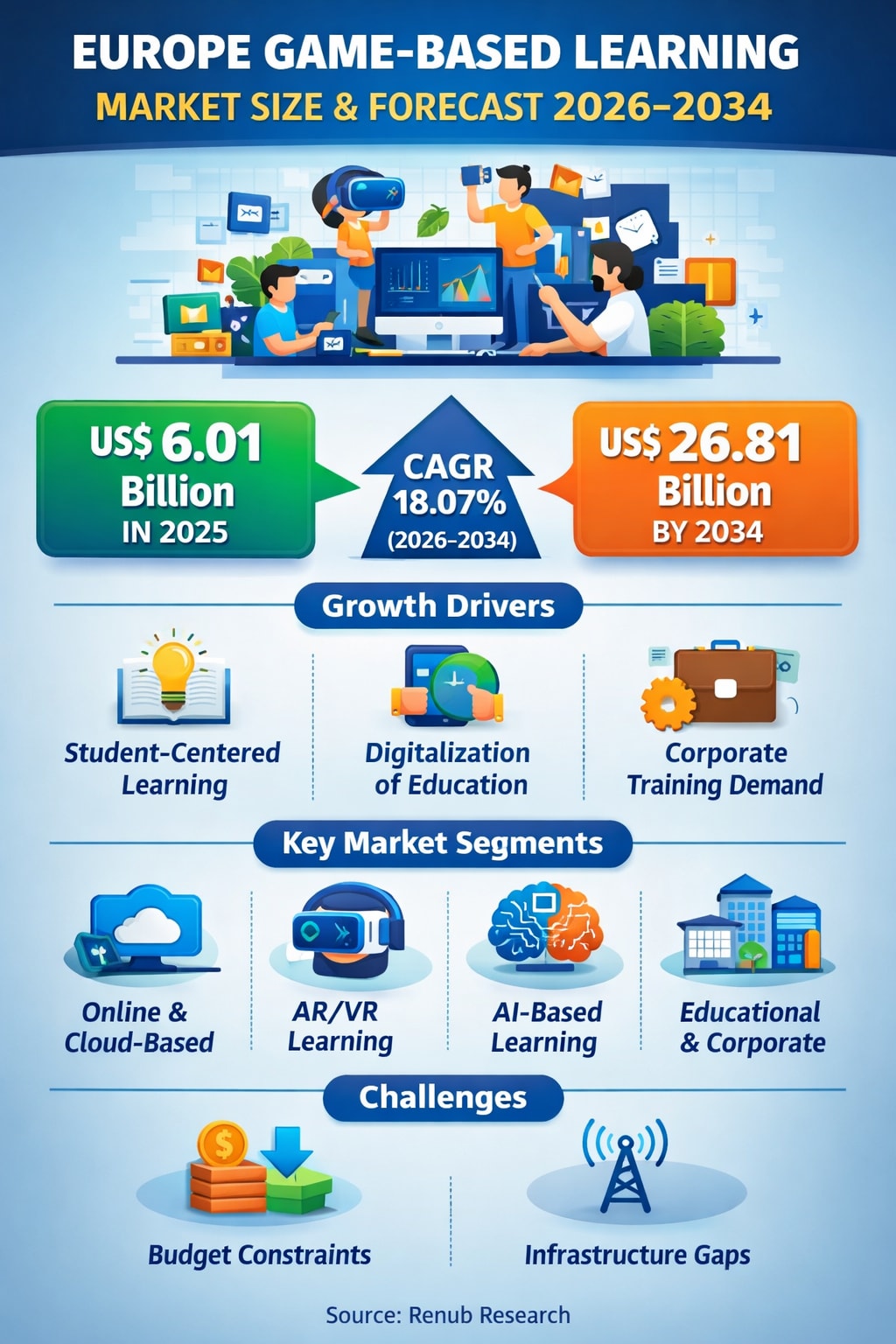
The Europe game-based learning market is entering a phase of accelerated growth as digital education tools reshape the way knowledge and skills are delivered across schools, universities, and corporate training environments. According to Renub Research, the market is projected to grow from US$ 6.01 billion in 2025 to US$ 26.81 billion by 2034, expanding at a robust CAGR of 18.07% during 2026–2034. This remarkable growth reflects Europe’s increasing focus on interactive, learner-centric, and outcome-driven education models.
Game-based learning (GBL) has moved beyond its early experimental stage and is now being integrated into mainstream education and professional training. Rising e-learning penetration, strong internet infrastructure, widespread device adoption, and supportive education policies are creating favorable conditions for the expansion of this market. Across Europe, institutions are recognizing that engagement, motivation, and real-time feedback are essential for effective learning outcomes, making game-based approaches a natural fit for modern education systems.
Europe Game-Based Learning Market Outlook
Game-based learning refers to the use of game mechanics, digital games, and interactive simulations to teach academic, professional, or behavioral skills. By incorporating elements such as challenges, rewards, storytelling, competition, and instant feedback, GBL transforms learning into an active and immersive experience. Unlike traditional teaching methods that rely heavily on passive instruction, game-based learning emphasizes participation, problem-solving, and experiential learning.
In Europe, GBL is increasingly used across K–12 education, higher education, corporate training, healthcare education, and even military and public-sector simulations. The region’s strong emphasis on digital literacy, innovation, and lifelong learning has accelerated adoption. European governments and educational authorities are actively encouraging the integration of digital tools into classrooms to prepare students for technology-driven economies. At the same time, enterprises are using game-based learning to improve workforce productivity, compliance training, and leadership development.
With educators and employers placing greater importance on measurable learning outcomes, personalization, and engagement, game-based learning continues to gain traction across the European region.
Growth Drivers in the Europe Game-Based Learning Market
Shift Toward Student-Centered and Experiential Learning
One of the primary drivers of the Europe game-based learning market is the transition from teacher-centered instruction to learner-centered education models. European education systems are increasingly moving away from rote memorization toward approaches that emphasize critical thinking, creativity, collaboration, and real-world problem-solving.
Game-based learning aligns perfectly with these objectives by placing learners in interactive scenarios where they actively make decisions and experience the consequences of their actions. This approach enhances knowledge retention and encourages deeper understanding. Teachers also benefit from the flexibility of GBL, as it allows differentiation for mixed-ability classrooms and provides alternative ways to engage disengaged learners.
Educational reforms across Europe increasingly prioritize competency-based learning, digital skills, and creativity, all of which are effectively supported by serious games and simulations.
Digitalization of Education and Expansion of E-Learning Ecosystems
Rapid digitalization across European education systems has created a strong foundation for the adoption of game-based learning. Schools and universities are investing in learning management systems, tablets, laptops, smart boards, and digital content platforms that support interactive learning experiences.
E-learning platforms now commonly include gamified elements such as badges, leaderboards, and interactive modules, making the transition to full game-based learning smoother. Hybrid and blended learning models have further increased demand for engaging digital content that motivates learners both inside and outside the classroom.
National and regional initiatives aimed at improving digital literacy and reducing educational inequalities are also driving investments in educational technologies. Collaboration between publishers, edtech companies, and game developers has resulted in curriculum-aligned content available in multiple European languages, enhancing accessibility and adoption.
Corporate Training Demand and Lifelong Learning Culture
Europe’s strong emphasis on lifelong learning and workforce upskilling is another major driver of the game-based learning market. Rapid technological change is forcing employees to continuously update their skills in areas such as digital tools, cybersecurity, compliance, leadership, and soft skills.
Traditional corporate training methods often struggle to engage employees or produce lasting behavioral change. Game-based learning addresses this challenge by offering immersive simulations, role-playing scenarios, and interactive decision-making environments that closely mirror real-world situations.
With the rise of remote and hybrid work models across Europe, digital game-based training solutions provide scalable, consistent, and measurable learning experiences. The use of analytics and performance tracking further enhances the value of GBL in corporate settings.
Challenges in the Europe Game-Based Learning Market
Budget Constraints and Uneven Digital Infrastructure
Despite strong growth prospects, the Europe game-based learning market faces challenges related to funding disparities and uneven digital infrastructure. While some countries and institutions have well-developed digital ecosystems, others lack sufficient budgets, devices, or high-speed connectivity to fully adopt advanced game-based solutions.
Rural areas and smaller institutions often face limitations in hardware availability and bandwidth, making it difficult to implement AR/VR or cloud-based GBL platforms. Public procurement processes and cautious investment attitudes can further slow adoption.
Additionally, effective implementation requires teacher training and ongoing professional development, which adds to costs and resource requirements.
Skepticism, Teacher Workload, and Curriculum Alignment
Skepticism among educators and administrators remains a barrier in some parts of Europe. Games are sometimes perceived as distractions rather than serious educational tools, particularly when they are not clearly aligned with curriculum standards and assessment frameworks.
Teachers already face heavy workloads, making them hesitant to adopt new platforms that require lesson redesign or additional preparation time. In some cases, available games lack depth or measurable learning outcomes, reinforcing doubts about their educational value.
Clear pedagogical frameworks, evidence-based content, and institutional support are essential to overcoming these challenges and ensuring wider adoption.
Europe Game-Based Learning Solutions Market
The solutions segment includes educational games, serious games, simulations, platforms, and game authoring tools. Many schools and training providers prefer ready-to-use solutions covering subjects such as mathematics, languages, science, history, and soft skills.
At the same time, no-code and low-code authoring tools allow educators to create or customize games aligned with local curricula. Integration with learning management systems enables progress tracking, performance analysis, and competency assessment.
Corporate solutions tend to focus on realistic simulations, compliance training, and scenario-based learning that supports decision-making and skill transfer.
Europe Game-Based Learning Services Market
Services play a critical role in the successful adoption of game-based learning across Europe. These include consulting, implementation support, teacher training, curriculum integration, and custom game development.
Educational institutions often require guidance in selecting appropriate tools and designing effective game-based pedagogies. Corporate clients frequently demand bespoke simulations tailored to their specific processes and regulatory requirements.
Localization services are particularly important in Europe’s multilingual and culturally diverse market, while ongoing support and content updates ensure long-term value.
Technology-Based Market Segments
Online game-based learning dominates due to its flexibility and suitability for blended and remote learning. Cloud-based solutions are gaining popularity for their scalability, centralized management, and cost efficiency. AR and VR technologies are transforming experiential learning by enabling immersive simulations, particularly in vocational training and healthcare education.
AI-based game-based learning is emerging as a powerful tool for personalization, adaptive difficulty, and intelligent feedback. These technologies enhance engagement while providing instructors with detailed insights into learner performance.
Country-Level Insights
France benefits from strong public education support and growing digital investments. The United Kingdom stands out as a hub for edtech innovation and educational game development. Germany’s focus on vocational training and engineering drives demand for realistic simulations and serious games. Other European countries are steadily adopting GBL as part of broader digital education strategies.
Market Segmentation Overview
The Europe game-based learning market is segmented by component, platform type, deployment mode, game type, end-user, and country. Solutions and services cater to education, enterprises, government, and consumers. Countries across Western, Central, and Eastern Europe contribute to overall market growth, reflecting widespread adoption.
Final Thoughts
The Europe game-based learning market is set for strong long-term expansion, driven by digital transformation, evolving pedagogical models, and rising demand for engaging and effective learning solutions. With the market projected to grow from US$ 6.01 billion in 2025 to US$ 26.81 billion by 2034, game-based learning is no longer a niche innovation but a core component of Europe’s education and training ecosystem.
As infrastructure improves, content quality increases, and educators gain greater familiarity with game-based approaches, GBL is expected to become an integral part of formal education and professional development across Europe. The coming decade will likely see game-based learning play a critical role in shaping future-ready skills and lifelong learning across the region.
About the Creator
Mastering the Mental Game: Pro Poker Strategies to Eliminate Tilt for Good
Avoiding tilt is one of the most crucial elements for long-term success in poker. Tilt, the emotional state that leads to poor decision-making, can unravel even the most skilled player’s efforts. Professional poker players understand that maintaining a calm, composed mindset is as important as knowing the odds or mastering bluffing techniques. Here’s how the best in the game stay mentally sharp and emotionally resilient.
By Micah Raskin Poker 3 days ago in Education



Comments
There are no comments for this story
Be the first to respond and start the conversation.