
New Technologies for Radiation Protection on Deep Space Missions
Space

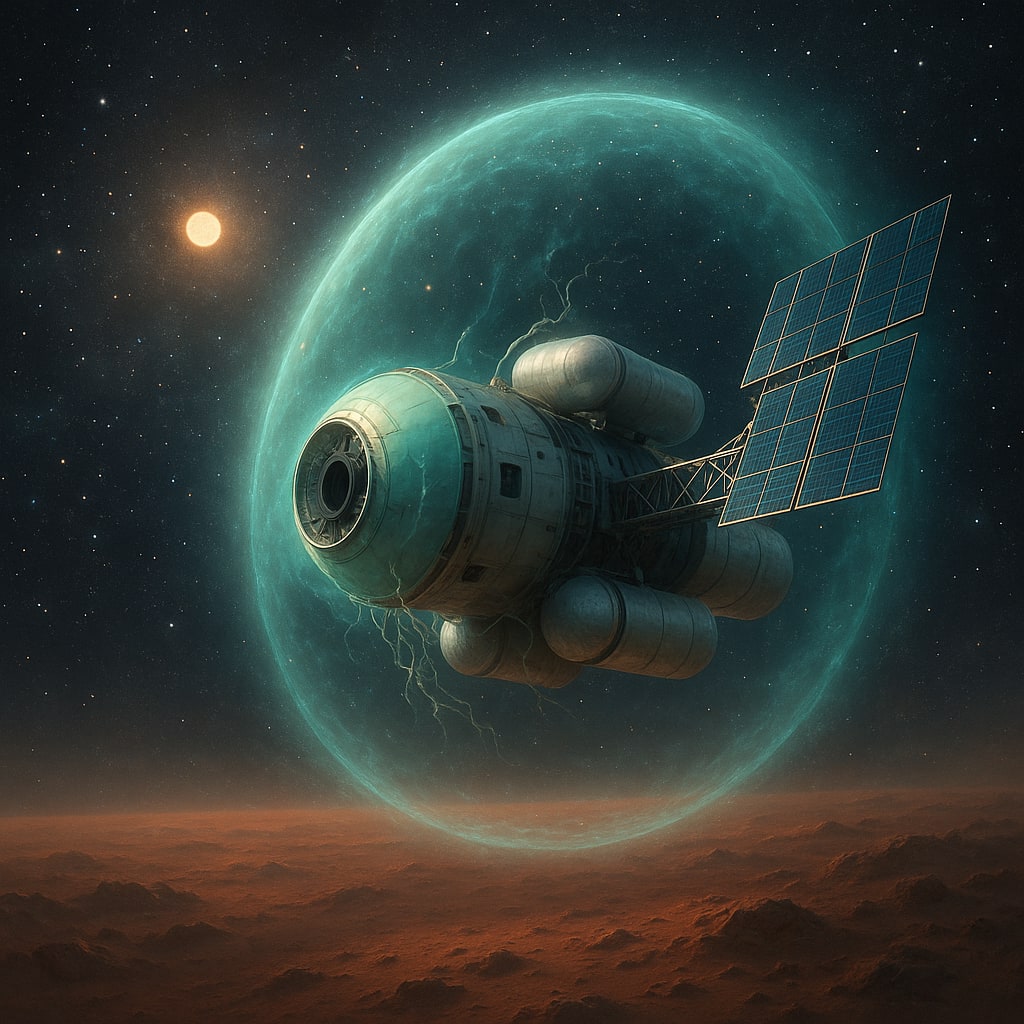
When we talk about humanity’s future in space, images of astronauts walking on Mars or mining asteroids often come to mind. Yet behind these bold visions lies a sobering reality: space is a hostile environment, and one of the greatest dangers lurking beyond Earth’s protective atmosphere is radiation. Without our planet’s thick blanket of atmosphere and its magnetic shield, astronauts become vulnerable to streams of charged particles from the Sun and high-energy cosmic rays from distant galaxies. Prolonged exposure increases the risk of cancer, neurological damage, and even acute radiation sickness.
This makes radiation protection one of the most urgent challenges for deep space exploration. The good news is that researchers around the world are experimenting with a range of innovative solutions — some inspired by advanced physics, others by biology, and even by nature itself.
The Idea of an “Active Shield”
Science fiction has long imagined force fields protecting spaceships, and now scientists are working on something surprisingly close. One of the most ambitious concepts involves creating an artificial magnetosphere around a spacecraft. Using superconducting magnets, engineers hope to generate a field strong enough to deflect incoming charged particles, much like Earth’s own magnetic field does.
While still highly experimental, simulations suggest such a system could cut radiation exposure significantly. Imagine a spacecraft traveling to Mars enveloped in an invisible bubble, where dangerous cosmic rays are bent away before they even reach the hull. The technology is not ready yet — superconducting systems require extreme cooling and consume vast amounts of energy — but progress in compact superconductors is keeping the idea alive.
Rethinking Materials: Light but Strong
Traditionally, shielding against radiation meant using dense materials like lead. But when every kilogram counts in spaceflight, lead becomes impractical. Modern research has shown that lighter materials rich in hydrogen, such as polyethylene, can actually do a better job against certain types of radiation, particularly protons.
NASA, ESA, and private companies are testing polymer composites, carbon nanotube structures, and even multifunctional shielding. For example, water tanks or fuel containers could double as radiation barriers by surrounding living quarters. This idea transforms “dead weight” into protective armor, maximizing efficiency.
Borrowing from Biology
One of the most fascinating frontiers is biotechnological protection. Scientists are studying radioprotective drugs that could boost the body’s resistance to radiation damage. There’s also genetic research into organisms that thrive in extreme environments. A famous example is Deinococcus radiodurans, a bacterium nicknamed “Conan the Bacterium,” capable of surviving radiation doses thousands of times higher than humans can withstand.
Could insights from such organisms help develop therapies or even genetic modifications to shield astronauts on long voyages? While this sounds futuristic — and raises ethical questions — the fact that nature already holds the blueprint for radiation survival makes it a promising direction.
Living Shields: The Power of Biology
Another innovative idea is to grow the shield itself during the mission. Some researchers are exploring whether fungal mycelium or cyanobacteria could form protective layers. Experiments on the International Space Station have shown that certain fungi can absorb radiation, thriving in conditions deadly to humans.
Imagine a Mars habitat where the walls are reinforced not with concrete, but with self-replicating, self-healing biological material that doubles as a radiation sponge. This kind of “living architecture” would not only save launch mass but could also adapt and regenerate, making it more sustainable than traditional shielding.
Hybrid Strategies for Real Missions
No single solution is likely to provide complete protection. Instead, future missions will probably rely on a hybrid approach:
- Layered passive shields made from lightweight hydrogen-rich materials.
- Active electromagnetic systems to reduce exposure during solar storms.
- Smart habitat design, where crew quarters are placed deep inside spacecraft, surrounded by water and supplies.
- Medical countermeasures, including radioprotective drugs.
This layered defense would turn the spacecraft itself into a carefully engineered fortress against invisible cosmic threats.
Looking Ahead: From Lab to Launchpad
Radiation remains the single greatest barrier to long-term crewed missions beyond Earth orbit. Without solving it, journeys to Mars or beyond will remain risky experiments rather than practical exploration. But technology is moving fast. Ten years ago, the idea of using fungi or bacteria as shields sounded like science fiction. Today, it’s the subject of real experiments in orbit.
When astronauts eventually set foot on Mars, their survival will depend not just on rockets and rovers, but on innovations born from physics labs, biotech research, and even microbiology. It’s a powerful reminder that the future of space travel may lie not only in machines, but in the clever ways we combine nature, technology, and imagination.
As we prepare for the next giant leap, one thing is clear: conquering cosmic radiation isn’t just a technical hurdle. It’s the key to unlocking the rest of the solar system — and, one day, perhaps, the stars beyond.
About the Creator
Keep reading
More stories from Holianyk Ihor and writers in Education and other communities.
The First Human Flight to Mars: A Reality of the 2030s or Just a Myth?
For centuries, Mars has been a canvas for human imagination. From H. G. Wells’ War of the Worlds to Hollywood blockbusters, the Red Planet has been portrayed as everything from a hostile wasteland to humanity’s next home. Today, however, the conversation about Mars has moved beyond fiction. Leading space agencies and private companies are drawing up blueprints for the first human mission. Some experts predict we could see astronauts set foot on Martian soil as early as the 2030s, while others dismiss the timeline as wildly optimistic. The truth, as always, is caught somewhere in between hope, hype, and hard reality.
By Holianyk Ihor4 months ago in Education
The Human Guide Behind Technical Excellence
Mentorship of skilled technicians plays a decisive role in shaping strong careers and reliable work standards. Technical skill alone does not make a technician capable. Real growth comes from shared experience, steady guidance, and trust built over time. In many industries, mentorship fills the gap between classroom learning and real job demands. It helps technicians move from basic ability to confident performance. This article explores how mentorship supports learning, builds skills, and strengthens the future workforce.
By Michael Gastinela day ago in Education
Pioneering Therapies for Untreated Diseases
Medical science has made incredible progress in treating many illnesses. Yet, some diseases remain resistant to conventional therapy. These untreated diseases affect millions of people worldwide, causing long-term disability or shortened lifespans. Pioneering therapies for untreated diseases aim to fill this gap, offering hope where traditional treatments have failed. Scientists, clinicians, and biotech companies are working together to create therapies that are both innovative and effective.
By Dr. Janet Chollet2 days ago in Education
Miss Persephone's Manual to a Seemingly Ordinary Life
Miss Persephone was found at the dining table, her blue eyes swollen, her tears arriving and retreating like the tides of the ocean. Earlier that day, her family had visited her in the retirement home where she had lived for eight years. It was her eightieth birthday.
By Imola Tóth2 days ago in Fiction


Comments
There are no comments for this story
Be the first to respond and start the conversation.