
Japan's First Private Moon Landing Mission Fails: UAE's Rashid Rover Lost on the Moon
Japan's 1st private Hakuto-R mission lost with UAE's Rashid rover on the Moon
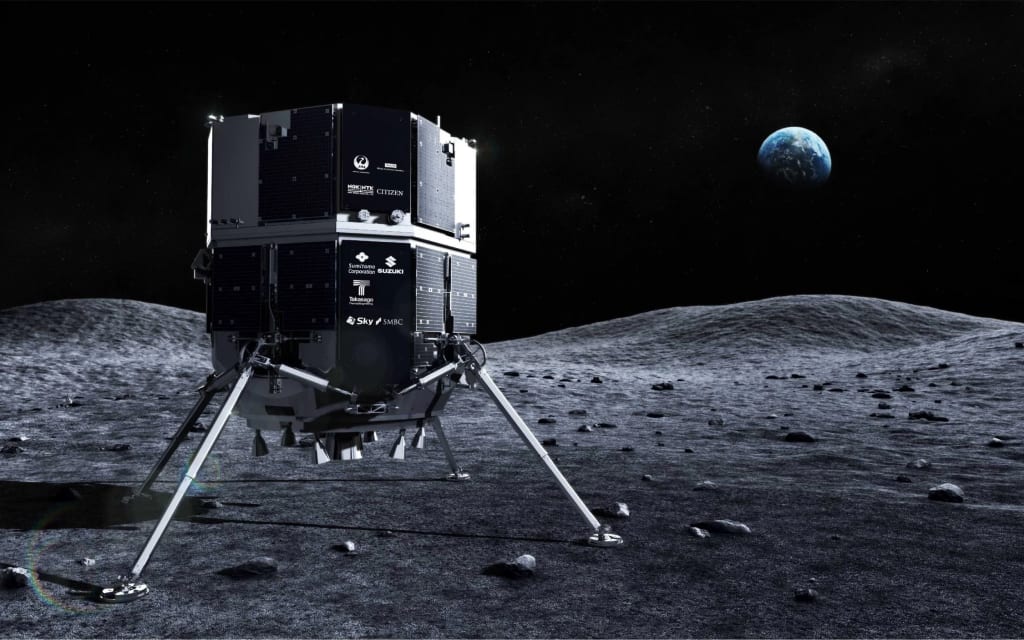
Japan's First Private Moon Landing Mission Fails: UAE's Rashid Rover Lost on the Moon
A private Japanese mission to land on the Moon has failed, with the Hakuto-R mission appearing to have crash-landed on the surface following a fast landing attempt with the UAE's Rashid rover. The mission was carrying both government and commercial payloads, including the Emirati-built Rashid rover, which was designed to study the geology of the Moon.
The Rashid rover was the UAE's first mission to the Moon and was designed to operate for a single lunar day, which lasts approximately 14 Earth days.
The loss of the mission is a significant setback for both Japan and the UAE, which were hoping to make history with the first private Moon landing.
The Mission and the Failure
The Hakuto-R mission had entered the Moon's orbit in March 2023 and was preparing to land on the Moon on April 26, 2023. The spacecraft had arrived in lunar orbit about a month ago after being launched on a SpaceX Falcon-9 rocket in December last year. The Hakuto-R began a descent on the lunar surface on Tuesday from an altitude of 100 kilometers above the surface of the Moon, while flying at a speed of 6,000 kilometers. However, the mission failed, and the officials from ispace, the Japanese company that sent the lander, said that they have not been able to establish communication and have to assume that they could not complete the landing on the lunar surface.
The cause of the mission's failure is currently unknown. The officials from ispace said that their engineers are continuing to investigate the situation and will update once they finish the investigation. The loss of the Hakuto-R mission is a setback for both Japan and the UAE, which were hoping to make history with the first private Moon landing. The mission was a part of a larger effort to establish a transportation system to the surface of the Moon and give private companies affordable access to the lunar surface.
The Rashid Rover and the UAE's Ambitious Plans
The Rashid rover was developed by the Mohammed Bin Rashid Space Centre and was the UAE's first lunar mission. It was designed to operate for a single lunar day, which lasts approximately 14 Earth days. The UAE previously launched the Mars Hope Probe in July 2020, which went into orbit around the Red Planet in February 2021. Emirati astronaut Sultan Al Neyadi is currently on the International Space Station as part of the Crew-6 mission, which launched earlier this month.
The UAE has already made significant strides in space exploration, and its ambitious plans for the future include a mission to Mars by 2117. The loss of the Hakuto-R mission is a significant setback for the UAE, which was hoping to establish itself as a major player in the global space race. However, the UAE is likely to continue its efforts to explore space and push the boundaries of human knowledge.
The Challenges of Space Exploration
The loss of the mission highlights the challenges of space exploration and the risks involved in such endeavors. Despite the setback, the UAE and Japan are likely to continue their efforts to explore space and push the boundaries of human knowledge. Japan, too, has a long history of space exploration and has made significant contributions to the field. The loss of the Hakuto-R mission is a reminder that space exploration is a difficult and risky endeavor, but it is also a testament to the human spirit of exploration and the desire to push the boundaries of what is possible.
Conclusion
In conclusion, the loss of the Hakuto-R mission is a significant setback for both Japan and the UAE, but it is also a reminder of the challenges and risks involved in space exploration. Despite the setback, the UAE and Japan are likely to continue their efforts to explore space and push the boundaries of human knowledge. The loss of the mission is a reminder that space exploration is a difficult and risky endeavor, but it is also a testament to the human spirit of exploration and the desire to push the boundaries of what is possible.
About the Creator
Keep reading
More stories from Abirami muruganantham and writers in Education and other communities.
Top 10 Machine learning projects that help you crack the interview like a Pro
Introduction: Machine learning has become one of the hottest areas in the tech industry today. Developing algorithms and models that enable machines to learn from data and improve performance without being explicitly programmed. Demand for skilled machine learning engineers and data scientists is skyrocketing as the demand for intelligent systems that can analyze massive amounts of data and generate insights grows.
By Abirami muruganantham3 years ago in Education
Python vs Rust Performance: Speed, Memory Usage, and Scalability Explained
When developers compare programming languages, performance is often one of the most debated factors. Two languages that frequently come up in these discussions are Python and Rust. While both are powerful in their own ways, they approach performance, memory management, and scalability very differently. This makes the Python vs Rust comparison especially relevant for teams choosing the right technology for their next project.
By Lennox Gray4 days ago in Education
💦The Water Cycle💦
Water is one of the most essential substances on Earth. It covers over 70% of our planet’s surface and is crucial for all forms of life. But have you ever wondered how water moves continuously around the Earth? How rivers, oceans, clouds, and rain are all connected in a constant cycle? This amazing natural process is called the water cycle, and it ensures that life never runs dry.
By Talha khan2 days ago in Education
Miss Persephone's Manual to a Seemingly Ordinary Life
Miss Persephone was found at the dining table, her blue eyes swollen, her tears arriving and retreating like the tides of the ocean. Earlier that day, her family had visited her in the retirement home where she had lived for eight years. It was her eightieth birthday.
By Imola Tóth4 days ago in Fiction




Comments
There are no comments for this story
Be the first to respond and start the conversation.