
Inside the Mind: The Secret Mechanics of How We Think
Why Your Thoughts Are Not as Random as They Seem

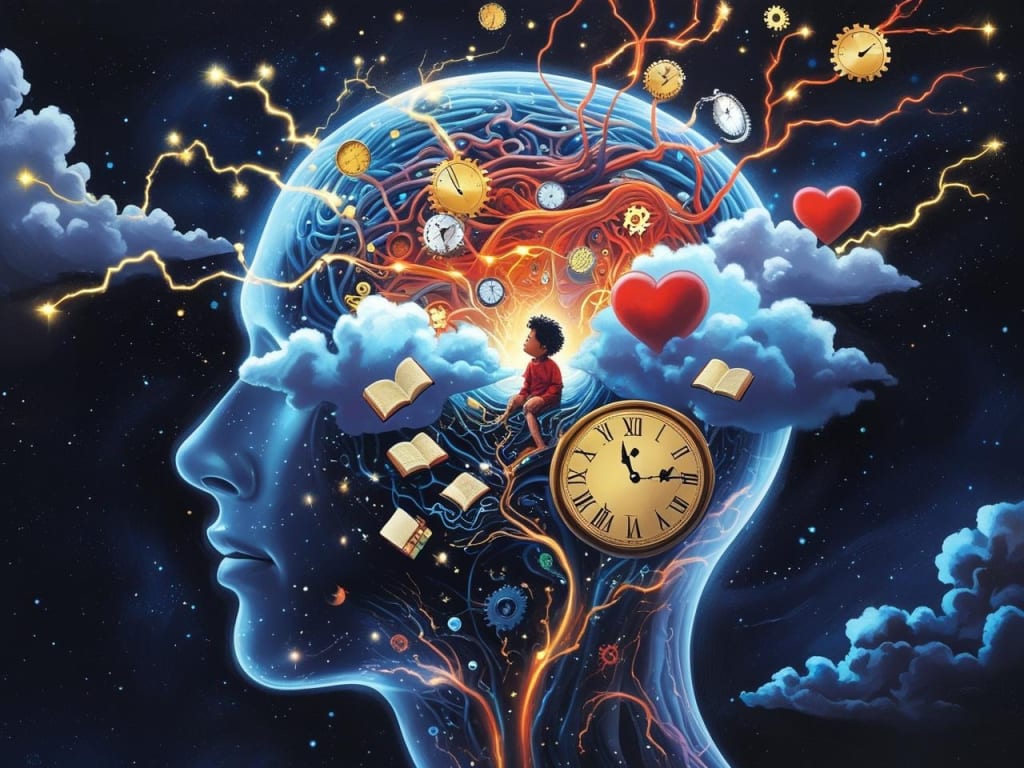
Have you ever stopped in the middle of a thought and asked yourself, “Why am I thinking this?” One minute you're focused on work, the next your mind is replaying a childhood memory, jumping to future fears, or dreaming up wild imaginations. Our thinking seems random, chaotic, and unpredictable—but beneath that surface lies a complex and fascinating system that runs our entire experience of life.
This is the story of how we think—not just the biology of it, but the emotions, the subconscious, the logic, and the memories that all come together to create the unique voice in your head.
---
The First Spark: Where Thoughts Begin
Every thought starts with something small: a trigger. It could be a sound, a smell, a sight, a word someone says, or even a feeling inside you. Your brain takes in that trigger through your senses and instantly connects it to something you’ve already experienced. That’s why the smell of fresh bread might remind you of your mother’s kitchen, or the sound of rain may make you feel calm or sad.
Our thoughts are built on associations. Your brain doesn’t just store memories—it links them. One memory links to another, and your thoughts jump from place to place like stepping stones across a river. The deeper the emotion connected to a memory, the stronger the link. That’s why trauma or happiness can shape how and what we think about years later.
---
The Invisible Voice: Your Inner Narrator
Think about the voice in your head reading this sentence right now. That voice is always talking—narrating your life, questioning your actions, dreaming about the future. This is called your “inner monologue.” For some people, it’s loud and nonstop. For others, it's more like feelings or pictures than actual words.
This voice is shaped by your beliefs, your past, your culture, and even the people around you. If you grew up in a critical environment, that voice might be harsh and doubting. If you were loved and supported, it might be kind and encouraging. But the good news is—you can change this voice.
Once you become aware of your inner thoughts, you gain the power to reshape them. This is the foundation of mindfulness, therapy, and even spiritual growth.
---
Logic vs. Emotion: The Great Battle
One of the most interesting parts of thinking is how emotion and logic constantly fight for control. Say you’re deciding whether to message someone you like. Logic tells you to wait, think, don’t look desperate. But emotion says, Do it now! What if you lose the chance?
Both voices are part of the thinking process. Your amygdala (the emotion center) responds instantly—like a reflex. But your prefrontal cortex (the logical part) is slower, more careful. That’s why sometimes you react quickly with anger or fear—and later regret it.
A big part of emotional intelligence is learning to pause before reacting—to let your logical brain catch up with your emotional one. This balance is what separates impulse from wisdom.
---
The Subconscious Mind: Thoughts You Don't Even Know You Have
Here’s the part that’s hard to believe: most of your thinking happens without you even knowing it.
Your subconscious mind is always active, filtering information, remembering smells, solving problems quietly in the background. It’s why you sometimes “suddenly” remember something or wake up with the solution to a problem you couldn’t figure out last night. It was never lost—your brain was just working silently.
This is also why repeated thoughts become habits. If you constantly think negative thoughts, your brain starts to expect them. It literally creates "paths" in your brain that become easier to follow the more you think them. But the opposite is true too—thinking positive or
Thanks for watching
By Farid ullah
About the Creator
Reader insights
Outstanding
Excellent work. Looking forward to reading more!
Top insight
Heartfelt and relatable
The story invoked strong personal emotions
Keep reading
More stories from Farid Ullah and writers in Education and other communities.
Why we fear something — even if it’s not dangerous
When Calla was seven years old, she screamed at the sight of a rope in her grandfather’s barn. It wasn’t just a small cry or a startled jump—it was a full-bodied, blood-draining scream that echoed through the rafters. Her grandfather, a quiet man who rarely raised his voice, came running so fast he dropped his hammer. But when he reached her, all he saw was a piece of old rope curled on the dusty floor, half-covered in hay.
By Farid Ullah6 months ago in Psyche
Why Great Customer Service Is Non-Negotiable for Modern Businesses
Excellent customer service is no longer something businesses can choose to offer later. It is a basic requirement in today’s fast-moving market. Customers expect respect, clear communication, and fast solutions. When they do not get these things, they leave. This is why excellent customer service is non-negotiable for businesses that want to survive and grow.
By Apex Service Partners5 days ago in Education


Comments (1)
Good