
Why we fear something — even if it’s not dangerous
The Heart Doesn’t Always Listen to Logic

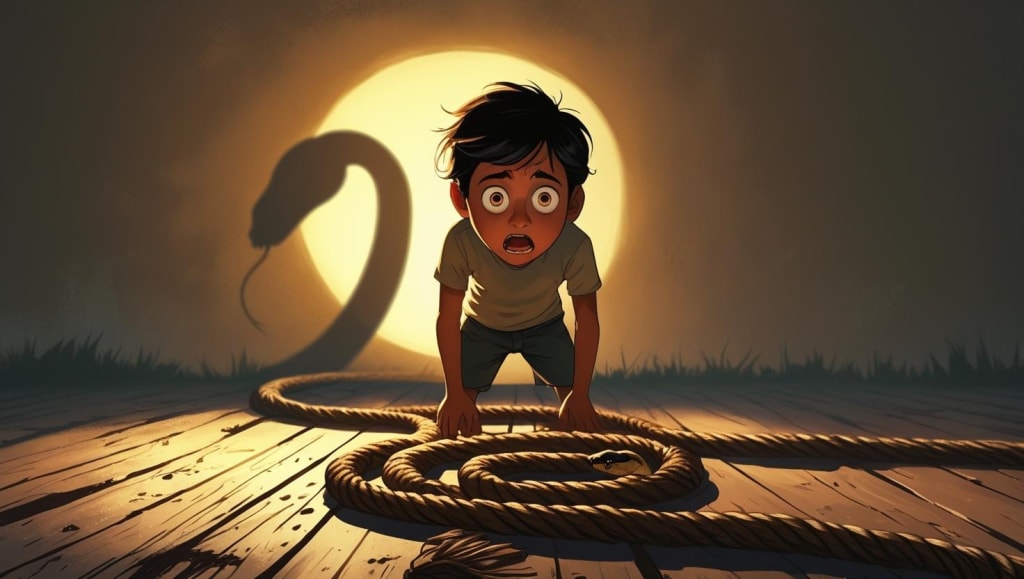
When Calla was seven years old, she screamed at the sight of a rope in her grandfather’s barn.
It wasn’t just a small cry or a startled jump—it was a full-bodied, blood-draining scream that echoed through the rafters. Her grandfather, a quiet man who rarely raised his voice, came running so fast he dropped his hammer. But when he reached her, all he saw was a piece of old rope curled on the dusty floor, half-covered in hay.
Calla was shaking, her eyes wide and fixed on the rope.
“Snake,” she whispered.
Her grandfather knelt beside her, gently picking up the rope and handing it to her. “It’s just this, see? Nothing but a rope.”
But Calla wouldn't touch it.
From that day on, she refused to go into the barn alone. Even years later, when she was twelve and knew better, she still walked wide around any coiled garden hose, any twist of rope or dark crack in the pavement.
No one teased her. Her family was kind. But the fear stayed.
By the time Calla turned sixteen, she was good at hiding it. She no longer screamed, no longer froze, but something still turned in her chest whenever she saw certain shapes. She felt embarrassed by it. After all, she knew better. She had read enough books and passed enough science classes to understand that fear should match the threat.
But it didn’t. Not always.
One summer, her psychology teacher assigned a project called "Roots of Fear." The task: explore a personal fear—its origin, its effects, and what could be done about it.
Calla groaned when she saw the topic. She had tried so hard not to think about hers. But part of her knew: this was the chance to dig deeper.
She visited her grandfather’s barn for the first time in a long while. It looked smaller now, not the giant cave she remembered from childhood. The light through the wooden slats painted warm lines across the hay. She stood in the middle of the floor, where the rope had once been.
She didn’t scream this time. But her pulse quickened.
Later, over tea, she asked her grandfather, “Did anything happen that day before I screamed at the rope? Anything that might have made me think it was a snake?”
He stirred his tea slowly.
“You don’t remember?” he asked.
Calla shook her head.
“You were five, maybe younger. There was a snake in the garden. Real one. Curled near the carrot patch. You nearly stepped on it. I pulled you back just in time.”
“Was it dangerous?”
“No. Harmless little thing. But it surprised you. You cried then, too.”
Calla blinked. The memory came in pieces. The garden. The tug on her arm. The sharp hiss.
Her grandfather continued, “Fear has a long tail, Calla. Sometimes it follows us for years, even when the danger’s gone.”
She decided to use the barn rope in her project. She photographed it, wrote about her childhood reaction, and researched how the brain processes fear. She learned that our amygdala, the brain’s fear center, can light up even when we only think we see something dangerous. That fear doesn’t always wait for logic—it acts first, questions later. It’s a survival mechanism.
But she also learned something more important: the brain can relearn.
So Calla started a small routine. Each day, for one minute, she sat beside a coiled rope. Just sat. Sometimes her heart raced. Sometimes she laughed at herself. After a few weeks, she picked it up. Then she coiled it herself. Then she walked into the barn without even thinking.
At the end of the summer, she gave her presentation. On the screen behind her was the image of the rope, coiled on the barn floor, next to a garden hose she had placed there on purpose.
She said, “Our brains are built to protect us. But sometimes, they overreact. They remember old pain, even when the threat is long gone. That doesn’t make us weak. It makes us human.”
She paused, looking at her classmates.
“What matters is that we look again. That we challenge the fear when it no longer serves us.”
After the class clapped, her teacher came up to her and said, “Thank you. That was brave.”
But Calla didn’t feel brave. She felt—relieved. Like something inside her had finally been given a name, and once it had a name, it could begin to shrink.
Years later, when she became a teacher herself, she kept a coil of rope in her classroom. When students asked why it was there, she smiled and said, “To remind me that not everything that looks dangerous is dangerous.”
And sometimes, she added, “The scariest things aren’t the ones in front of us. They’re the ones we never stop to question.”
---
Moral:
We often fear things not because they’re dangerous—but because our minds once believed they were. Fear is a signal, not a sentence. And when we learn to look again, the shadows grow smaller.
About the Creator
Reader insights
Outstanding
Excellent work. Looking forward to reading more!
Top insight
Heartfelt and relatable
The story invoked strong personal emotions
Keep reading
More stories from Farid Ullah and writers in Psyche and other communities.
She Built Herself From Broken Pieces
There was a time when Areeba didn’t recognize the woman in the mirror. The girl who once laughed freely, who danced barefoot in the rain, who believed in fairy tales and kindness—that girl was gone. Replaced by someone hollow-eyed, quiet, and uncertain. Her dreams were folded away like old clothes, her voice buried beneath the echoes of words that had wounded her.
By Farid Ullah6 months ago in Motivation
Center Stage with Paul Stewart
*** I'm keen to republish the interviews I did for my series with Vocal creators. It's been a few years and I thought it might be nice to revisit these wonderful conversations. I'll be releasing them one at a time for a few weeks/months.
By Heather Hubler2 days ago in Interview




Comments (1)
Outstanding