
Infrared Region
"Vibrational Area of the Infrared Region"


Interaction of electromagnetic radiations with the matter is termed as spectroscopy. All types of compounds organic and inorganic, containing covalent bonds must absorb frequencies in the range of Infrared of the electromagnetic radiations. This region has wavelength higher than the ultraviolet region and has shorter wavelength than the microwaves region. It ranges from 400cm-1 to 4000cm-1. We use the infrared spectrum for the identification of compounds much like the fingerprint that we use for human identification. We simply compare the infrared spectra of two compounds to confirm whether they are identical or not. If their spectra match peak for peak, they must be identical compounds. Infrared spectroscopy did not provide complete information about compound spectra. The information obtained from it, nevertheless often correct, is always indefinite and is used together with confirmations by chemical, physical and other means of spectroscopy. Amines can be derived from ammonia. In amines one of the hydrogen atoms of ammonia compound can be displace by hydrocarbon group like alkyls. These amines can be distinguished on the basis of their spectra in dilute solutions in infrared region. Primary amines depict two bands in the region of 3300 to 3000cm-1 due to their fundamental N-H stretching vibrations. Secondary amines show only single band in this region of 3300 to 3000cm-1 while, tertiary amines do not show any band at all. Stretching vibrations of N-H region shows absorption bands near the range of 3550 to 3300cm-1. In clear solution samples the N-H shows feeble and acute peaks than O-H band which mostly appears in same region. For primary amines spectra shows in plane strong N-H scissoring absorptions at the range of 1550 to 1650cm-1 along with out of plane wagging vibrations at the range of 650 to 900cm-1. These peaks are usually broad and are the characteristics of amines. Infrared spectra of secondary amines showed weak N-H bending absorptions that are visible in the infrared region of 1500 to 1600cm-1. An intense broad wagging absorption bands may appear in the range of 650 to 900cm-1. Tertiary amines showed broad bands in the infrared spectra aside from the N-H stretch and these compounds shown specific characteristics for their alkyl and aryl substituents.
1-Infrared spectroscopy:
The term spectroscopy is defined as interaction of the electromagnetic radiations with the matter. All types of compounds organic and inorganic, containing covalent bonds must absorb frequencies in the range of Infrared of the electromagnetic radiations. This region has wavelength higher than the ultraviolet region and has shorter wavelength than the microwaves region. It ranges from 400cm-1 to 4000cm-1. For convenience we are interested in the vibrational area of the infrared region. These radiations are invisible to human eye. IR would be sectioned into three major types:
• Near-infrared (14000-4000 cm-1)
• Middle-infrared (4000-400 cm-1)
• Far-infrared (400-10 cm-1)
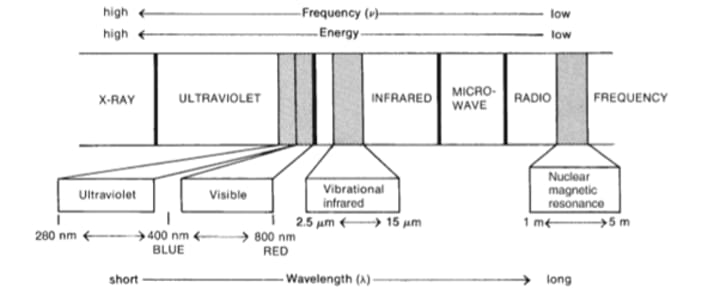
In near-infrared region we observe and study about overtones along with combination vibrations. The middle infrared region gives us information about fundamental vibrations and also informs about rotational and vibrational structural information of small compound. While the far infrared region is used to study low intensity vibrations of heavy atoms such as metal ligands.
The most important work of infrared spectroscopy is to determine the molecular structural information. Each types of bond shows absorption frequency which clearly found in certain narrow areas of the vibrational IR region of spectra. Each bond appears with a definite and different range for absorption bands. Absorptions beyond this specific area are mostly due to indication of some other types of bonds. For instance, absorptions that shows in the range of 3000 ± 150 cm−1is almost indicates the appearance of C-H bond. While absorptions in the range of 1715 ±100 cm−1 indicates the appearance of C-O bond in the molecules.
About the Creator
Fatima Jamil
In a world where you can be anyone, be yourself.
Keep reading
More stories from Fatima Jamil and writers in Education and other communities.
Phosphoryl Group Transfer Potential
Introduction “High energy phosphate bond” is a misleading word as it was thought that the bond itself contains energy. But in actual term, the hydrolysis of this bond requires an input of energy. The change in energy during the hydrolysis of phosphate bond does not result in bond breakage but infects the energy that comes from the products that have low free energy content. Therefore, for convenience, we use the term high energy phosphate compounds for those compounds that contain phosphate groups. In living organisms, phosphate compounds can be divided into two parts on the basis of their free energy change; “low energy” compounds and “high energy” compounds. We noticed a change in energy in a series of reactions when a phosphorylated compound is formed by reacting to another phosphorylated compound that has a negative free energy of hydrolysis.
By Fatima Jamil3 years ago in Education
Building Stronger Schools Through Student Mental Health Support
Schools across the United States face a growing responsibility to support students with anxiety and depression. Academic pressure, social media influence, family stress, and uncertainty about the future affect students at younger ages than ever before. Therefore, schools must recognize that mental health directly shapes learning outcomes, behavior, and long-term well-being. When students feel emotionally supported, they engage more fully in class and build stronger relationships. As a result, mental health care should stand alongside academic instruction as a core school priority.
By Martin Karp7 days ago in Education
Critical College Application Mistakes That Lower Your Acceptance Odds
Applying to college is a pivotal step in shaping your future, and even strong students often make preventable mistakes that reduce their chances of getting accepted. Although the application process may feel complicated and time-consuming, avoiding common errors can significantly strengthen your overall profile. Eventually, understanding what admissions officers look for helps you create a more polished and compelling submission. While every applicant has unique strengths and challenges, developing a thoughtful approach ensures that the admissions success strategy supports your goals at every stage.
By Carmen Reid3 days ago in Education



Comments
There are no comments for this story
Be the first to respond and start the conversation.