
Phosphoryl Group Transfer Potential
"Phophoenolpyruvate has such a high Phosphoryl Group Transfer Potential"


Introduction
“High energy phosphate bond” is a misleading word as it was thought that the bond itself contains energy. But in actual term, the hydrolysis of this bond requires an input of energy. The change in energy during the hydrolysis of phosphate bond does not result in bond breakage but infects the energy that comes from the products that have low free energy content. Therefore, for convenience, we use the term high energy phosphate compounds for those compounds that contain phosphate groups. In living organisms, phosphate compounds can be divided into two parts on the basis of their free energy change; “low energy” compounds and “high energy” compounds. We noticed a change in energy in a series of reactions when a phosphorylated compound is formed by reacting to another phosphorylated compound that has a negative free energy of hydrolysis.
High Phosphoryl Group Transfer Potential
Phosphoenolpyruvate produce during glycolysis has a high Phosphoryl group transfer potential. It contains a phosphate ester bond that can undergo hydrolysis to yield the enol form of pyruvate. The enol form of pyruvate is highly unstable and simultaneously undergoes towards the more stable keto form by tautomerization.

Reason: There are some basic factors;
• Charge separation
• Solvation
• Resonance hybrid
• Tautomerization
• Charge Separation: Electrostatic repulsion creates among the four negatives charged groups on the ATP during the hydrolysis process. This electrostatic repulsion separates the charges within the Phosphoenolpyruvate molecule and the phosphate group separate in the form of inorganic phosphate.
• Solvation: High degree of solvation of ADP and Pi as compare to ATP also favors ATP hydrolysis.
• Resonance Hybrid: The inorganic phosphate group stabilizes itself by forming a resonance hybrid structure. In this way, all the Phosphorus-oxygen bonds share the same degree double-bond character and the hydrogen ion is not directly linked with any of the four oxygen atoms.
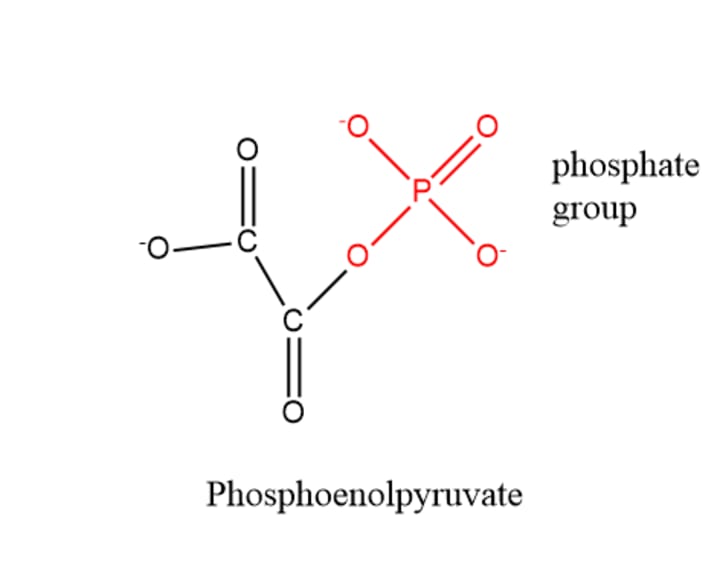
• Tautomerization: The second major factor is tautomerization. The enol form of pyruvate contains a double bond with a carbon atom and through a single bond attach with oxygen. While in keto form double bond links with oxygen. From the structure, we clearly see that in the enol form tautomerization is not possible so it immediately converts into its keto form that is more stable.
Part II: why glycolysis produces NADH and the pentose phosphate pathway produces NADPH?
NAD and NADP: Nicotinamide Adenine Dinucleotide (NAD) and Nicotinamide Adenine Dinucleotide Phosphate (NADP) are the two most abundant and vital enzymes used in metabolic pathways. NADH and NADPH are their reduced form. These enzymes used for the transportation of electron along the metabolic pathway to generate ATP form of energy. Both enzymes show many similarities. A prominent difference between both enzymes; NADH used in catabolic pathways while NADPH used in anabolic pathways.
Production of NADH during Glycolysis
• NADH produces during catabolic pathways
NADH is a special enzyme used in cellular respiration to catalyzed oxidation-reduction reaction. It is abundantly found in the cells and involved in catabolic pathways. As glycolysis is an anabolic pathway so it is the major site for the synthesis of NADH. In glycolysis, many dehydrogenase enzymes use NAD+ as a coenzyme which is oxidized form. The dehydrogenase enzymes donate their one electron and hydrogen ion to the oxide form of NAD+ and reduce it into NADH. Glycolysis produces two NADH which stores electron and passes it to the respiratory chain where it is utilized for the production of energy.
Production of NADPH in PPP
• NADPH produced during anabolic pathways
NADPH is the reduced form of NADP and mostly used to catalyze oxidation-reduction reactions. It is abundantly found in the cell. The major role of this enzyme is associated with anabolic pathways like the Pentose Phosphate Pathway. It structurally differs from NADH by the presence of a phosphate group that is linked to the ribose ring at position 2. It act as a reducing agent and helps in the transportation of electron for the generation of ATP the “energy currency” of the cell.
Conclusion
Phosphoenolpyruvate produce during glycolysis has a high Phosphoryl group transfer potential. It contains a phosphate ester bond that can undergo hydrolysis to yield the enol form of pyruvate. The enol form of pyruvate is highly unstable and simultaneously undergoes towards the more stable keto form by tautomerization. Some factors influence Phosphoenolpyruvate to show high Phosphoryl group transfer potential like Charge separation, Tautomerization, Resonance hybrid, etc.
Nicotinamide Adenine Dinucleotide (NAD) and Nicotinamide Adenine Dinucleotide Phosphate (NADP) are the two most abundant and vital enzymes used in metabolic pathways. NADH and NADPH are their reduced form. These enzymes used for the transportation of electron along the metabolic pathway to generate ATP form of energy. Both enzymes shows much similarities. The prominent difference between both enzymes; NADH used in catabolic pathways like glycolysis while NADPH used in anabolic pathways like Pentose Phosphate Pathway.
About the Creator
Fatima Jamil
In a world where you can be anyone, be yourself.
Keep reading
More stories from Fatima Jamil and writers in Education and other communities.
Time to Time Advancements in Tetrafluoroethylene
6-The Chronological profile of Polytetrafluroethylene List of the Events: 1-Discovery of PTFE PTFE burst upon the scene quite by the accident, true to the discovery pattern of so many great inventions. In 1938 Mr. Roy J. Plunkett, a DuPont chemist, was developing a new refrigerant when he discovered “Polytetrafluoroethylene” often referred to as the PTFE resins.
By Fatima Jamil3 years ago in Education
How to Implement Digital Signage in Your Pharmacy
I'll never forget the first time I walked into a pharmacy with digital signage displays showing real-time prescription wait times and health tips. As someone who'd spent years waiting in line wondering how much longer I'd be there, seeing that information displayed so clearly felt revolutionary. That experience stuck with me, and when I later helped my cousin implement digital signage in her independent pharmacy, I realized just how transformative this technology could be for both pharmacy owners and customers.
By Jerry Kane 6 days ago in Education
Starting Strong: Learning the Basics of Investment Management
Investment management involves managing money set aside to grow over time. It is about deciding how and where to put money so that it earns more in the future. This process includes choosing among options such as stocks, bonds, or real estate. It also involves planning how long to hold these investments and how to react when markets change. For beginners, learning about investment management is the first step toward gaining control over their financial future.
By Winston Feng7 days ago in Education




Comments
There are no comments for this story
Be the first to respond and start the conversation.