
How Stars Form: A Stunning Journey From Cosmic Clouds to Brilliant Light
The birth and life of a star is one of the most remarkable processes in the universe. Stars are far more than tiny glowing dots in the night sky—they are enormous nuclear furnaces that create light, heat, and the very elements that make planets and life possible. Understanding how stars form gives us insight into the structure of the cosmos and our own origins

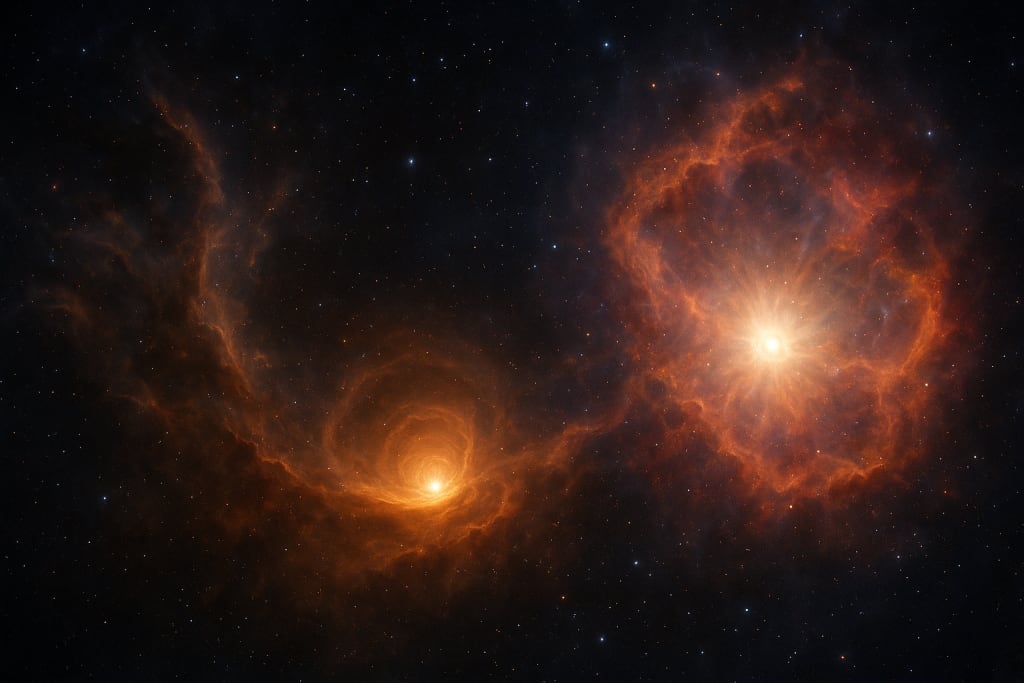
The Birthplace of Stars: Molecular Clouds
Every star begins its life inside a massive region of gas and dust known as a molecular cloud or stellar nursery. These clouds are mostly made of hydrogen, along with helium and traces of heavier elements. Despite their size, they are extremely cold—often around −250°C (−420°F).
Inside these clouds, certain regions become dense enough for gravity to take over. When a pocket of gas and dust collapses under its own gravitational pull, it forms the seed of a new star called a protostar.
Stage 1: The Protostar Phase
As gravity gathers more material from the cloud, the forming protostar grows hotter and denser. A swirling disk of gas and dust develops around it—this is the region where planets, moons, and asteroids may eventually form.
Inside the core, temperatures continue rising. The protostar shines faintly, not from nuclear reactions yet, but from the heat generated by gravitational contraction. It continues growing until the conditions become extreme enough to ignite a new, powerful process.
Stage 2: Nuclear Fusion Ignites
When the core temperature reaches about 15 million°C (27 million°F), a dramatic transformation occurs—nuclear fusion begins.
Hydrogen atoms fuse into helium, releasing enormous amounts of energy. This outward pressure balances gravity, allowing the star to stabilize. The star officially enters the period known as the main sequence, the longest stage of its life.
The Main Sequence: The Star’s Longest Life Stage
A star spends about 90% of its life in the main sequence stage. During this time, it continuously fuses hydrogen into helium, producing the light and heat we see.
Types of Stars
Stars vary dramatically depending on how much mass they had at birth:
Red Dwarfs: Small, cool, and extremely long-lived. They burn slowly and can survive for trillions of years.
Sun-like Stars (G-Type): Medium-sized stars, including our Sun. They shine for billions of years.
Massive Stars (O- and B-Type): Very large, hot, and bright. They burn fuel rapidly and live only a few million years.
Astronomers use the Hertzsprung–Russell Diagram to compare stars based on temperature and brightness, helping them understand how stars evolve over time.
How Stars Die: The Final Stages of Stellar Evolution
When a star runs out of hydrogen fuel, it can no longer maintain nuclear reactions in its core. What happens next depends entirely on its mass.
1. The Death of Low-Mass Stars
Stars like our Sun expand into red giants after exhausting their hydrogen. Their outer layers drift away, forming a glowing shell called a planetary nebula.
The leftover core becomes a white dwarf—a dense, Earth-sized object that slowly cools over billions of years.
2. The Explosive Death of Massive Stars
Massive stars undergo a far more dramatic ending. After using up hydrogen, they fuse heavier and heavier elements—helium, carbon, oxygen, and eventually iron.
Fusion stops at iron, causing the core to collapse. The result is a titanic explosion known as a supernova, one of the brightest events in the universe.
3. What Remains After a Supernova?
Depending on the remaining core mass, two incredible objects may form:
Neutron Star: If the core is about 1.4–3 times the Sun’s mass. These are unimaginably dense—just a teaspoon of their material would weigh billions of tons.
Black Hole: If the core is more than three solar masses. Gravity becomes so intense that nothing—not even light—can escape.
Why Stars Matter: The Builders of the Universe
Stars are essential to the cosmos. Through nuclear fusion, they create heavier elements like carbon, oxygen, and iron—the building blocks of planets and living organisms.
When massive stars explode, these elements spread into space, becoming part of new stars, new planets… and eventually, life itself.
As astronomer Carl Sagan famously said, “We are made of star stuff.”
Conclusion
The formation and evolution of stars is a breathtaking journey—from cold molecular clouds to glowing giants, and from brilliant explosions to exotic remnants like neutron stars and black holes.
Studying how stars form not only helps us understand the universe but also reminds us of our deep connection to it. The atoms in our bodies were once forged in ancient stars, linking us to the cosmos in the most profound way.
About the Creator
Keep reading
More stories from shahkar jalal and writers in Education and other communities.
Could the Laws of Physics Be Different in Other Universes?
The Multiverse Concept The multiverse theory encompasses various models that suggest the existence of multiple, perhaps infinite, universes beyond our own. These universes may differ in fundamental ways, including the laws of physics that govern them. Some notable interpretations of the multiverse include:
By shahkar jalal2 months ago in Education
Image-to-text technology, also known as Optical Character
Image-to-text technology, also known as Optical Character Recognition (OCR), has transformed the way we interact with visual information. It allows machines to extract text from images, enabling various applications across multiple industries. From digitizing printed documents to reading text from scanned images, OCR plays a vital role in making printed content accessible, editable, and searchable. The need for such technology has grown exponentially with the increasing reliance on digital data and the rapid shift from physical to digital content in nearly all sectors of life. As the digital world continues to expand, image-to-text technology has paved the way for more seamless workflows, enabling businesses and individuals alike to save time, effort, and resources.
By Alexander Jackson5 days ago in Education
Most Sales Deals Fail Because Sellers Talk to the Wrong People
There is a quiet reason many sales conversations feel productive but go nowhere. Everyone leaves the call optimistic. Emails move back and forth. Documents get shared. Then momentum fades. Weeks pass. The deal stalls without a clear explanation.
By Armi Ponsica3 days ago in Education


Comments
There are no comments for this story
Be the first to respond and start the conversation.