
How Eye Macular Hole Surgery is Transforming Lives in 2025
New Hope for Clearer Vision


Few diagnoses impact daily life as profoundly as a macular hole. This small defect in the retina’s center can blur vision, distort faces, and make reading difficult. But in 2025, rapid advances in eye macular hole surgery have brought new hope to patients. With improved techniques, real-time imaging, and faster recovery, the treatment is helping thousands reclaim their sight and independence.
Understanding the Macular Hole
The macula is the central portion of the retina responsible for sharp, detailed vision. When a hole forms due to aging or tractional forces in the vitreous, the result is blurred or darkened central vision.
Common causes include:
- Age-related changes in the vitreous gel
- High myopia (severe nearsightedness)
- Trauma or retinal disease
- Secondary effects after retinal detachment surgery
If left untreated, a macular hole can enlarge and cause permanent visual loss. Early detection through optical coherence tomography (OCT) is crucial for timely treatment.
The Goal of Modern Surgery
The main goal of macular hole surgery is to close the defect and restore the normal structure of the retina. This helps improve central vision and prevent further deterioration. Today’s surgical precision allows for excellent closure rates, even for chronic or large holes.
Key Innovations in 2025
Advancements in surgical technology and imaging have made the procedure safer, quicker, and more effective. Here’s what’s new in 2025:
- Micro-incision vitrectomy systems: These ultra-small tools minimize trauma, shorten surgery time, and promote faster healing.
- Internal limiting membrane (ILM) peeling and flap techniques: Enhanced precision ensures higher closure success, especially for complex holes.
- Intraoperative OCT: Surgeons can now visualize the macula in real-time during surgery, ensuring precise tissue handling and closure confirmation.
- Gas alternatives: New biocompatible gases and tamponade agents have improved patient comfort and visual outcomes.
“Small refinements in surgical technique have made once-difficult macular holes routine cases with remarkable success rates.” – Dr. A. Kumar, Retinal Surgeon.
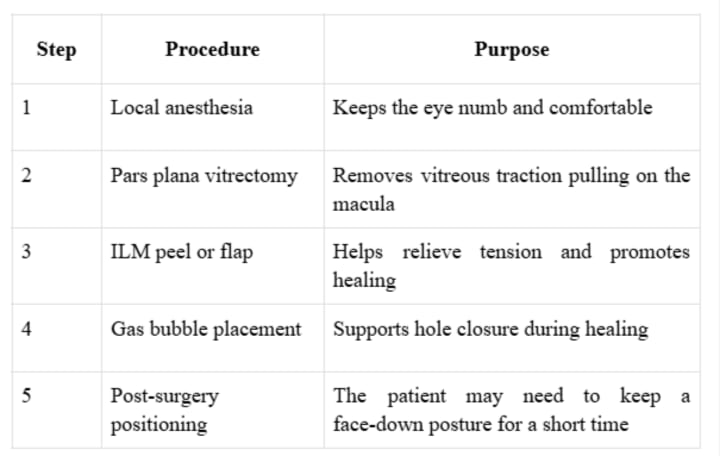
Step-by-Step: How the Procedure Works
Below is a simplified view of how macular hole surgery is performed:
Recovery and Results
Macular hole surgery recovery has improved dramatically. While individual healing varies, most patients regain functional vision within a few weeks to months.
What to Expect
- Vision may appear distorted initially, but improves gradually.
- Avoid air travel or high altitudes while a gas bubble remains in the eye.
- Regular follow-ups are crucial to monitor progress through OCT scans.
Pro Tip: Wear sunglasses outdoors post-surgery to reduce light sensitivity and protect healing tissues.
How Macular Hole Surgery Improves Vision
Vision improvement depends on several factors—hole size, duration, and pre-surgery vision quality. Most patients report:
- Sharper central vision
- Better ability to read and recognize faces
- Enhanced depth perception
Clinical studies in 2025 show that over 90% of surgeries achieve complete anatomical closure, and about 70–80% of patients experience meaningful visual gain.
Do You Know?
Macular holes are more common in women over 60 and often affect one eye first, though the other eye remains at risk.
Quick Facts
- The average success rate of macular hole closure in 2025 exceeds 95%.
- Surgery duration: typically 30–45 minutes.
- Long-term recurrence rate: less than 5%.
- OCT scans are used before and after surgery to confirm healing.
Pre-Surgery Checklist
Before your appointment, make sure you:
- Arrange transportation (you can’t drive post-surgery).
- Follow pre-surgery fasting or drop instructions.
- Inform your doctor about any medications or supplements.
- Plan time off work for rest and follow-up visits.
Notes for Patients
Not all macular holes require immediate surgery. Small, early holes may be observed for a short period under guidance from your retina specialist near you. Decision-making depends on your symptoms, OCT results, and visual needs.
Why the Future Looks Bright
With evolving techniques, advanced intraoperative imaging, and patient-centered recovery plans, macular hole surgery outcomes are better than ever. The once-daunting operation is now minimally invasive, offering faster healing, fewer complications, and restored clarity.
The integration of artificial intelligence in pre-operative imaging and predictive analytics also helps surgeons plan precisely for each patient’s unique anatomy—improving both anatomical and visual success.
Key Takeaways
- Modern surgical tools and imaging have revolutionized outcomes.
- Early diagnosis through OCT is vital for the best visual recovery.
- Customized surgical techniques ensure safer and more predictable results.
- Patient education and postoperative care are crucial for sustained improvement.
Final Words
Eye macular hole surgery in 2025 represents a leap forward in ophthalmology. It’s not just about closing a retinal hole—it’s about restoring lives. With precision tools, better imaging, and patient-tailored recovery plans, people who once faced vision loss are now regaining their clarity and confidence.
This transformation underscores a simple truth: when technology and compassionate care combine, sight can be saved—and lives can truly change.
The year 2025 has made vision restoration through macular hole surgery more achievable than ever—transforming not just eyesight, but quality of life.
FAQs
Q1. How long does vision take to improve after surgery?
Most patients notice better vision within 6–12 weeks, though final results may take up to a year.
Q2. Is macular hole surgery painful?
No, the procedure is performed under local anesthesia, and discomfort is minimal.
Q3. Can a macular hole come back?
Recurrence is rare but possible. Regular follow-ups and careful monitoring help prevent complications.
About the Creator
Franklin Norton
Franklin Norton is a dedicated health writer specializing in eye care. With a passion for vision health, he educates readers on eye conditions, treatments, and preventive care for optimal eye wellness.
Keep reading
More stories from Franklin Norton and writers in Education and other communities.
The Role of Vitrectomy in Treating Complex Eye Conditions
Our eyes provide us with a window to the world, but complex conditions can sometimes cloud that view. When issues arise in the delicate, jelly-like substance filling the eyeball, known as the vitreous humor, a specialized procedure is often required. An eye surgery vitrectomy is a sophisticated technique used by retinal specialists to treat a wide range of problems affecting the back of the eye, helping to restore, protect, and improve vision for countless patients. This procedure involves the careful removal of the vitreous humor, allowing surgeons to access the retina and make necessary repairs.
By Franklin Norton3 months ago in Education
Designing a Meaningful Future: Strategic Planning for Mission-Focused Entrepreneurs
In today’s evolving business landscape, entrepreneurs are increasingly motivated by more than financial success. Many are building companies around a mission to create social, environmental, or community-driven impact. While passion and vision ignite these ventures, strategic planning transforms purpose into a lasting, scalable business. For mission-focused entrepreneurs, planning is not about restriction but about clarity, alignment, and sustainable growth.
By Mario Payne4 days ago in Education
Digital Signage Solutions Supporting Communication in Schools
I still remember the chaos of my first week as a communications coordinator at a mid-sized university. Between emergency alerts that never reached students, event posters peeling off bulletin boards, and faculty members who couldn't find the right room for meetings, I realized our campus communication system was stuck in the 1990s. That experience changed how I think about information flow in educational settings.
By Jerry Kane 7 days ago in Education




Comments
There are no comments for this story
Be the first to respond and start the conversation.