
How ChatGPT Works: The Model Behind The Bot
Understanding the Inner Workings of ChatGPT, the Next-Generation Language Model
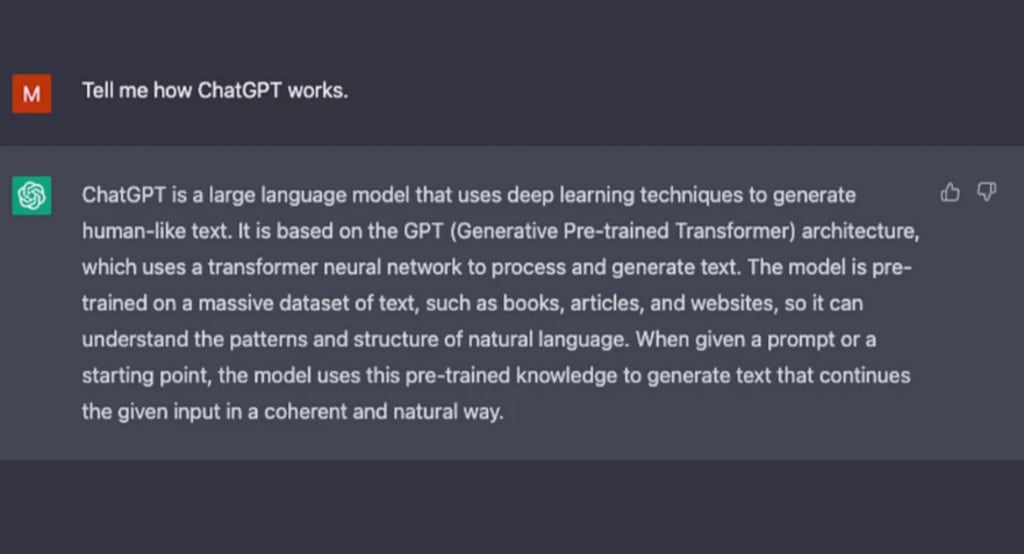
ChatGPT is an artificial intelligence language model developed by OpenAI that is designed to generate human-like responses to natural language input. It is a deep learning model that is pre-trained on a large dataset of text and fine-tuned on specific tasks, such as answering questions or completing sentences.
How ChatGPT is trained
ChatGPT is trained using a technique called unsupervised learning, which means it does not require human supervision to learn. It is pre-trained on a massive corpus of text data, such as books, articles, and web pages, using a technique called transformer neural networks. These networks are capable of processing vast amounts of text data and can learn patterns and relationships between words and phrases.
The architecture of ChatGPT
ChatGPT's architecture is based on the transformer neural network architecture. The transformer architecture consists of a series of encoder and decoder layers that allow the model to learn from large amounts of text data. The encoder layers process the input text and extract features, while the decoder layers generate responses based on the input.
ChatGPT's natural language processing capabilities
ChatGPT's natural language processing capabilities enable it to understand and respond to natural language input. It can recognize and interpret various aspects of language, such as syntax, semantics, and context, to generate relevant and coherent responses.
How ChatGPT generates responses
ChatGPT generates responses by predicting the most likely next word or phrase based on the input text and the context. It does this by using a technique called autoregressive modeling, which involves predicting the next word in a sequence based on the previous words.
ChatGPT's strengths and weaknesses
One of ChatGPT's strengths is its ability to generate human-like responses to natural language input. It can understand complex sentences and can provide coherent and contextually relevant responses. However, it may struggle with certain types of language, such as sarcasm, humor, and irony, and may occasionally produce irrelevant or nonsensical responses.
Applications of ChatGPT
ChatGPT has a wide range of applications, including chatbots, virtual assistants, and language translation tools. It can be used in industries such as customer service, healthcare, and education, to provide personalized and efficient services to users.
Future developments of ChatGPT
The future developments of ChatGPT include improving its natural language processing capabilities, such as understanding idiomatic expressions and figurative language, and expanding its knowledge base by incorporating additional data sources. It may also involve improving the efficiency and scalability of the model to handle more significant amounts of data.
Conclusion: The potential of ChatGPT
ChatGPT has tremendous potential to revolutionize various industries by providing personalized and efficient services to users. Its natural language processing capabilities and ability to generate human-like responses make it a valuable tool for applications such as customer service and education. As technology continues to advance, the possibilities for ChatGPT are endless, and it is an exciting development in the field of artificial intelligence.
Who Behind
Certainly, I understand that it's important to make the content relatable to the reader. When it comes to ChatGPT, it's a fascinating technology that can sometimes seem distant and impersonal. However, it's essential to remember that behind ChatGPT, there is a team of dedicated individuals who work hard to make this technology work seamlessly.
The developers, researchers, and engineers who work on ChatGPT are passionate about artificial intelligence and natural language processing. They are committed to building a system that can understand and respond to human language in a way that mimics human intelligence.
It's also important to note that while ChatGPT can be seen as a "bot" or "robot," it's not meant to replace human interaction. Rather, it's designed to enhance human communication, making it faster and more efficient.
Think of ChatGPT as a helpful assistant that can assist you with everyday tasks such as booking a restaurant, setting reminders, or providing information on a topic you're interested in. It's like having a personal assistant at your fingertips, available 24/7.
Additionally, ChatGPT is constantly evolving, thanks to the hard work of its team. With every interaction, the system learns and adapts, becoming even more proficient at understanding and responding to natural language.
Overall, it's essential to remember that behind ChatGPT is a team of humans dedicated to making this technology work for the betterment of society. While the technology may seem futuristic and advanced, it's important to remember that it's built and maintained by people with a passion for innovation.
About the Creator
Keep reading
More stories from Salman Razzaq and writers in Education and other communities.
How to Earn Money with Instagram
In recent years, Instagram has become one of the most popular social media platforms, with over one billion active users worldwide. Apart from sharing photos and videos, Instagram is also a great platform for earning money. In this article, we will discuss the different ways you can earn money with Instagram.
By Salman Razzaq3 years ago in Education




Comments (1)
This article sounds like it was mostly written by the ChatGPT bot. If not, I beg you to please, FOR THE LOVE OF GOD... STOP using the phrase "It's important to remember" as well as it's numerous variations!! (IE: "it's essential to remember", "it's important to note"... etc.) If I see that written one more time today, I think I might try to fight Mr. GPT... Or the author, Mr. Razzaq. 🙄