
Who Is Really Controlling Your Urge to Pee 🧠🚽
#HumanBodyFacts #BrainVsBody #MedicalScience #BiologyExplained #ScienceTok

Have you ever noticed this strange moment—
when your bladder is screaming, “Go. NOW.”
but somehow… you don’t?
You’re standing in traffic.
Or stuck in a meeting.
Or lying in bed at night, thinking, “I can hold it a little longer.”
So here’s the big question:
Who is actually holding your urine?
Is it the bladder?
The kidneys?
Or some invisible biological switch?
At that moment, your body is fighting a silent internal war—and most people don’t even realize it.
Let’s rewind to where everything begins.
Urine is not made in the bladder.
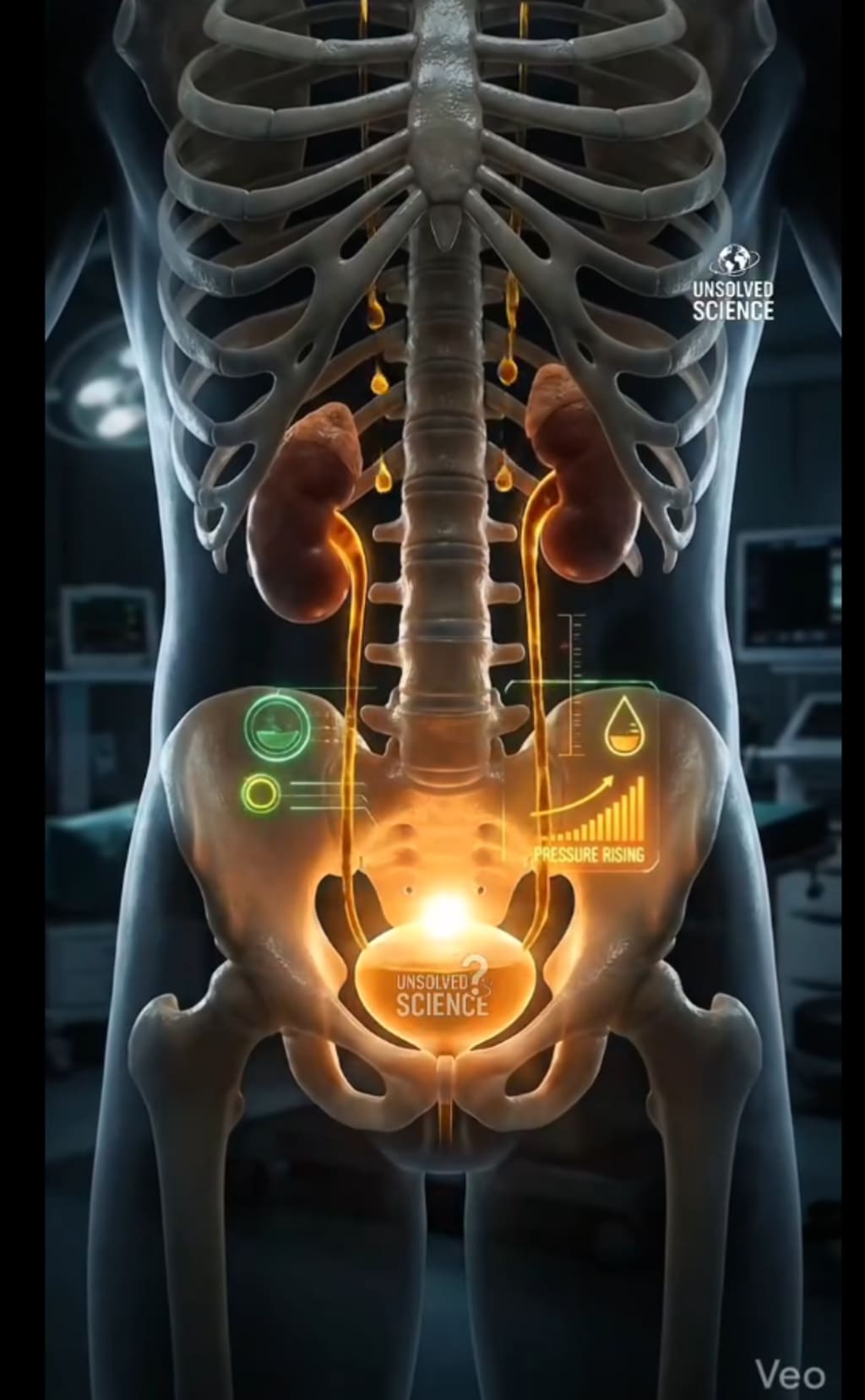
It’s made in the kidneys—two intelligent chemical factories constantly filtering your blood. Every minute, your kidneys remove excess water, salts, and waste products, turning them into urine. This urine then travels through thin tubes called ureters, slowly dripping into the bladder.
Now think of the bladder not as a tank…
but as a stretchy balloon.
As it fills, it expands. Gently. Quietly.
And inside its walls are tiny pressure sensors—stretch receptors—that constantly measure how full it’s getting.
At first, the message sent to your brain is polite:
“Hey… we’re filling up.”
You ignore it.
As more urine arrives, the message becomes firmer:
“Pressure is increasing.”
Still manageable.
But then—
when the bladder reaches a critical stretch—
those sensors send an urgent signal straight to your brainstem:
“We need to empty. Now.”
Here’s the twist.
The bladder’s job is simple: empty itself.
It wants to contract automatically and push urine out.
But it doesn’t get the final say.
That authority belongs to your brain.
Between the bladder and the outside world lies a powerful muscle called the urinary sphincter. Think of it as a security gate. When it’s closed, nothing gets through. When it opens… well, you know.
This sphincter is controlled by two systems:
An automatic system that works without thinking
And a voluntary system—the one that answers to your conscious mind
When the bladder contracts, it’s basically asking permission.
And the decision comes from a very special part of your brain:
the prefrontal cortex.
This is the same region responsible for planning, judgment, discipline, and self-control.
That’s why babies urinate instantly when the bladder fills.
Their prefrontal cortex isn’t fully developed yet.
Adults, on the other hand, can say:
“Not now.”
“Later.”
“Wait.”
So when you’re holding urine, it’s not your bladder being strong.
It’s your brain overriding a reflex.
Your bladder is pushing.
Your brain is resisting.
A silent tug-of-war is happening inside you.
But here’s where things get dangerous.
What happens if you win this battle too often?
When you repeatedly suppress the urge to urinate, the bladder stretches beyond its comfort zone. Over time, its muscles can weaken, making it harder to empty completely. Leftover urine becomes a perfect breeding ground for bacteria—raising the risk of infections.
Even worse, excessive pressure in the bladder can push urine backward toward the kidneys. And kidneys are not designed to handle that pressure.
In extreme or long-term cases, the communication system between the bladder and the brain can become confused. Signals weaken. Control becomes unreliable.
That’s when people say things like:
“I didn’t feel the urge.”
“It came suddenly.”
“I couldn’t control it.”
So here’s the truth.
Urine is not being held back by the bladder.
It’s not the kidneys either.
It is being held back by your brain—
by your ability to delay, decide, and control impulses.
Every time you hold your urine, you’re witnessing the power of human self-control in action.
A small moment.
A silent war.
And a reminder that even the most basic bodily functions
are ultimately ruled by the mind.
About the Creator
Lovely Diya
Storyteller of the bold, bizarre, and beautiful. I craft unforgettable tales, deep dives, and viral reads across love, mystery, lifestyle, and real talk. Follow me for content that makes you feel, think, and share.
Keep reading
More stories from Lovely Diya and writers in Education and other communities.
Why Men Are Drawn to Women: The Allure of Feminine Heat
The magnetic pull that draws men to women is a primal, intoxicating force, woven into the very fabric of human instinct, where biology and desire collide in a sultry dance of attraction. It’s no secret that the female form—its curves, its softness, its heat—ignites something deep within a man’s core, a fire that’s both ancient and immediate. The sway of a woman’s hips as she moves, each step a silent promise of sensuality, captures the male gaze like a spell. Those hips, wide and inviting, whisper of fertility and pleasure, a subconscious signal that stirs the primal urge to create life, even if the mind cloaks it in lust. The female body is a masterpiece of evolution, designed to entice—soft skin that begs to be touched, a waist that curves inward like an hourglass, pulling eyes downward to the promise of what lies below. And then there’s the breasts, those twin symbols of nurture and seduction, their fullness a beacon of femininity that men can’t help but worship. Whether spilling over a low neckline or subtly hinted at beneath a tight blouse, they command attention, their weight and warmth an unspoken invitation to explore. The science is clear: men are wired to respond to these cues, their brains flooding with dopamine at the sight of a woman’s cleavage, a reaction as old as humanity itself. But it’s not just the body; it’s the heat she exudes—confidence in her stride, the glint in her eye that says she knows her power. A woman’s hotness isn’t merely skin-deep; it’s the way she owns her sexuality, the way her laugh can make a man’s pulse race, or how her perfume lingers like a tease. The lips, plump and painted, promise kisses that burn, while her voice, low and husky, can unravel a man’s composure in seconds. This attraction isn’t just about the physical—it’s the fantasy, the forbidden. Men are drawn to the mystery of a woman’s body, the hidden places that only intimacy reveals: the smooth expanse of her thighs, the delicate arch of her back, the secret warmth between her legs that drives them wild with anticipation. Evolution plays its part, too—men are programmed to seek partners who signal health and vitality, and nothing screams that louder than a woman’s radiant skin, her glossy hair, or the flush of her cheeks when she’s aroused. The adult truth is that this desire is raw, unfiltered, and unapologetic. A woman’s hotness is her power, and men are helpless against it—not because they’re weak, but because they’re human. The curve of her ass in tight jeans, the way her body moves under silk, the fleeting glimpse of lace beneath a skirt—it’s a language of seduction that speaks directly to a man’s baser instincts. And yet, it’s not just about lust; there’s a deeper reverence, a need to possess and protect, to lose oneself in the softness of her embrace. The adult lens reveals that this attraction is a game of contrasts: the softness of her breasts against the hardness of his chest, the delicate strength of her fingers gripping his skin, the way her body yields and demands in equal measure. Society might dress it up in romance or shame, but the truth is primal: men crave women because their bodies are a map of desire, each curve a destination, each glance a spark. The heat of a woman’s presence—her scent, her touch, her unabashed femininity—sets off a chain reaction in a man’s mind, blurring logic and amplifying want. It’s why a fleeting touch on the arm can feel electric, why the sight of her bending over can stop a man’s breath, why the thought of her naked skin keeps him awake at night. This is the secret: women are the embodiment of life’s most intoxicating pleasures, their bodies a canvas of heat and promise that men are biologically destined to chase. And in that chase, there’s no shame—only the raw, beautiful truth of being alive, of bodies calling to each other in a language older than words, where every glance, every curve, every whispered moan is a reminder of why we burn for one another.
By Lovely Diya9 months ago in Humans
Leading with Insight: Always Informed by Professional Development and Market Trends
The workplace is changing faster than ever. Technology, customer needs, and job roles are constantly shifting. To keep up, workers and leaders must continually stay informed through professional development and market trends. It’s not just about learning — it’s about staying ready.
By Stacey Yimabout 9 hours ago in Education
Learning to Grow: How Farmer Education Improves Food Security
Food security matters to every family and every community. People need steady access to safe and healthy food to live well. In many rural areas, farmers struggle to grow enough crops because they lack the knowledge and skills to do so. When farmers receive proper training, they can improve how they plant, care for, and harvest crops. As a result, food becomes more available, more reliable, and more affordable. This is why farmer education improves food security in powerful ways.
By Convoy of Hope7 days ago in Education



Comments
There are no comments for this story
Be the first to respond and start the conversation.